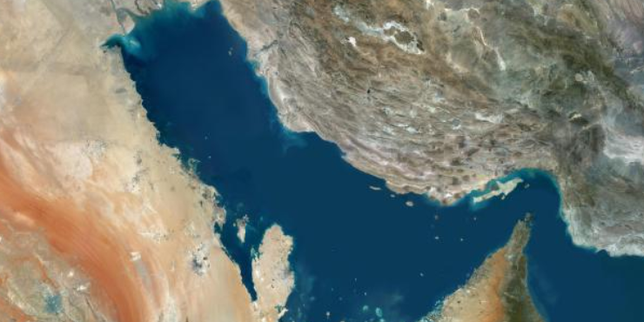
You’d think a body of water spanning 251,000 square kilometers would have a fixed name by now. It doesn't. If you fly into Tehran, you are looking at the Persian Gulf. If you land in Dubai or Riyadh, it is explicitly the Arabian Gulf. This isn't just petty cartographic bickering; it is a high-stakes proxy war over identity, oil, and geopolitical dominance that has been boiling for over six decades.
The real question driving people to look this up isn't just a linguistic curiosity. You want to know who is right, why international bodies choose one over the other, and how using the wrong term can literally get you banned from a country.
Here is the unvarnished reality of the naming row, the history behind it, and why the middle ground is a diplomatic minefield.
The Weight of Deep History
For thousands of years, the world's most critical maritime bottleneck had a universally accepted label. Ancient Greek geographers like Strabo and Ptolemy logged it as Sinus Persicus—the Persian Gulf. This made logical sense at the time. The massive Achaemenid and Sasanian empires dominated the northern coast, dictating trade and naval power across the region.
Even early Arabic-speaking historians and geographers weren't bothered by this. Thinkers like Agapius in the 10th century used the Arabic equivalent, al-Khaleej al-Farsi, without hesitation. European mapmakers like Gerard Mercator solidified the Latinized variant on world maps in the 16th century. For centuries, the name stuck simply because Persia was the dominant regional heavyweight.
The Western world formalized this early on. For instance, the United States officially adopted "Persian Gulf" as its standard geographic nomenclature back in 1917. The United Nations followed suit, establishing it as the standard recommended name based on deep historical precedent.
The Rise of Arab Nationalism and the 1960s Shift
Everything fractured in the mid-20th century. The catalyst wasn't a sudden discovery of new historical texts; it was the explosive rise of pan-Arabism, heavily championed by Egyptian President Gamal Abdel Nasser.
As Arab states gained independence and realized the immense value of the oil reserves sitting beneath their coastlines, sharing a name with their non-Arab, Shia neighbor across the water became politically unpalatable. The tension spiked further when Iran’s last Shah maintained diplomatic ties with Israel, infuriating the Arab bloc.
Nasser and regional leaders actively pushed to replace "Persian Gulf" with al-Khaleej al-Arabi—the Arabian Gulf. The rationale shifted from deep history to modern demographics. Arab nations now line the majority of the shoreline, spanning Iraq, Kuwait, Saudi Arabia, Bahrain, Qatar, the United Arab Emirates, and Oman. From their perspective, calling the water "Persian" was an outdated colonial relic that ignored the millions of Arabs living along its borders.
Real Retaliation Over a Map
If you think this is just a symbolic war of words, ask the corporate executives and diplomats who have run afoul of Tehran’s zero-tolerance policy. Iran views any attempt to alter the name as a direct attack on its sovereign heritage and historical rights.
The consequences for using the alternative term are swift and severe:
- Airlines Banned: The Iranian government has repeatedly threatened to bar foreign airlines from its airspace if their in-flight entertainment maps display the term "Arabian Gulf."
- Magazines Seized: In 2006, copies of The Economist were banned from distribution inside Iran because the publication dropped the word "Persian" and simply used "The Gulf."
- Cultural Protests: When the Louvre Museum in Paris omitted "Persian" from its gallery guides, it faced intense diplomatic protests from Tehran.
- Cancelled Events: The 2010 Islamic Solidarity Games, scheduled to be held in Iran, were completely called off. The reason? Saudi Arabia and other Arab states objected to the inclusion of the term "Persian Gulf" on the event's promotional brochures and athlete medals.
The National Geographic Society experienced this wrath firsthand in 2004 when they printed an atlas featuring "Persian Gulf" but added "Arabian Gulf" in smaller, parenthetical text underneath. The backlash from the global Iranian diaspora and the Iranian government was so fierce that the society pulled the atlas, edited the plates, and replaced the text with a note clarifying that the alternative name is only used by some regional parties.
The Diplomatic Cop-Out
To navigate this minefield without alienating billionaires in Dubai or oil ministers in Tehran, international corporations and Western military forces have resorted to an intentional cop-out: The Gulf.
It is grammatically lazy, but politically safe. The US Navy frequently utilizes "The Gulf" or even "Arabian Gulf" depending on which regional fleet command is issuing the press release. Major energy conglomerates and shipping firms rely heavily on the shortened version to keep their tankers moving smoothly through the Strait of Hormuz without sparking a diplomatic incident.
Some academic institutions try to bridge the gap by utilizing the hyphenated monstrosity "Arabo-Persian Gulf." Honestly, it pleases absolutely no one. Iranians view it as an unnecessary compromise on an undisputed historical fact, while Arab states see it as a stubborn refusal to recognize modern geopolitical realities.
Actionable Takeaways for Professionals
If you operate in international business, logistics, content creation, or regional security, you cannot afford to get careless with your vocabulary. Follow these baseline rules to avoid costly errors:
- Audit Your Visual Assets: Check all corporate maps, presentations, and shipping documentation. If your business depends heavily on Iranian airspace or markets, ensure "Persian Gulf" is explicitly stated.
- Localize Your Marketing: If you are launching campaigns targeted at the GCC (Gulf Cooperation Council) nations, use "Arabian Gulf" or scrub specific water bodies entirely to avoid instant local boycotts.
- Default to Neutrality in Broad Contexts: When writing general corporate copy or shipping guidelines that touch both sides of the water, stick strictly to "The Gulf" to keep yourself out of the crosshairs.