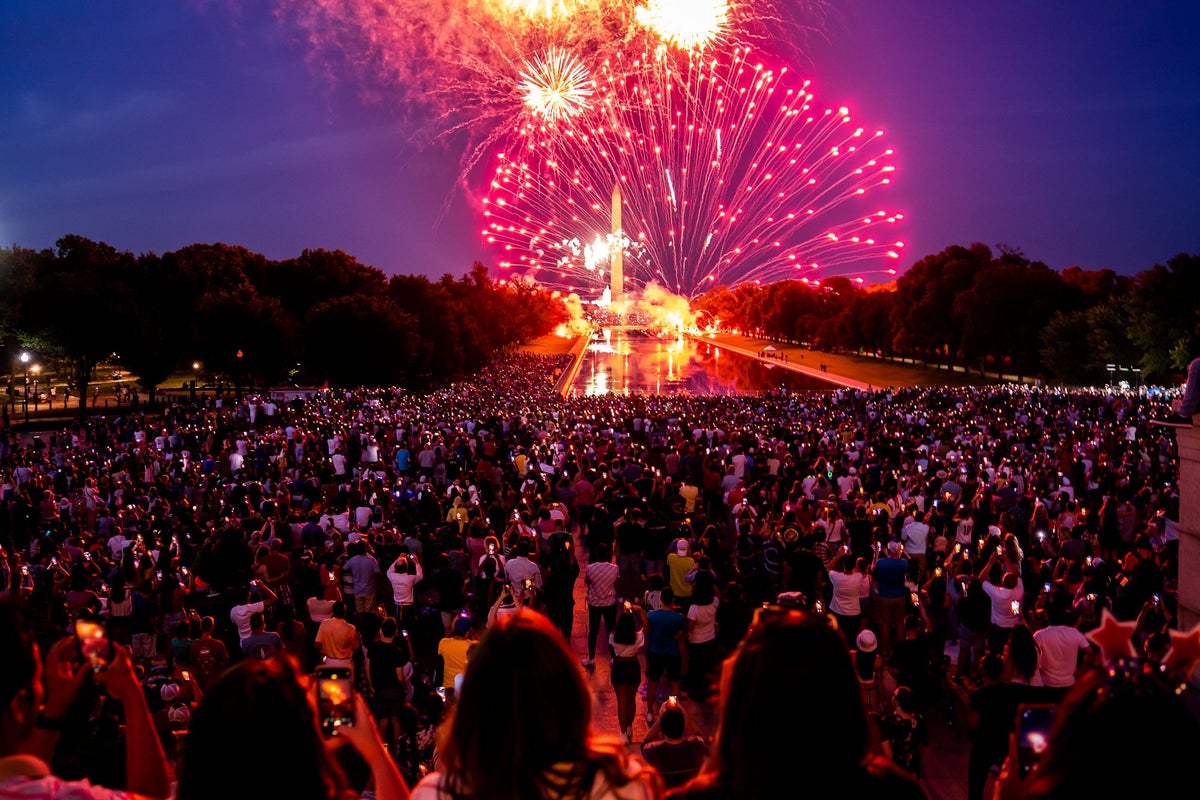
If you plan to watch the record-breaking fireworks on the National Mall this Fourth of July, prepare for a long night. The massive show, meant to mark America's 250th birthday, won't start until 11 p.m. ET. That's a massive shift from the traditional 9:00 p.m. slot.
Why the sudden schedule change? It isn't a supply issue or a technical glitch. The delay sits squarely on a massive political event. President Donald Trump has effectively co-opted the semiquincentennial celebration, turning the evening into a massive campaign-style "Tribute to America" rally. He is scheduled to take the stage at 9:00 p.m. near the Lincoln Memorial, pushing the pyrotechnics into late-night territory.
For families with young kids, local pet owners, and anyone relying on public transit, this creates a major logistical headache.
The Logistics of a High-Stakes Late Night
The sheer scale of this year's show is staggering. Organizers are promising over 850,000 pyrotechnic effects packed into a 40-minute display, making it the largest in Washington history. But holding a massive, loud event at 11:00 p.m. brings massive consequences.
Local officials, including Washington D.C. Mayor Muriel Bowser, confirmed the late-night timeline during a recent security briefing. The late hour completely disrupts the typical flow of the city.
- The Metro Crunch: WMATA announced special holiday hours, running the Metro rail from 6:00 a.m. until 2:00 a.m. to accommodate the late crowds. However, transit experts predict unprecedented congestion, with peak crowding hitting the system right as the final bombs burst near midnight.
- Airport Shutdowns: The security footprint and flyover schedules have forced Reagan National Airport (DCA) to suspend all arriving and departing flights from noon on July 4 until the next day.
- Waterway Closures: The Coast Guard is shutting down major sections of the Potomac and Anacostia rivers to keep the safety perimeter secure.
A Tale of Two Anniversaries
A lot of people expected the nation's 250th anniversary to look like the Bicentennial in 1976—a moment of bipartisan national unity. Instead, it has turned into an intensely partisan battleground.
Congress originally set up a bipartisan commission called "America 250" years ago to plan the milestone. The current administration bypassed those efforts, launching a public-private partnership called "Freedom 250" to run high-profile events like the Great American State Fair on the National Mall.
The July 4 rally serves as the grand finale of this parallel programming. Trump has heavily promoted the event on Truth Social, explicitly inviting his base to turn out in massive numbers to counter negative media narratives. The event will feature a personal playlist from the president, military flyovers, and speeches delivered behind heavy protective glass.
This heavy political branding has triggered a deep divide. A handful of Democratic-led states are actively boycotting the official festivities. Progressive activist groups are organizing counter-events, including a march on Washington by an organization called We The People 250, which is protesting what they call an exclusionary narrative of the holiday.
Unprecedented Security Challenges
Because of the overlapping events, the Department of Homeland Security has designated this year's fireworks display a National Security Special Event for the first time. This gives federal authorities supreme coordination power over the entire district.
Law enforcement is dealing with a highly complex security matrix. The presence of a sitting president who frequently draws massive crowds, combined with a recent rise in political demonstrations near the White House, means the National Mall will look like a fortress. Over 5,000 National Guard troops will deploy alongside thousands of local and federal police officers. Visitors can expect military-style vehicles stationed at major intersections and extensive security checkpoints throughout the Mall.
Survival Steps for Attending the 2026 Celebration
If you still intend to go to the National Mall to see the historic display, you need to throw out your usual July 4 playbook.
First, ditch the car. Road closures will be extensive, and parking will be nonexistent. Rely completely on the Metro, but expect to wait on platforms for an hour or more after the show ends.
Second, prepare for a long, hot day that stretches into the next morning. Bring extra water, portable phone chargers, and snacks, as local food trucks will be swamped and navigating the crowds after dark will be incredibly slow.
Finally, if you have young children or pets sensitive to noise, your best bet is to avoid the downtown core entirely. Consider watching the broadcast from home or finding an elevated viewing spot far outside the security perimeter, like the Marine Corps War Memorial in Arlington, though even suburban viewpoints will face traffic restrictions.