The ground in northern Venezuela didn’t just shake on Wednesday night. It tore itself apart in a terrifying double strike. Two massive earthquakes, measuring 7.2 and 7.5 magnitude, ripped through the region just 39 seconds apart.
Now, the numbers are climbing fast. National Assembly President Jorge Rodríguez announced on state television that the official death toll has jumped to 1,430. Over 3,200 people are injured. More than 3,100 are completely homeless.
But anyone on the ground in La Guaira or Caracas knows the official count is barely scratching the surface.
The Nightmare of a Seismic Doublet
Geologists call this a seismic doublet. It isn’t a main shock followed by smaller aftershocks. It's a one-two punch where the first massive rupture instantly triggers a second, sometimes larger fault failure nearby.
The first 7.2 quake struck near San Felipe. Before anyone could even process what was happening, the second 7.5 monster hit less than 40 seconds later near Morón. This shallow movement occurred just 10 to 22 kilometers deep along the San Sebastián fault system. Because the shaking was so close to the surface, it maximized the violence of the ground movement, completely leveling multi-story apartment blocks before residents could run to safety.
While the government lists hundreds missing, an opposition-backed crisis tracking website has over 55,000 people registered as unaccounted for by their families. The US Geological Survey released models suggesting the ultimate fatality count could realistically top 10,000. If those numbers hold true, this will rank among the deadliest seismic events in modern Latin American history.
Bare Hands Against Shattered Concrete
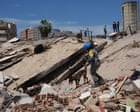
In the coastal state of La Guaira, the response looks less like an organized disaster plan and more like a desperate community brawl against physics. Neighbors are using shovels, iron bars, and their bare hands to pull apart collapsed concrete slabs.
The public infrastructure was already struggling from years of systemic underinvestment and economic strain before the disaster hit. When the twin quakes struck, the local power grid crashed immediately. Hospitals already short on basic medical supplies were forced to treat horrific crush injuries by flashlight.
Estimated Economic Losses: $6.7 Billion
Impact on National GDP: Approximately 6%
Damaged or Destroyed Structures: Over 1,400
The United Nations Development Programme used satellite data to put a preliminary price tag on the physical destruction. They estimate the damage at $6.7 billion. That wipes out roughly 6% of the country's entire gross domestic product.
The International Rescue Bottleneck
Help is trying to get into the country, but logistics are turning into a nightmare. Simón Bolívar International Airport, the vital transport hub serving Caracas, suffered severe structural damage and had to close its runways to commercial traffic.
This closure has caused chaos for incoming emergency teams. A specialist British rescue squad from the charity Serve On got stranded at Madrid airport for over 24 hours because their connecting flights were canceled. Every hour spent stuck in a European airport terminal is an hour lost for people trapped inside pockets of collapsed buildings.
Some international aid is making it through. Over 1,600 foreign rescue workers from Mexico, Brazil, El Salvador, France, and the United States have arrived. The US military is assisting by coordinating flights for mobile field hospitals, and a US Navy transport ship is stationed off the coast to provide emergency medical evacuations. Acting President Delcy Rodríguez has deployed 14,000 military and police personnel to patrol the hardest-hit zones, setting up strict checkpoints that require civilian volunteers to hold special credentials just to move between cities.
The dead include citizens from all over the world who lived along the coast. Officials have confirmed the fatalities include 15 people of Portuguese descent, seven Chinese nationals, five Spaniards, two Brazilians, and an Italian-Venezuelan.
Concrete Action Steps for Immediate Relief
If you want to support relief operations directly without your aid getting lost in bureaucratic red tape, prioritize established international groups with active ground logistics.
- Financial Contributions: Direct funds to organizations like Samaritan's Purse, Convoy of Hope, or the International Red Cross. They are currently bypassing major airport blockages by utilizing maritime logistics and regional hubs.
- Missing Persons Registry: If you have family members in northern Venezuela who haven't made contact, submit their details to the open-source community missing persons database rather than waiting for state television updates.
- Equipment Donations: Ground teams desperately need portable water filtration systems, industrial chlorination tools, and heavy-duty concrete cutting equipment. Coordinate with local Venezuelan diaspora groups in major transit cities like Miami, Madrid, or Bogota, which are chartering private cargo flights directly to military airfields.