The standard playbook for urban search and rescue says a person trapped under concrete has about 72 hours to live. After three days without water, the human body begins to shut down. Dehydration, crush syndrome, or suffocation usually finishes the job.
Then came Hernán Alberto Gil Flores.
On July 2, 2026, international rescue teams pulled the 43-year-old security guard alive from the pulverized basement of the Galerías Playa Grande shopping center in Catia La Mar, Venezuela. He had been buried for eight agonizing days. His extraction did more than spark wild celebration among weary crews from seven different nations. It shattered conventional assumptions about disaster survival limits in the modern era.
People tracking this tragedy are asking one central question. How does someone survive a multi-story structural collapse for over a week? The answer lies in a mix of split-second positioning, sheer structural luck, and an unprecedented level of global rescue coordination that kept him stable while heavy machinery shifted unstable concrete directly above his head.
The Void inside the Concrete
When the twin earthquakes hit northern Venezuela on June 24, 2026, they did not offer a gentle warning. A magnitude 7.2 foreshock violently rocked the coast near Morón. Just 39 seconds later, a massive magnitude 7.5 mainshock finished the destruction. It was the strongest seismic sequence to hit the country in more than 125 years.
In La Guaira state, buildings simply folded. The Galerías Playa Grande commercial complex pancaked into its own basement.
Gil Flores was working the night shift. He was inside his small, reinforced security cabin when the walls began to tear apart. As thousands of tons of concrete collapsed around him, his workstation cabin did something remarkable. It held its ground. Instead of flattening, the reinforced framing of the small booth buckled slightly but absorbed the impact, creating a protective void.
This is what rescue experts call a survivable void space. In major structural collapses, large debris can fall across interior walls or heavy furniture, leaving a small triangular pocket of air. If you are lucky enough to be in that pocket, your chances of surviving the initial impact skyrocket. Gil Flores had air. He had space to move his limbs. What he did not have was a guarantee of escape.
The multi-national race against time
By the third day after the disaster, the official death toll across Venezuela was climbing past 1,700, on its way to exceeding 2,200. Hope was fading fast. Most local operations were transitioning from rescue to body recovery.
On Sunday, four days after the collapse, a specialized canine and listening team from the Costa Rican Red Cross heard something. They detected faint signs of life deep within the mall basement. They drilled a tiny pilot hole through layers of fractured masonry and dropped a telescopic camera down.
There was Gil Flores. He was alive, but he was terrified.
"When we found him, he asked us not to tell his wife that he was alive, just in case he wouldn't make it," said Minyar Collado, a rescuer with the Costa Rican team. It is a heartbreaking glimpse into the psychological toll of being buried alive. He did not want to give his family false hope.
Getting him out was a logistical nightmare. The entire structure was highly unstable. Heavy rains were battering the coast, and over 430 aftershocks had already rattled the region, threatening to trigger a secondary collapse that would kill both the survivor and his rescuers.
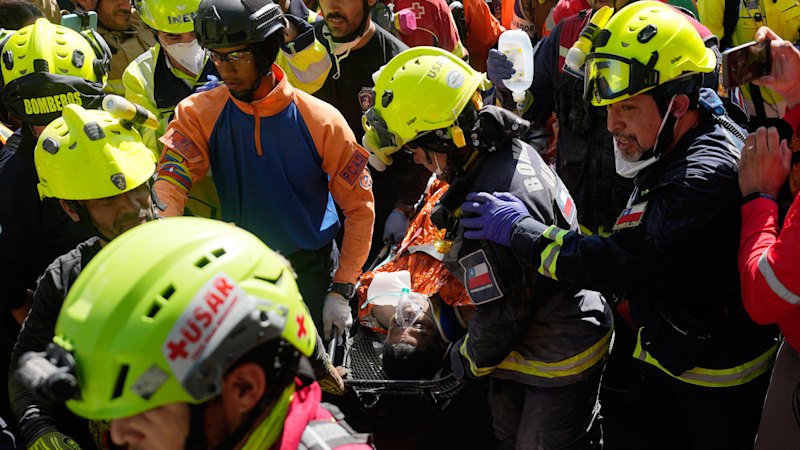
An elite coalition of urban search and rescue teams took over the site. Firefighters from Chile coordinated the effort, working alongside teams from the United States, Portugal, El Salvador, and Mexico. Manny Sampang, a task force leader from the Los Angeles County Fire Department, described the terrifying complexity of the site. Multiple damaged buildings were literally leaning into the structure they were trying to excavate. One wrong move with a hydraulic jack or a concrete saw could cause a domino effect.
How rescuers beat dehydration over eight days
You cannot live eight days without fluids. Rescuers knew this, so they did not just dig. They used the narrow shaft they had drilled to pass down water and liquid nutrients. For the final three days of the extraction, Gil Flores was being kept alive by a literal lifeline.
This tactic changes the timeline of modern disaster response. If a rescue team can locate a survivor early and establish a baseline of hydration, the old 72-hour survival window stretches indefinitely. The bottleneck is no longer human biology. It is engineering.
While international crews meticulously shored up the leaning concrete blocks above him, Chilean firefighter María Paz Campos stayed on the microphone. She talked to Gil Flores for hours on end, keeping his mind anchored. In video clips captured by the rescue team in the final hours, Gil Flores could be seen drawing on scraps of paper inside his tiny cabin to pass the time.
Campos coached him through the final, dangerous phase of the extraction, reminding him to keep protective goggles on to shield his eyes from falling concrete dust as heavy tools breached his enclosure.
Early on Thursday morning, rescuers finally widened the tunnel enough to pull him through. Covered in an orange tarp and wearing an oxygen mask, Gil Flores emerged into the blinding daylight to the sound of hundreds of rescuers cheering, weeping, and waving international flags.
His wife, Gusbimar González, who had spent days mourning what she assumed was his certain death, called the rescue a ray of light in total darkness. The couple has two young children, ages 8 and 10, who were waiting at a nearby Red Cross station.
The lessons for urban disaster readiness
The survival of Hernán Alberto Gil Flores is a brilliant moment in a massive tragedy. The 2026 Venezuela earthquakes have devastated the country's north-central infrastructure, putting immense pressure on an already fragile health system. According to reports from the Pan American Health Organization, nine hospitals suffered major damage, and thousands of people remain missing across the region.
This rescue offers critical insights for anyone living in a seismically active urban zone. Survival is rarely about wandering through a collapsed building looking for a way out. It is about immediate protection.
If you are caught in a major earthquake inside a building, remember these practical realities.
- Look for industrial rigidity: Gil Flores survived because his work cabin acted as an internal exoskeleton against falling debris. In an office or commercial building, heavy metal desks, structural pillars, or reinforced service utility areas offer the best chance of forming a protective void.
- The hydration priority: If you are ever trapped, your primary goal after checking for injuries is securing fluid or finding ways to minimize sweat and exertion. Rescuers are getting better at finding people with thermal imaging and acoustic sensors, but they need you alive when they get there.
- Establish communication early: If you hear rescue teams, use hard objects to tap on pipes or walls in rhythmic intervals. Sound travels far better through structural steel and concrete than a human voice does. Saving your voice saves energy and prevents dust inhalation.
The global response in Catia La Mar proved that international rescue standards are evolving. By combining specialized listening technology, cross-border team integration, and immediate deep-void medical support, crews pulled off an extraction that would have been impossible a decade ago.
The focus now shifts to the thousands of families still displaced along the Venezuelan coast, who are facing a long, difficult rebuilding process.