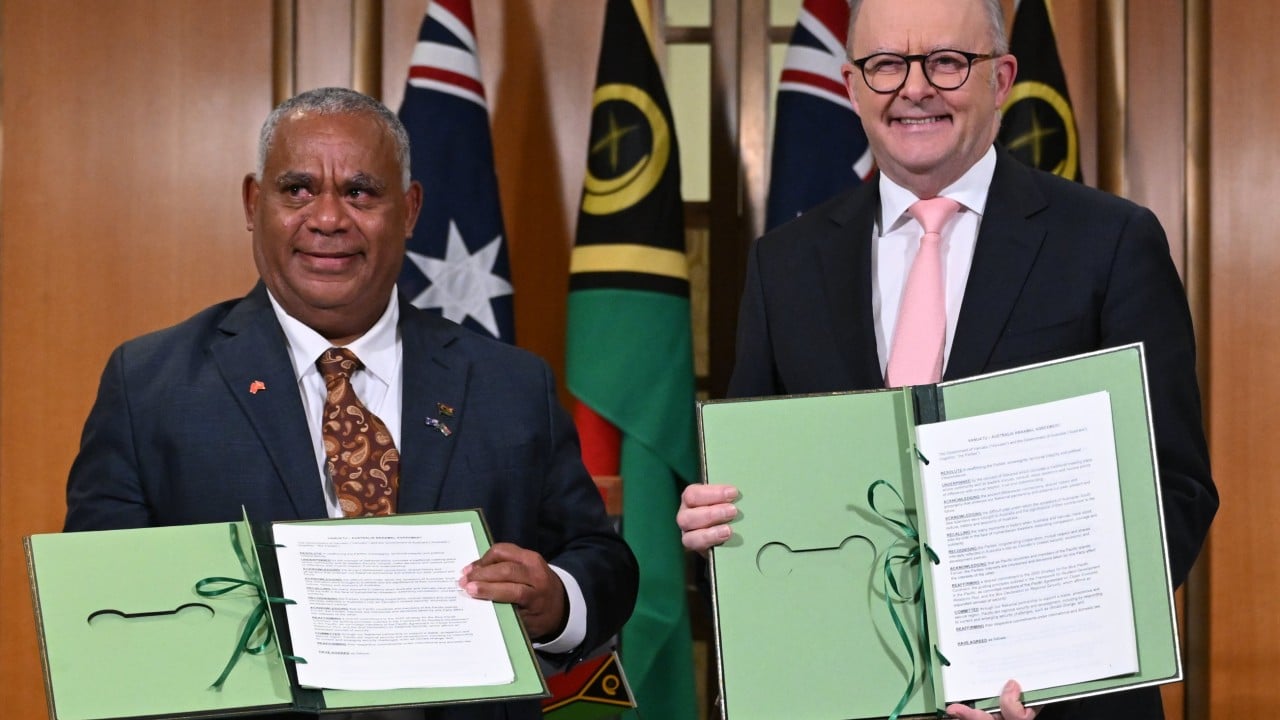
Canberra just pulled off a major diplomatic win in the South Pacific, but the reality on the ground is far messier than the official press releases suggest. On June 29, 2026, Australian Prime Minister Anthony Albanese and his Vanuatu counterpart, Jotham Napat, sat down in Canberra to sign the long-delayed Nakamal Agreement. This treaty formally bars any foreign military base from being built on the Pacific island nation. Everyone knows what this is about. It is a direct effort to stop China from establishing a permanent military footprint right in Australia's backyard.
But if you only read the mainstream headlines, you miss the actual mechanics of how this deal happened and why it almost fell apart completely. This was not a smooth piece of diplomacy. It was a grinding, multi-year struggle that forced Australia to scale back its original ambitions. It reveals a lot about how Pacific nations are playing the major powers against each other to protect their own sovereignty.
Understanding the Vanuatu Australia security pact requires looking past the handshakes. The agreement matters immensely for regional security, but the concessions made behind closed doors matter even more.
The Long Road to the Nakamal Agreement
This deal was supposed to be wrapped up a long time ago. The initial groundwork was laid years back, and a signing ceremony was pencilled in for September. Then, everything ground to a halt.
Vanuatu's political scene is notoriously volatile. In Port Vila, political coalitions shift like sand. Several government ministers threw a wrench in the gears by raising serious concerns about sovereignty. They worried that tying themselves too closely to Australia's defence apparatus would make them look like a puppet state. They also feared it would anger China, which happens to be Vanuatu's largest external creditor.
Prime Minister Napat had to pull back. He needed to placate his domestic critics. The delay forced Australian negotiators back to the table to adjust their expectations.
What we see signed now is a modified version of Canberra's original dream. Early discussions pointed toward a massive ten-year, 500-million-dollar package. That scale got trimmed down. Australia had to accept a more balanced partnership model to get the signatures on the page. The name itself, the Nakamal Agreement, is a nod to this cultural shift. A nakamal is a traditional Melanesian meeting place where leaders discuss community matters based on mutual respect and consensus. Australia had to learn to speak that language rather than just throwing money around.
What is Actually inside the Security Pact
The core of the treaty focuses on keeping foreign military infrastructure out of Vanuatu. This means no foreign naval bases, no military airfields, and no dual-use facilities controlled by outside powers.
Vanuatu has legally bound itself to keep its critical infrastructure free from militarisation. But the treaty goes deeper than just banning bases. It touches on domestic policing, disaster response, and maritime surveillance.
Under the new terms, Vanuatu agrees to look to the Pacific Island Forum members first for its policing needs. Australia remains the primary partner here, providing equipment, training, and cyber security support. The treaty also solidifies a framework for natural disasters. If a major cyclone hits, Vanuatu has committed to turning to Australia, New Zealand, and France first for humanitarian assistance.
There is also a crucial clause about third-party engagement. If Vanuatu decides to let an outside country invest in or develop its critical infrastructure, it must consult with Australia first. This gives Canberra an early warning system. It prevents sudden surprises like the secret security deal China signed with the Solomon Islands a few years ago.
The Ghost of the Luganville Wharf
You cannot talk about this pact without talking about China. For years, Western defence analysts have been terrified of what might happen at the Luganville wharf.
Luganville was a massive American military base during the Second World War. A few years ago, Beijing funded a major expansion of the wharf there. The official line from China and Vanuatu was that the expansion was meant for cruise ships. Washington and Canberra did not buy that explanation for a second. They saw a deep-water pier perfectly capable of servicing large Chinese naval vessels.
Chinese navy ships have made repeated port calls to Vanuatu over the years. Each visit sent ripples of anxiety through the Australian Department of Defence. If China managed to turn that commercial presence into a permanent naval asset, it would fundamentally change how Australia has to defend its eastern approaches.
By signing this pact, Prime Minister Napat is trying to calm those anxieties while keeping his nation out of the crossfire. Vanuatu has passed an Act in Parliament ensuring that its infrastructure stays demilitarised. They are drawing a line in the sand. They will take China's money for development, but they will not give Beijing a military outpost.
Why this Deal is Watered Down
Let's be completely honest about what Australia wanted versus what it got. Canberra wanted a hard-edged defence alliance. They wanted something that mirrored the traditional security treaties of the twentieth century.
Instead, they got an agreement heavily focused on economic development and climate change. During the joint press conference in Canberra, both leaders spent significant time talking about the transition to renewable energy and regional resilience.
This shift happened because Pacific leaders are tired of being treated as mere chess pieces in a geopolitical game between Washington and Beijing. They face an existential threat from rising sea levels and intense cyclones. To them, climate change is the real security crisis, not a theoretical naval battle in the South China Sea.
Australia had to compromise. If they wanted the hard security guarantee of "no foreign bases," they had to pay for it by supporting Vanuatu's green energy shift and respecting their independence. Albanese had to publicly state that this is a balanced agreement built on equal partnership. Any hint of heavy-handedness would have killed the deal entirely.
How Vanuatu Leverages Both Sides
Vanuatu is playing a very smart game. They are not abandoning China. They cannot afford to. Beijing has built roads, stadiums, and government buildings across the islands. Port Vila owes millions to Chinese state banks.
By signing this pact with Australia, Vanuatu actually gains leverage against Beijing. They can tell Chinese officials that their hands are tied by a legal treaty when it comes to military access. This allows them to accept Chinese infrastructure money without the pressure of giving up sovereign control of their ports.
At the same time, they get upgraded police capabilities, maritime intelligence, and guaranteed disaster relief from Australia. It is a masterclass in small-state diplomacy. They have turned their strategic location into a valuable commodity, extracting benefits from both regional superpowers while yielding as little sovereignty as possible.
What This Means for the Rest of the Pacific
The signing of the Nakamal Agreement is just one piece of a much larger puzzle. Australia is currently scrambling across the region to lock down similar agreements before China can get a foothold.
Albanese is already planning trips to Fiji and the Solomon Islands to progress separate security negotiations. The Australian government wants to create a ring of friendly nations bound by treaties that explicitly prioritise the "Pacific family" for security needs.
The strategy has met mixed success. The Solomon Islands famously resisted Western pressure and maintained its close security relationship with Beijing. Papua New Guinea signed a defence cooperation agreement with the United States but faced intense domestic blowback because of it.
The Vanuatu model shows the only path that really works right now. If Western powers want security guarantees, they must offer comprehensive economic packages and show genuine respect for local political sensitivities.
Action Steps for Regional Observers
If you are tracking geopolitical risks or looking at investments in the Pacific region, you need to watch how this treaty is implemented on the ground.
First, monitor the upcoming third-party infrastructure bids in Vanuatu. Watch how the consultation process with Australia plays out when a Chinese state-owned enterprise bids on a new airport or port expansion. That will be the first true test of the Nakamal Agreement.
Second, keep an eye on Vanuatu's domestic politics. Prime Minister Napat's government faces constant pressure from opposition factions. If his coalition falls, a new prime minister could try to reinterpret or stall the implementation of specific clauses within the treaty.
Finally, watch the upcoming climate meetings, including the pre-COP events in Fiji and Tuvalu. Australia has promised to champion the Pacific's climate concerns on the global stage as part of this broader diplomatic push. If Canberra fails to deliver on those environmental promises, the goodwill built by this security pact will evaporate quickly.