We've spent decades trying to fix damaged ecosystems by looking backward through a blurred lens. Conservationists guess what a meadow looked like two centuries ago, or when bluebells used to bloom before global temperatures started creeping upward. But guessing doesn't work when you're trying to rebuild a collapsing natural world.
That's why a dusty, overlooked collection of paper sheets tucked away in a Gloucestershire university lab is suddenly one of the most exciting tools in ecological science. Don't miss our recent coverage on this related article.
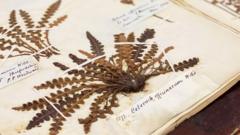
The Royal Agricultural University in Cirencester recently finished cataloguing its historic herbarium—a massive press-dried archive of more than 10,000 plant specimens dating back to 1787. Now, thanks to the nationwide Distributed System of Scientific Collections network, this hidden archive is going digital, joining over a million biological records across the UK to give scientists an exact blueprint of what grew where, and when, over the last two centuries.
It turns out that 19th-century Victorian botanists weren't just pursuing a quaint hobby. They were quietly building a high-precision baseline for the planet's survival. If you want more about the background here, USA Today provides an informative summary.
The Victorian plant hunters who unknowingly mapped climate change
To understand why a 200-year-old pressed leaf matters today, you have to look at how it was collected. Back in the 1840s, Samuel Pickworth Woodward, a professor of geology and natural history at what was then the Royal Agricultural College, roamed the Cotswold hills pressing wild specimens into paper folders. Around the same time, his colleague James Buckman set up experimental plots on campus.
Buckman's work was so detailed that Charles Darwin actually referenced it in On the Origin of Species.
These weren't quick sketches or artistic watercolours. The botanists carefully dried each plant, mounted it on sturdy paper, and recorded crucial metadata in flowing ink: the exact parish, the elevation, the date of collection, and the precise stage of flowering.
When you gather thousands of these individual records spanning 200 years, you don't just get a botanical catalog. You get a physical timeline of ecological transformation.
By comparing a dried specimen of wild orchid collected in 1845 with modern plant surveys from the same Gloucestershire hills, ecologists can track precisely how flowering times—known as phenology—have shifted as temperatures rose. We aren't relying on estimates or computer simulations anymore. We have the physical proof, dried and preserved down to the cellular level.
Why small archives pack a massive punch for nature restoration
Big institutions like the Natural History Museum in London or the Royal Botanic Gardens at Kew hold millions of specimens. They're incredible resources, but they have a blind spot: they tend to collect rare, exotic, or generalized national samples.
Smaller regional herbaria operate differently. Dr. Kelly Hemmings, Associate Professor in Ecology and Agroecosystems at the Royal Agricultural University, has pointed out that small regional collections hold an extraordinary proportion of unique local data.
The RAU collection contains thousands of specimens gathered from local fields, hedgerows, and forgotten roadside verges across rural England. Many of these micro-habitats were wiped out by post-war intensive agriculture and urban sprawl during the 20th century.
When modern conservation groups attempt rewilding projects, they often struggle with a phenomenon called shifting baseline syndrome. Each generation accepts the degraded state of nature they grew up with as the default normal. A nature reserve created today might look green and thriving to us, yet contain only a fraction of the plant species that occupied that same soil in 1820.
The RAU herbarium strips away that historical amnesia. It gives land managers an accurate biological ledger. If a local trust wants to restore a floodplain meadow in the Severn Vale, they don't have to guess which wild grasses or wildflowers belonged there naturally. They can query the digitized archive, pull up the actual pressings made on that exact stretch of riverbank in 1848, and build a targeted seed mix based on hard historical evidence.
Extracting deep genetic data from fragile paper sheets
Paper doesn't last forever. Handling 200-year-old dried specimens risks crumbling irreplaceable stems and shedding brittle flower petals. That's why physical access had to be strictly limited for generations, effectively locking this wealth of information away from the public and field researchers alike.
Digital transformation changes the entire dynamic. Through the Central England DiSSCo UK hub—a strategic network led by the Universities of Cambridge and Oxford—specialists are using high-throughput imaging and specialized software to scan every single specimen sheet at high resolution.
Each sheet is calibrated with precise color standards, catalogued with standardized geographical coordinates, and indexed so that researchers worldwide can inspect a rare moss or meadow grass without ever touching the fragile original.
The value goes far beyond visually inspecting a digital photo:
- Genetic sequence extraction: Advanced DNA extraction techniques now allow scientists to sample tiny micro-fragments of 150-year-old dried leaves, sequencing the plant's genome to see how wild populations adapted to historical drought or disease outbreaks.
- Pest and disease tracking: Fungal spores and insect damage preserved on the pressed leaves give plant pathologists a window into how crop diseases evolved alongside changing farming practices.
- Granular location mapping: Handwritten place names on 19th-century labels are cross-referenced with historical maps to trace exact historic land boundaries and soil conditions.
Researchers at the university have even experimented with Large Language Models and Retrieval-Augmented Generation to build an interactive AI interface trained on Professor Woodward's historic records. Instead of digging through static spreadsheets, ecology students can query the database directly to ask specific questions about historical species distribution across regional landscapes.
Moving beyond token rewilding to evidence-based recovery
Britain is widely recognized as one of the most nature-depleted countries on Earth. Decades of heavy fertilizer use, habitat fragmentation, and drainage schemes have stripped diversity out of rural environments. In response, modern rewilding efforts have surged in popularity, but many projects suffer from a lack of clear biological targets. Planting generic "wildflower mixes" bought off the shelf often introduces non-native genetic strains that outcompete delicate local flora.
Having access to hyper-local historical baselines changes the recovery playbook completely:
- Match species to precise soil history: Historical herbarium sheets show exactly which species thrived before heavy chemical runoff altered the soil chemistry.
- Protect genetic integrity: By knowing which local sub-species naturally occurred in a catchment area, conservationists can harvest seed from the nearest surviving remnants rather than importing commercial stock.
- Establish true restoration benchmarks: Instead of aiming for the nature metrics of 1990, environmentalists can aim for the rich biodiversity levels recorded in the 1840s.
When you look at a pressed sheet containing Luronium natans—floating water-plantain—collected in a Shropshire lake in 1848, you aren't just looking at an antique curiosity. You're looking at a blueprint for bringing that specific waterway back to functional health.
What you can do to support local plant heritage
Unlocking historic biological collections isn't just a job for university professors or national museums. The digitisation of local natural history archives relies heavily on regional involvement, community science, and grassroots monitoring.
Here is how you can directly support plant conservation and help protect local ecological records:
- Contribute to local biological recording networks: Join regional natural history societies—like the Gloucestershire Naturalists' Society or your local Wildlife Trust—and log current plant sightings through apps like iRecord. Your observations today become the essential historical baseline for researchers 100 years from now.
- Volunteer for heritage digitisation projects: Many local herbaria, civic archives, and museum collections run community transcription programs where volunteers help transcribe handwritten 19th-century labels into searchable digital formats.
- Practice native seed sourcing in land management: If you own or manage land, avoid generic commercial seed mixes. Consult local botanical records and source native seeds harvested from nearby ancient meadows to safeguard the genetic lineage of regional flora.
- Audit your local environment for historical remnants: Learn to identify indicator species of ancient woodland and unimproved grassland in your local area. Finding a tiny patch of survivor plants often signals a location where historical habitat restoration stands the highest chance of success.