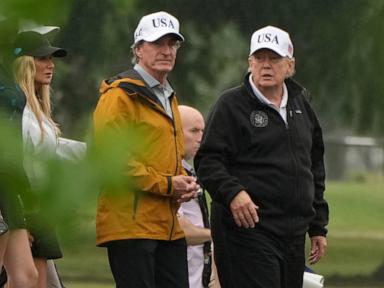
Donald Trump wants to bring a major golf championship directly to the heart of Washington. On Sunday, June 28, 2026, the president toured the historic East Potomac Golf Links, accompanied by Interior Secretary Doug Burgum and the legendary golf course architect Tom Fazio. Shortly after, Trump declared on social media that his sweeping renovation plans would transform this humble municipal track into a venue capable of hosting the U.S. Open, the PGA Championship, and the Ryder Cup.
It is a grand vision. It is also an logistical, legal, and environmental nightmare.
The idea of elite professional golf returning to the nation's capital sounds great on paper. But when you look past the social media hype, you find a project buried under federal lawsuits, political warfare, and literally toxic soil. The gap between political rhetoric and the rigid mechanics of professional golf scheduling is vast. Here is exactly why the dream of an East Potomac U.S. Open is facing an incredibly steep uphill climb.
The Clean Calendar Problem
Professional golf does not move fast. Major championships do not simply show up at a newly renovated course because a president requests them. The organizations that run these tournaments plan their schedules decades in advance.
Look at the U.S. Open. The United States Golf Association has already locked in its host venues all the way through 2051. If you look closely at their calendar, there are only a tiny handful of unassigned slots left over the next quarter-century. We are talking about 2043, 2046, and 2048. The PGA of America is similarly booked solid, with the PGA Championship venues set in stone through 2035.
The governing bodies of golf are also notoriously risk-averse. The USGA and the PGA of America have spent the last few years intentionally steering clear of political lightning rods. The PGA of America famously stripped Trump Bedminster of the 2022 PGA Championship following the events of January 6, moving it to Southern Hills. It takes years of institutional bridge-building to earn a major. You cannot bypass that process with a single renovation, no matter how famous the architect is.
Toxic Waste on the Fairways
Even if the golf world cleared a path on the schedule, the physical ground at East Potomac presents a major obstacle. Trump complained online about the current state of the grass and a broken sprinkler system. The real problem lies deep beneath the turf.
During recent construction and demolition work at the White House East Wing, truckloads of debris were transported and dumped directly onto the East Potomac grounds. Last month, the National Park Service dropped a bombshell report. Environmental testing on that specific rubble came back positive for toxic heavy metals, including lead and chromium.
You cannot simply plant premium bentgrass over a pile of contaminated government demolition debris and call it a day. A world-class golf course requires massive earth-moving operations, deep irrigation lakes, and extensive drainage networks. Disturbed toxic soil threatens the local water table and risks the health of workers and players. Before a single tee box can be shaped, the site requires a massive, costly environmental remediation process that could tie up the September 1 construction start date for months or even years.
The District Court Battle
The plan is also stuck in a federal courtroom. For years, a non-profit called the National Links Trust managed Washington’s public golf courses under a long-term lease agreement. They had a clear, community-focused mission to keep golf affordable, accessible, and environmentally sustainable for local residents.
The administration’s sudden move to take control of these public parks and hand development power over to private interests sparked immediate resistance. The resulting lawsuit in U.S. District Court aims to block the entire overhaul.
Lawsuits involving federal parkland and public assets drag on forever. Discovery processes, environmental impact studies, and injunction requests can stall bulldozers indefinitely. While Trump insists that work begins on September 1, a federal judge has the final say on whether those tractors can even turn their engines on.
Local Political Warfare
The golf course dispute has also triggered a fierce political proxy war within the District. Trump used his social media platform to attack Janeese Lewis George, the progressive democrat who recently won the primary for Washington D.C. mayor. Trump labeled her a "Communist" in his posts.
Lewis George is the presumptive next mayor of a city that has long fought for greater local autonomy. She responded directly, stating that while she is willing to work with anyone, including the president, for the best interests of D.C. residents, she will absolutely not comply in advance with federal demands that undermine the local government.
This creates a highly adversarial dynamic. The local government controls various city permits, traffic routing, utility hookups, and municipal cooperation. Trying to build a massive project in a city while publicly feuding with its incoming leadership is an incredibly difficult strategy.
What Happens to Everyday Golfers
East Potomac has always been a refuge for regular working-class golfers in the D.C. area. It is a place where public school kids, federal workers, and local seniors can play a round of golf without paying an expensive country club membership fee.
When a historic municipal course gets a multi-million-dollar Fazio redesign, the green fees usually skyrocket. The course layout changes to become incredibly difficult, designed to test the world's best professionals rather than the average weekend golfer. The local community fears losing an affordable recreation space in favor of an exclusive playground designed for television cameras.
How to Track This Project
The future of East Potomac Golf Links is moving fast. If you want to see how this fight unfolds, skip the social media commentary and look at the official channels.
First, monitor the U.S. District Court dockets for updates on the active litigation surrounding the course management contract. Second, watch for the National Park Service to release its formal remediation plan regarding the toxic East Wing debris. Finally, follow the incoming D.C. mayoral transition statements to see how the local government intends to handle zoning and permitting challenges as the September 1 deadline approaches.