Donald Trump was supposed to read a children's book. Instead, he spent his time talking about his own waistline, rating the attractiveness of John F. Kennedy, and admitting that the only thing he really reads is coverage of himself. The recent appearance of the president on the Trump Usha Vance podcast—officially titled Storytime with the Second Lady—turned what should have been a wholesome, literacy-promoting segment into a classic, unfiltered campaign-style riff.
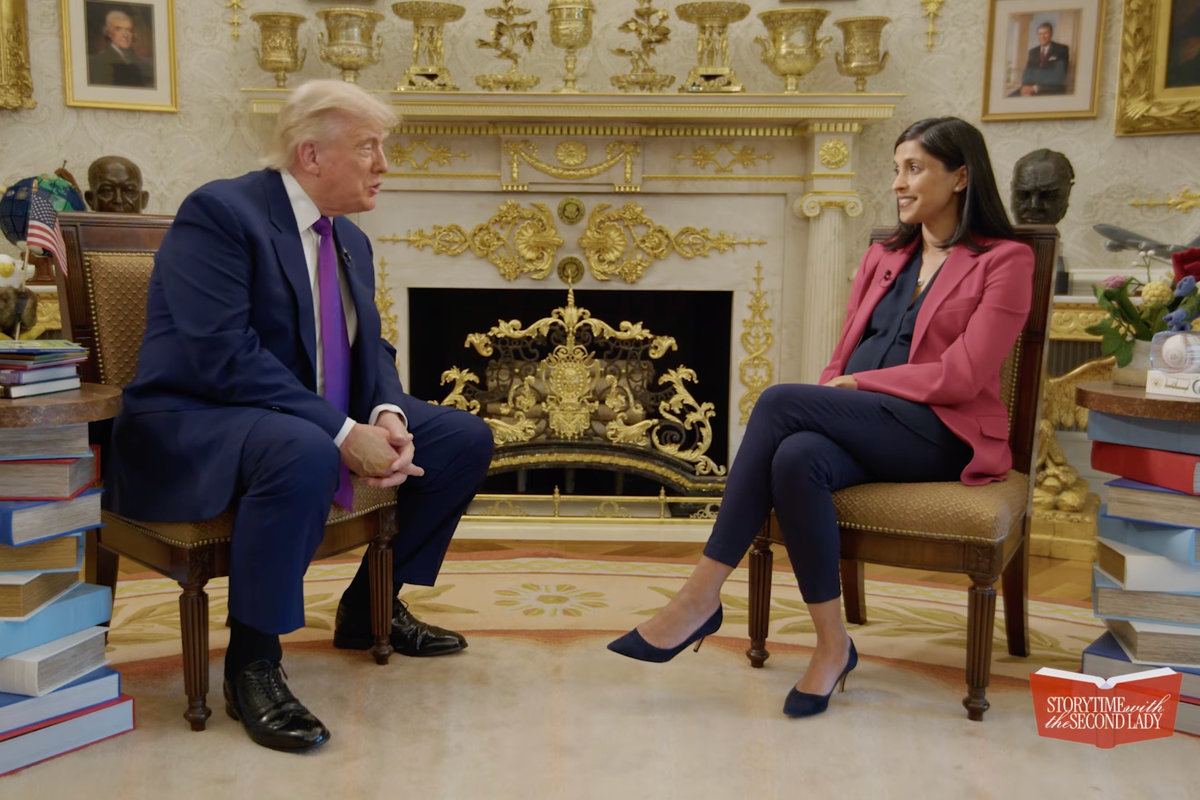
When Second Lady Usha Vance launched her podcast earlier in 2026, it was pitched as a soft-focus initiative to encourage kids to read. She reads classics like Peter Rabbit and brings on guests to do the same. But when your guest is Donald Trump, the script goes out the window. Pre-taped in the Oval Office amidst an array of gold accents, Lego globes, and stuffed bald eagles, the episode revealed a lot more about Trump's current mindset than any history lesson ever could.
He didn't really read the book. The book in question was Presidents Play!, a publication from the White House Historical Association showcasing past commanders-in-chief staying active. Trump simply flipped the pages and offered his own unvarnished reviews of America's past leaders.
The Real Agenda Behind the Trump Usha Vance Podcast Session
Political observers knew this joint appearance wasn't just about childhood literacy. Usha Vance has been executing a careful public relations strategy since her husband took office. Her podcast is clearly designed to soften the administration's hardline image, appealing directly to suburban parents and women who might be put off by raw partisan politics.
Bringing the president onto Storytime with the Second Lady should have been a slam-dunk moment for unity. Instead, it put the stark stylistic contrast between the disciplined, Ivy League-educated second lady and the freewheeling president on full display. Usha Vance sat by as Trump hijacked the focus, pivoting every historical anecdote back to his favorite subject: himself.
When she asked him if he finds time to read for pleasure while managing the presidency, Trump didn't hesitate. He flatly stated that he mostly reads newspapers, adding that he usually just reads stories about himself. It's a level of blunt honesty that you rarely get from modern politicians. Most would invent a classic biography or an inspiring historical text to sound profound. Trump doesn't care about that.
Rating the Presidents on Looks and Weight
The meat of the episode involved Trump flipping through the illustrations of past presidents and giving them report cards based entirely on their physical traits and personal vibes.
John F. Kennedy and the Beauty Contest
When Trump reached the page featuring John F. Kennedy, he didn't talk about the Cuban Missile Crisis or the space race. He looked at the illustration and declared JFK to be "the second-most good-looking president."
He didn't name who holds the number one spot. He didn't need to. The implication hung heavy in the Oval Office air. Trump has always viewed politics through the lens of star power, television ratings, and physical presentation. Rating Kennedy's looks is a natural extension of how he evaluates everyone around him.
The Fear of Overtaking William Howard Taft
The most viral moment of the podcast came when Trump stared at a drawing of William Howard Taft. Taft famously tipped the scales at over 350 pounds during his time in office in the early 20th century.
Trump noted that Taft was a large man who loved hot dogs at baseball games. Then he got personal. He noted that Taft was the heaviest president, and said he has to be careful because he doesn't want to supersede that specific record. He called it possible if he allowed it to happen, before telling the young audience members to keep themselves in good shape.
Watching an 80-year-old president warn children about the dangers of gaining too much weight while comparing himself to William Howard Taft is the kind of surreal political theater that defines this era.
Quick Hits on Past Leaders
Trump didn't stop at Kennedy and Taft. He had thoughts on almost every figure immortalized in the picture book.
- Lyndon B. Johnson: Trump labeled him a "tough cookie," acknowledging the legendary Texan's aggressive political style.
- Ronald Reagan: He praised Reagan as a "high-quality person" and told Usha Vance that Reagan was "like your father was president."
- Richard Nixon: Trump kept it brief, noting that Nixon simply "got himself into trouble, I guess."
- Barack Obama and Joe Biden: Seeing an illustration of a football game inside the White House, Trump mused about inviting Obama, Biden, and the Bushes over to watch a game together just to watch the press go wild. He also took a jab at Obama's golf game, claiming he won't be playing in the Masters anytime soon.
- Bill Clinton: Looking at a drawing of Clinton on the White House jogging track, Trump remarked that he doesn't think he'll ever do that himself, though he noted he likes Clinton a lot.
- Abraham Lincoln: A picture of Lincoln on horseback gave Trump the idea that he might want to ride a horse too, but he quickly backed out of the idea. He noted that falling off horses is dangerous and concluded he would only ride a nice old horse that is extremely slow and lazy.
Why This Media Playbook Still Succeeds
Critics immediately pounced on the episode as an example of Trump's inability to focus on anyone else, even when participating in a show meant for young children. Social media reactions were swift, with opponents calling out the self-absorption of admitting he only reads about himself on a literacy program.
But looking at this through a traditional political lens misses the point entirely. Trump's supporters don't want to see him deliver a stiff, scripted reading of a children's book. They tune in precisely for the unscripted detours. By turning a children's book into an impromptu stand-up routine, Trump reminded his base exactly why they like him: he refuses to act like a typical politician.
The setting itself reinforced this. The Oval Office was redecorated for the show with stacks of oversized books and a Lego globe, trying to create a cozy library environment. Yet Trump used the platform to brag about the massive, expensive new ballroom he is currently constructing on the White House grounds, completely ignoring the cozy aesthetic.
A Mixed Message for the Fourth of July
Toward the end of the session, Usha Vance attempted to bring the conversation back to a traditional, patriotic theme. She asked the president if he had any specific advice for children on why they should get out and celebrate the upcoming Fourth of July festivities.
Instead of a standard message about freedom, democracy, or the founding fathers, Trump offered a dark assessment of the nation's current status. He told the children that the country is currently on a ledge and could go one way or another. He promised that his administration is going to make it go the right way and make America greater than ever, but the imagery of a country on a ledge is a heavy concept to drop on a podcast aimed at elementary schoolers.
This interaction encapsulates the ongoing challenge of the current administration's public relations efforts. While figures like Usha Vance try to build mainstream, culturally soft on-ramps to win over skeptical voters, the president's natural instinct is to return to the language of national crisis and personal grievance.
If you want to understand how this administration operates, ignore the official press releases. Look at the moments where the official packaging cracks. A children's book about sports, a concerned second lady, and an unfiltered president obsessing over presidential weight records tells you everything you need to know about modern American politics.
To track how these media strategies continue to evolve as the administration pushes its cultural agenda through the rest of the year, pay close attention to the guest lineups on official White House media channels. Look past the curated backdrops and listen to the unscripted remarks. That's where the real policy and posture reveal themselves.