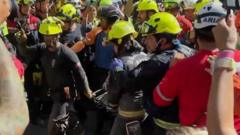
When you watch a video of a security guard rescued from rubble, you immediately hear the crowd erupt. You see the clapping, the tears, and the intense relief on the faces of the emergency crews. It feels like an instant, joyful miracle.
But it isn't instant. It's the end result of grueling, terrifying hours where a single wrong move can bring the entire pile down.
Most people watch these rescue clips on the news and think the hardest part is over once the dust settles. It's not. The reality of pulling a human being out of a collapsed building is a brutal race against physics and human biology. Security guards are often the first line of defense in a building, meaning they're frequently stationed in ground-floor lobbies or structural transit points when disaster strikes. When a collapse happens, they end up trapped under tons of concrete, steel, and shattered glass.
Getting them out requires a level of precision that looks painfully slow to the untrained eye. Here is what actually happens behind those viral videos of survival, and why the real battle starts long before the cheers begin.
The Hidden Threat Facing a Security Guard Rescued From Rubble
The public usually thinks the primary danger to a trapped person is suffocation or bleeding. While those are immediate threats, rescue workers are often fighting a much more insidious enemy known as crush syndrome.
Imagine someone is pinned beneath a fallen reinforced concrete beam. Their legs are crushed, but they're conscious and talking to the rescue team. You might think that lifting the beam off their body will instantly save them.
It can actually kill them within minutes.
When heavy debris compresses a limb for more than a few hours, blood flow cuts off completely. The muscle tissue begins to die. As it breaks down, it releases massive amounts of toxins, including myoglobin, potassium, and lactic acid, into the localized area.
If a rescue team simply jacks up the concrete beam without preparing the patient, the blood suddenly rushes back into the limb. It picks up that toxic cocktail and carries it straight to the heart and kidneys. The result is often sudden cardiac arrest or acute kidney failure.
Because of this, specialized medical personnel must crawl into the tight space with the victim long before they are pulled out. They have to start intravenous lines, pump the patient full of saline and sodium bicarbonate, and stabilize their internal chemistry while they are still pinned. It’s a terrifying environment. It’s dark, dusty, and aftershocks could crush the medic too. But it's the only way to ensure that the moment of rescue doesn't become a moment of tragedy.
How Rescue Teams Find a Void Space in a Structural Collapse
Buildings don't just flatten like pancakes. They collapse into complex, unstable geometric puzzles. When concrete slabs fall, they often catch on machinery, large furniture, or structural pillars, creating tiny triangular pockets of survival.
Rescue workers call these void spaces.
Finding a trapped guard means mapping these invisible pockets through shifting debris. Crews don't just start digging blindly with shovels. Heavy machinery can cause the entire pile to shift, crushing anyone alive inside.
Instead, the operation moves in highly disciplined phases.
First comes the physical search. Rescuers use sensitive technical equipment like acoustic listening devices. These tools can pick up the faintest sounds through feet of solid concrete, like a trapped guard tapping a ring against a pipe or scratching at a wall.
Next come the search dogs. K9 units trained in disaster response can track the scent of a living human through tiny air currents escaping the rubble. They don't bark constantly. They give a specific alert, and the team zeroes in.
Once a potential location is found, rescuers use snake cameras. These are fiber-optic lenses mounted on long, flexible poles that can slide through gaps as small as a couple of inches. They allow the crew to look into the void, check the structural stability of the pocket, and make eye contact with the survivor.
The Real Reason Emergency Crews Tell Crowds to Shut Up
You have probably seen news footage where a sudden, eerie silence falls over a disaster zone. A supervisor raises a hand, and hundreds of workers, heavy machine operators, and onlookers stop moving. They hold their breath.
These are called freeze periods. They're mandatory.
During a freeze period, every engine is switched off. Generators stop humming. Crowds are told to remain perfectly silent. Rescuers place seismic sensors on the concrete slabs and listen.
They are listening for two things. They want to hear if the trapped person is making noise, but they also need to hear if the building is groaning.
A building pile is alive. It settles, it creaks, and it moves. If a structural engineer hears a specific high-pitched pinging sound from a steel rebar or a low rumble from a concrete slab, it means the pile is about to shift. If it shifts, the rescue team and the victim will be buried together.
To prevent this, teams use structural shoring. They construct temporary wooden or mechanical jacks to prop up the debris as they dig deeper. Every foot of progress requires a new brace. It’s slow, exhausting work that explains why a rescue over a distance of just ten feet can take twelve hours.
What Happens in the Minutes Right After the Extraction
When the security guard is finally freed and carried out on a spine board, the media captures the applause. But look closely at the rescuers. You won't see them celebrating yet. They are moving fast.
The patient is immediately shielded from daylight. If they've been in darkness for days, sudden exposure to bright sunlight can cause permanent retinal damage. They are covered in thick thermal blankets because hypothermia can set in even in warm climates due to severe shock and blood loss.
Oxygen is administered instantly to combat the toxic dust and smoke inhaled within the void space. The medical team continues aggressive fluid therapy to protect the kidneys from the lingering effects of muscle breakdown.
The psychological shock is just as intense as the physical trauma. Being buried alive is one of the most primal human terrors. Survivors often emerge in a state of hyper-vigilance or profound dissociation. The chaotic noise of a cheering crowd, while well-intentioned, can be incredibly overwhelming for a nervous system that has spent hours or days in pitch blackness listening to the terrifying sounds of shifting concrete.
The Lessons We Must Take Away From Structural Failures
Every time we witness someone being pulled from the wreckage of a building, it shouldn't just be viewed as an inspiring human interest story. It needs to be a wake-up call about structural integrity, building maintenance, and emergency preparedness.
If you run a business or manage a facility, you need to understand that your security personnel are your frontline exposure. They don't have the luxury of sitting near emergency exits in the deep interior of an office. They are at the perimeter.
Take a hard look at your facility's structural health. Ensure emergency protocols aren't just words on a dusty PDF in your human resources folder. Run realistic drills. Invest in heavy-duty structural assessments. True safety isn't about hoping for a miraculous rescue after a disaster occurs, it's about building spaces that don't fall down in the first place.