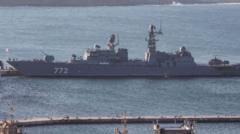
When a Russian warship decides to run live-fire naval drills just a short distance off the British coast, headlines immediately erupt across the media landscape. It sounds like an emergency straight out of a Cold War thriller.
If you caught the reports about Russian naval activity near Plymouth, you might wonder whether we're on the brink of an escalating confrontation right on the doorstep of the English Channel. The direct truth is much more strategic, deliberate, and frankly, routine for international maritime operations. Don't forget to check out our previous article on this related article.
Understanding what actually happens when foreign warships operate in these international corridors reveals the real chess game unfolding right off the south coast.
What Real Maritime Law Says About Foreign Warships in International Waters
When news breaks that a foreign naval vessel conducted firing exercises or live weapon tests near Plymouth, the initial reaction is usually shock. Isn't that British territorial water? To read more about the background of this, Associated Press provides an informative breakdown.
Actually, international law draws a very sharp, clear boundary line.
Territorial waters extend exactly 12 nautical miles (roughly 13.8 miles or 22 kilometers) from a nation's baseline coast. Outside that 12-mile zone lies international waters. Under the United Nations Convention on the Law of the Sea (UNCLOS), high seas freedoms apply to all nations, including the right to navigate, fly over, and even perform naval maneuvers and weapons firing tests in international airspace and waters.
       [ UK Coastline ]
              │
              │  <--- 12 Nautical Miles (Territorial Waters: Strict UK Sovereignty)
              │
       ═══════╧═══════
              │
              │  <--- High Seas / Exclusive Economic Zone (International Transit Rights)
              │       (Naval exercises allowed under UNCLOS, heavily monitored by Royal Navy)
Russia knows this framework inside and out. So does the Royal Navy. When Russian ships transit through the English Channel or set up temporary exercise areas off the coast of Devon and Cornwall, they almost always stay strictly within international passage zones. They push right up to the legal boundary, but rarely step over it.
The Reality Behind Live Fire Drills Off Plymouth
Plymouth isn't just another seaside city on the South West coast. It's home to HMNB Devonport, the largest naval base in Western Europe and the core hub for the Royal Navy's surface fleet and submarine support.
When foreign navies conduct exercises near this zone, it serves a dual purpose:
- Strategic Messaging: It's a calculated flex to demonstrate that Russia retains global naval projection capabilities regardless of geopolitical tensions or land conflicts elsewhere.
- Intelligence Gathering: Moving warships near major naval choke points allows intelligence crews to monitor Royal Navy radio frequencies, radar emissions, and response times.
Whenever a vessel like a Russian frigate or corvette enters the Channel approach, the Royal Navy doesn't just sit back and watch on screen. HMS Type 23 frigates, offshore patrol vessels, and RAF P-8A Poseidon maritime patrol aircraft shadow the ship constantly from the moment it enters the UK Maritime Zone of Interest.
If live firing occurs, maritime authorities issue standard Notice to Mariners (NOTAMs and NAVWARNs) to keep civilian vessels and shipping lanes clear of dangerous activity. It’s tense, highly coordinated, and watched with extreme scrutiny by military intelligence.
Why the English Channel Is a Global Maritime Flashpoint
The English Channel is one of the busiest maritime thoroughfares in the entire world. Over 500 commercial ships pass through these narrow waters every day.
When you mix heavy commercial traffic, fishing fleets, local yachts, and armed military hardware, the margin for error shrinks fast.
| Key Aspect | Diplomatic Norms | Real-World Practice |
|---|---|---|
| Right of Transit | Innocent passage allowed through territorial straits | Warships must maintain direct transit without stopping |
| Live Fire Exercises | Permitted in international waters with safe navigation warnings | Used intentionally to test air-defense reaction speeds |
| Shadowing Protocol | Escort ships keep safe distance | Royal Navy vessels sail closely alongside to monitor radar |
| Communication | Radio contact maintained via international hailing channels | Tactical silence often maintained until pushed |
Shadowing foreign naval ships isn't cheap or trivial. It places steady strain on Royal Navy crew rotation and ship availability, which is precisely why these maneuvers are designed to test operational endurance.
Practical Steps If You Encounter Military Operations at Sea
If you operate a private boat, commercial vessel, or leisure yacht anywhere in the English Channel or the approaches off Plymouth, coming anywhere near a military operation requires instant caution.
- Monitor VHF Channel 16: Local coastguards and military vessels broadcast active maritime safety warnings on Channel 16 constantly. Pay close attention to live coordinates.
- Respect NAVWARN Exclusion Zones: If a navigation warning flags an active military exercise or temporary hazard area, clear out immediately. Don't curiosity-sail closer.
- Maintain AIS Visibility: Ensure your Automatic Identification System (AIS) transponder is active so military radar operators can identify you as a civilian vessel right away.
- Give Warships Wide Berth: Warships on maneuver cannot alter course quickly. Standard maritime etiquette requires maintaining at least 1 to 2 nautical miles of separation wherever possible.
Keep your maritime charts updated, stay tuned to local coastguard broadcasts before setting sail out of Devon or Cornwall ports, and treat any reported military exercise zone as a hard perimeter.