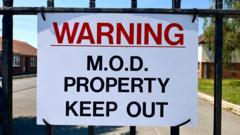
West Suffolk Council just sent a crystal clear message to Whitehall: RAF Barnham is the wrong place to warehouse human beings. In an emergency meeting, councillors voted unanimously to oppose the Home Office plan to convert the Cold War-era base into a mass housing facility for asylum seekers. This isn't just standard nimbyism. It's a logistical, ecological, and social collision course.
The government wants to stop using expensive hotels. Everyone gets that. But swapping hotels for isolated, decaying military barracks in tiny rural villages is merely trading one disaster for another. If you look at the geography, the math, and the history of these sites, it's easy to see why the local community is terrified.
The Reality of Forcing 1200 People into a Village of 600
Barnham is a sleepy Suffolk village. It has thatched cottages, a medieval church, a primary school, and about 600 residents. The Home Office wants to drop a massive influx of people—likely up to 1,200, mostly young men—right on its doorstep. The nearby town of Thetford, just over the Norfolk border, isn't much bigger and will bear the brunt of the infrastructure strain.
Think about the sheer scale of that imbalance. You're doubling the local population overnight.
Local public services are already stretched to the limit. There are no spare GP appointments. Dentists are non-existent. The local primary school wasn't even considered by the civil service during the initial planning phase, a fact that emerged during recent community briefings and triggered widespread local fury.
Buses already started arriving at the base with blacked-out windows before the official announcement was even made. This top-down, secretive approach completely shattered local trust. It's why hundreds of residents blocked the A134 in protest. People feel ignored, blindsided, and deeply exposed.
The Hidden Environmental and Infrastructure Roadblocks
Politicians love to point at empty military bases on a map and think they've found an easy fix. They haven't. RAF Barnham is a specialized site with a complex layout, once used for storing Britain’s early nuclear weapons. It's currently used by police for riot training.
Turning it into a large-scale residential center requires massive refurbishment. Right now, the site consists of narrow dormitory rooms with metal bed frames, thin mattresses, worn fixtures, and an empty industrial kitchen.
But the real dealbreaker isn't just the inside of the barracks. It's the land they sit on.
- Environmental Protection: RAF Barnham sits directly within a Special Protection Area (SPA) and a Special Area of Conservation (SAC) buffer zone.
- Strict Restrictions: These environmental protections severely limit what can be built or how the land can be used. This conservation status has blocked private housing developments and commercial expansion on the base for years.
- The Double Standard: Locals are asking a valid question: if private builders can't touch this land because of strict conservation laws, why does the Home Office get a free pass to bypass these rules for a high-density migrant camp?
Why Military Barracks Don't Work for Anyone
Refugee charities and right-wing politicians rarely agree on anything, but they're completely aligned on this: warehousing asylum seekers in remote military camps is a terrible idea.
Border Security and Asylum Minister Alex Norris claims the government is bringing the system under control by shutting down asylum hotels. But replacing hotels with isolated barracks is a broken strategy. We've already seen how this plays out at Wethersfield in Essex, which houses over 1,200 men. It became a magnet for protests, strained local policing, and cost taxpayers more than the hotels it was supposed to replace.
Isolated bases cut people off from legal support, healthcare, and basic community integration. You end up with hundreds of bored, anxious young men stuck in the middle of nowhere with zero transport links, while the nearby towns inherit a massive policing headache.
Suffolk Constabulary is already burning through resources just to manage the protests and traffic around the base. Taking police off the streets of local neighbourhoods to guard an isolated camp isn't a sustainable security plan.
What Needs to Happen Next
The government needs to stop treating rural communities like dumping grounds for bad policy decisions. If you want to follow this development or get involved in the local response, here are the direct steps being taken right now:
- Gathering the Evidence: West Suffolk Council is compiling a formal case against the Home Office proposal, focusing on the environmental restrictions of the Special Protection Area and the lack of infrastructure.
- Community Coordination: Local residents in Barnham and Thetford have organized community watch groups and communication networks to share updates on site activity and legal challenges.
- The Planning Fight: The Home Office still has to submit formal planning applications to transition the base. This is the legal window where local authorities and environmental bodies can tank the project based on statutory planning laws.
The battle over RAF Barnham is just beginning, and the government is realizing that rural communities won't stay quiet when a broken system is forced onto their doorsteps.