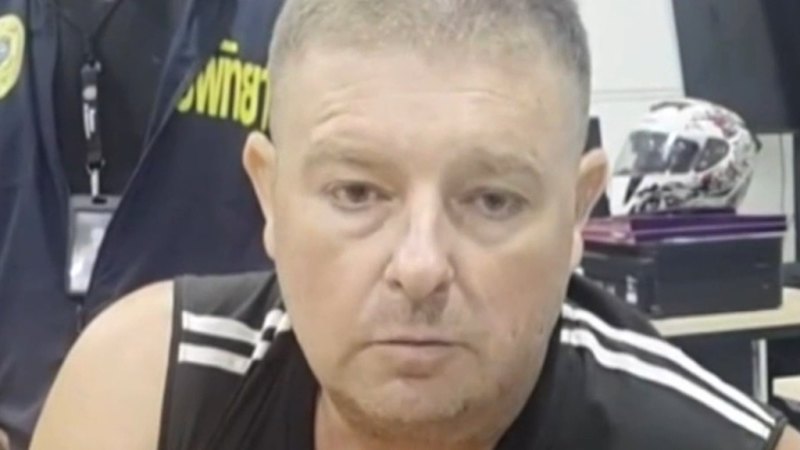
A horrific crime in a coastal resort city leaves a local teenager dead, a foreign tourist in handcuffs, and a trail of digital breadcrumbs that police reconstructed in less than 48 hours. When news broke that 46-year-old Australian Simon Carman was intercepted at Bangkok’s Suvarnabhumi Airport, the internet did what it always does. People jumped to wild conclusions about international law, foreign police competency, and what happens when an Australian citizen faces the absolute heaviest charges in Southeast Asia.
Let's look at the actual facts. Don't miss our recent coverage on this related article.
Carman, a truck driver with ties to both Western Australia and Victoria, stands accused of the brutal murder of 17-year-old Tunchanok Donhomla in Pattaya. Her body was found stuffed inside a black suitcase dumped near a railway line behind the local Floating Market.
Many commentators think foreign investigations move slowly or lack technical sophistication. This case proves the exact opposite. Thai authorities moved with terrifying speed, combining old-school street interrogation with an ironclad net of closed-circuit television tracking. If you want more about the background here, Reuters provides an excellent summary.
The Grim Forty-Eight Hour Timeline
The timeline dismantles any idea that this was a clumsy, slow-moving investigation. Everything went down over a chaotic 48-hour window.
It started in the pitch black of Thursday morning at around 3:30 AM. Street-level security cameras captured Carman walking hand-in-hand with Donhomla near the infamous Beach Road entertainment strip, heading straight toward his condominium accommodation.
Hours later, the cameras painted a completely different picture.
By Thursday evening, the same man emerged from the building alone. He wasn't light on his feet. He was hauling a massive, heavy black suitcase. Separate footage tracked him loading the heavy luggage onto the back of a motorbike and driving away into the Pattaya traffic.
Friday afternoon changed everything. The teenager's friends realized she hadn't come home and raised the alarm with local authorities. Pattaya City Police Station didn't just file a report and sit on it. They immediate pulled the girl's final phone locations and cross-referenced them with the building's security system.
By Friday night, the suitcase was found. The scene near the railway tracks was horrific. The victim’s naked body showed massive trauma, including severe facial bruising from a violent assault.
As forensic teams processed the gruesome site, a watch notice hit the desks of Thai Immigration officials at the capital’s main airport. Carman was already waiting in line at Suvarnabhumi Airport, holding a ticket for a Jetstar flight to Perth. He was taken down right at the gate at 9:30 PM.
The Spider Defense and Forensic Reality
When Thai police hauled Carman into custody, the physical evidence on his own body immediately drew attention. Investigators noted fresh, deep fingernail scratches across his neck and arms. To a veteran detective, these are classic signs of a defensive struggle.
Carman had an answer ready. When journalists yelled questions at him during his initial transfer, he claimed the marks came from a spider.
It's a weak excuse that won't hold up under a forensic microscope. Thai forensic teams have already processed the condominium unit where the crime allegedly took place. Reports out of Pattaya indicate the room showed clear signs of a violent struggle, with DNA swabs and physical displacement matching the injuries found on both the victim and the suspect.
Carman continues to deny all involvement, claiming the young girl simply got up and left the room while he was fast asleep. But his story directly contradicts the video evidence of him dragging the heavy black suitcase down the hall and loading it onto his bike.
The Shocking Reality of the Charges
People often misunderstand how foreign legal systems treat crimes against minors. Thailand takes a fiercely aggressive stance here, especially when tourism hot spots are involved.
Carman isn't just facing a single count of homicide. Prosecutors are stacking charges to ensure he stays behind bars for life, or worse. The official charge sheet includes:
- Premeditated or intentional murder
- Concealing and moving a corpse to hide the cause of death
- Abduction of a minor under 18 for indecent or sexual purposes
Under Section 288 of the Thai Penal Code, murder carries a baseline penalty of 15 to 20 years in prison, life imprisonment, or execution. Because the victim was a minor and sexual exploitation is allegedly tied to the crime, prosecutors have a direct path to pursue the death penalty.
While Thailand rarely carries out executions anymore—the last judicial execution occurred by lethal injection in 2018—the courts still hand down death sentences regularly. They usually get commuted to life sentences during royal holidays, but a life sentence in a maximum-security Thai prison like Klong Prem or Bang Kwang is no joke. It's an brutal environment with severe overcrowding and minimal comfort.
The Fiction of Consular Rescue
Whenever an Australian gets locked up in a high-profile overseas murder case, a segment of the public assumes the Australian government can step in and fix it. They expect the Department of Foreign Affairs and Trade (DFAT) to fly a legal team over and demand the citizen's release.
That's pure fantasy.
DFAT has officially confirmed they are providing consular assistance to Carman. But you need to understand what that actually means.
Consular officials cannot give legal advice. They cannot get you out of jail. They cannot interfere in the local judicial process of a sovereign nation.
Their role is strictly administrative. They visit the prison to check on the suspect's health and physical welfare. They ensure the prisoner is being treated humanely under local laws. They provide a list of local, English-speaking lawyers that the family can hire out of their own pocket. They can pass messages to family members back in Australia.
That is the absolute limit of their power. If you break the law in Thailand, you are entirely subject to the Thai court system. No exceptions.
What Happens Next
This isn't a quick trial that wraps up in a few weeks. The Thai legal system moves with deliberate, bureaucratic weight.
First, Carman will be remanded in custody for consecutive 12-day periods while police finalize their official investigation report. Under Thai law, they can hold him for up to 84 days before the formal arraignment must take place.
During this time, his legal team will likely try to secure bail. It won't work. Given that he was arrested at an international airport while trying to board a flight out of the country, he is the definition of a flight risk. He will remain behind bars throughout the pre-trial phase.
If you want to track how this case develops, focus on three specific elements that will dictate the outcome of the trial:
- The DNA Match: Look for the forthcoming forensic analysis matching the scratches on Carman's neck to the victim's fingernails.
- The Suitcase Contents: Watch for the forensic results from the interior of the black suitcase, which will link the fibers and biological material directly back to the hotel room.
- The Motorcycle Route: Pay attention to the traffic camera sequence tracking his exact path from the hotel to the railway line where the body was discarded.
This case is a stark, grim reminder that your passport offers no protection when you are accused of a capital crime on foreign soil. The digital net in modern tourist hubs is tight, and Thai authorities have shown they know exactly how to pull it closed.
This detailed Australian news broadcast features the actual CCTV footage of the suspect and details the precise location where local authorities uncovered the suitcase.