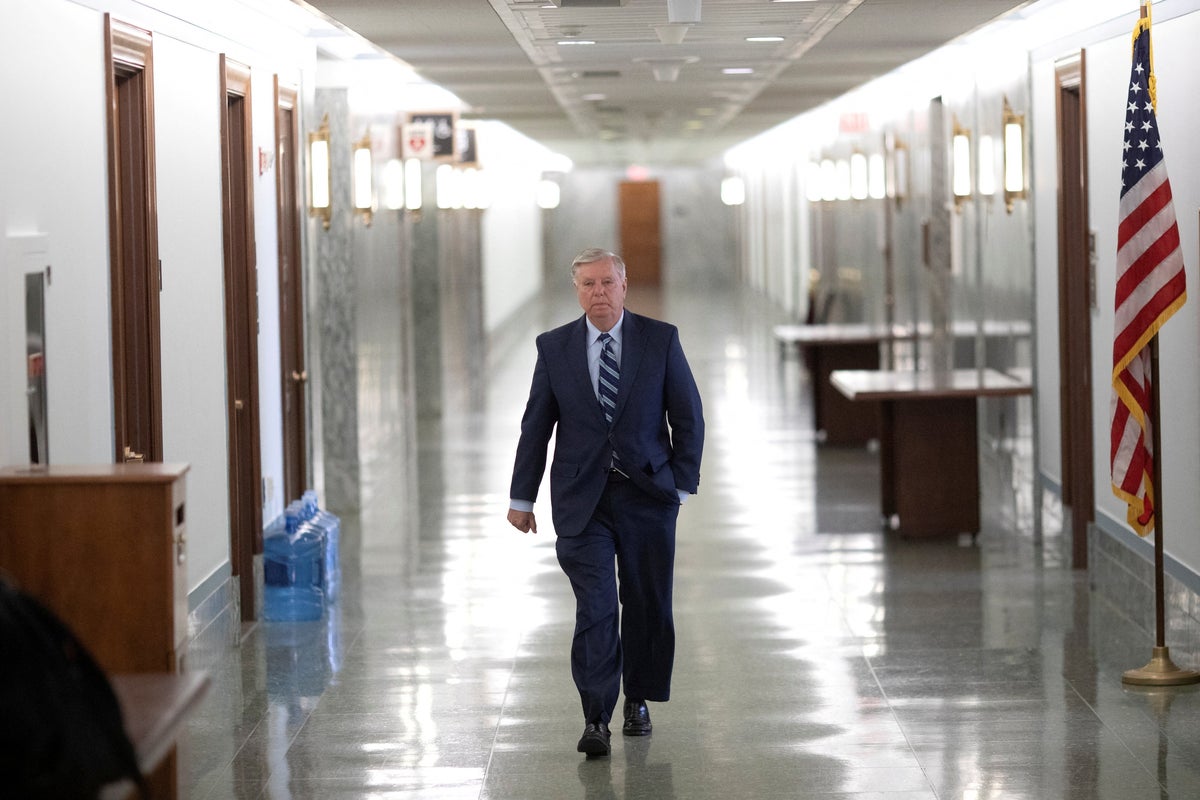
Lindsey Graham didn't care if you thought he was a hypocrite. The long-serving South Carolina senator, who died suddenly on July 11, 2026, at the age of 71, operated on a political calculus that baffled outsiders but made perfect sense to him. To the national media, he was a political chameleon. He mutated from John McCain’s loyal sidekick into Donald Trump’s primary defender on Capitol Hill. But if you look closely at his three decades in Washington, a different picture emerges.
Graham was a survivalist. He understood power, how to get close to it, and how to use it to keep America entrenched as the dominant military force on earth.
When news broke that he passed away from an aortic dissection at George Washington University Hospital, Washington lost its most unpredictable operator. His office confirmed the cause of death followed a sudden cardiac emergency at his Capitol Hill home. He had just returned from Kyiv. Literally 24 hours prior, he was sitting with Ukrainian President Volodymyr Zelenskyy, negotiating fresh sanctions against Russia. That was classic Graham. He died doing exactly what he loved, which was flying into a conflict zone and trying to direct the foreign policy of the United States.
The political fallout of his passing is immediate. It leaves a massive void in the Senate, shrinking the Republican majority to 53-47 and forcing South Carolina Governor Henry McMaster to appoint a temporary successor. But understanding Graham requires looking far beyond the immediate scramble for his seat. You have to understand how a kid who grew up in the back of a South Carolina pool hall became the ultimate Washington whisperer.
The Pool Hall Kid From South Carolina
Most people assume senior senators come from money or political dynasties. Graham didn't. His early life sounds like something out of a gritty Southern novel. Born in Central, South Carolina, his parents ran the Sanitary Cafe. It was a combination restaurant, bar, pool hall, and liquor store. The family lived in a single room behind the business. He grew up around working-class folks, learning early on how to talk to anyone and read a room.
Tragedy hit him hard and fast when he was just 20. His mother died of Hodgkin’s lymphoma. Just 15 months later, his father suffered a fatal heart attack. Graham was left entirely alone to care for his 13-year-old sister, Darline. To keep the family together, the military allowed him to attend the University of South Carolina so he could remain close to home as her legal guardian. He became the first person in his family to graduate from college.
He joined the Air Force as a judge advocate general attorney in 1982. He spent years handling military law, even appearing on a 60 Minutes segment in 1984 that exposed flawed drug testing within the military. He stayed in the reserves for decades, eventually retiring as a colonel in 2015. That military background wasn't just a resume builder. It formed the foundation of his worldview. He genuinely believed that American military might was the only thing keeping the world from spinning into total chaos.
From Trump Archenemy to Golf Course Confidant
You can't talk about Lindsey Graham without addressing the massive political pivot that defined his later career. During the 2016 Republican presidential primary, Graham ran a brief, doomed campaign for the White House. He used his platform to absolutely shred Donald Trump. He called Trump a jackass. He said Trump was unfit for office and a race-baiting, xenophobic religious bigot. He didn't even vote for him in 2016, choosing independent candidate Evan McMullin instead.
Then, everything changed.
Once Trump won the presidency, Graham didn't stay in the wilderness. He chose access. He started showing up at Trump’s golf courses, advising him on foreign policy, and defending him fiercely on television. Critics called it shameless opportunism. They said he sold his soul for a tee time.
Graham had a different explanation. He openly admitted that he wanted to remain relevant. He knew that a senator from South Carolina who fought the president would get frozen out. By becoming Trump's friend, he could steer the administration away from isolationism. He used his relationship to protect funding for the military and keep troops stationed abroad. He basically decided that playing the role of a sycophant was worth it if it meant he could influence the deployment of American power.
The partnership had plenty of rocky moments. After the January 6 Capitol riot, Graham took to the Senate floor and declared that he was done with the drama, stating that he and Trump had a hell of a journey but it was time to count him out. Yet, within months, he was right back down at Mar-a-Lago. He knew Trump completely controlled the Republican base, and Graham had a reelection campaign coming up. He did what he always did. He survived.
The Last of the Three Amigos
For years, Graham was part of a legendary legislative trio known as the Three Amigos. The group included Graham, Arizona Senator John McCain, and Connecticut Senator Joe Lieberman. They were an odd bunch. McCain was a maverick Republican, Lieberman was a centrist Democrat turned independent, and Graham was the partisan conservative.
They were united by a shared, aggressive foreign policy. They traveled the world together, visiting troop deployments in Iraq, Afghanistan, and the Balkans. They pushed for troop surges and consistently advocated for American interventionism.
With McCain’s passing in 2018 and Lieberman’s death in 2024, Graham was the final surviving member of that old guard. His death marks the true end of that specific era of Senate internationalism. While younger Republicans have increasingly leaned into an America First isolationist stance, Graham remained a throwback. He spent his final months fighting his own party to secure billions of dollars in aid for Ukraine and Israel. He openly defied the growing populist wing of the GOP, proving that his hawkish instincts were deeper than any temporary political alignment.
Shaking the Judiciary and the Kavanaugh Firestorm
While foreign policy was his true passion, Graham’s most explosive moment on the national stage happened right inside the Senate Judiciary Committee room. In 2018, the confirmation of Supreme Court nominee Brett Kavanaugh was melting down over allegations of sexual assault. The hearings had devolved into a bitter, hyper-partisan circus.
Graham, who had a reputation for being a relatively mild-mannered, joke-cracking institutionalist, completely snapped. He delivered a blistering, red-faced tirade that shifted the entire momentum of the hearings. He turned to the Democratic members of the committee and screamed that it was the most unethical sham he had ever seen in his political life. He warned them that if they wanted an all-out war, they were going to get it.
That single speech cemented his status as a hero among the Republican grassroots. It showed he could fight dirty when the stakes were high. When he took over as chairman of the Judiciary Committee shortly after, he used that power to fast-track judges through the system, including the confirmation of Amy Coney Barrett just days before the 2020 presidential election. If you love or hate the current conservative makeup of the federal courts, Graham is one of the main people responsible for it.
A War Hawk Until the Very End
It is almost poetic that Graham’s final hours were spent in Kyiv. He was a man who felt most at home in the middle of international crises. Just last week, he was photographed standing alongside Zelenskyy, smiling and promising that American support wouldn't waiver, even as political winds in Washington threatened to cut off funding.
He had just ironed out a bipartisan deal to slap heavier sanctions on Russia right before his flight back to Washington. His heart gave out hours after he landed.
The immediate domestic consequence of his death is a scramble for power in South Carolina. Governor McMaster will appoint a Republican to fill the seat until a special election can be held. Because Graham had already won his primary in June for the upcoming cycle, state election officials will have to rapidly scramble to organize a special primary process to select a new nominee for the ballot.
But the larger consequence is geopolitical. Israel lost one of its fiercest defenders in Congress. Prime Minister Benjamin Netanyahu quickly posted that Israel had lost a great friend, while Ukrainian leadership expressed deep shock at the sudden loss of their strongest Republican ally.
Graham leaves behind a complicated, messy record. He was an institutionalist who defended a president who attacked institutions. He was a hawk in an increasingly dove-ish party. He was a man of the Senate who wasn't afraid to blow up traditional norms to win a fight. Love him or despise him, Washington won't see another operator quite like him.
Next Steps for Following the Senate Shakeup
The political map is shifting quickly following Graham's passing. If you want to keep track of how this changes the balance of power, here is what to watch next.
- Watch the Governor's Appointment: Governor Henry McMaster will announce an interim senator within days. This choice will signal whether South Carolina is leaning toward a traditional conservative or a hard-right populist.
- Track the Foreign Aid Votes: Keep a close eye on the upcoming Senate votes regarding Ukraine and Israel sanctions. Without Graham's behind-the-scenes arm-twisting, these bills face a much tougher road to passage.
- Monitor the Special Primary: South Carolina election officials will release the timeline for the emergency primary to replace Graham on the November ballot. This will trigger a massive, fast-paced campaign inside the state.