Tehran is draped in black, but the mood on the street isn’t just about grief. It’s about survival. After four months of brutal conflict, Iran is finally preparing to bury Ayatollah Ali Khamenei. For a regime that thrives on the theater of martyrdom, this moment was supposed to happen in March. Instead, it took a fragile, U.S.-brokered ceasefire to clear the airspace long enough for a state funeral.
If you look at mainstream news coverage, you see images of weeping crowds and packed public squares. That’s what the state wants you to focus on. But if you want to understand what’s actually happening inside the Islamic Republic right now, you have to look past the official cameras. The real story isn't the funeral itself. It’s how the regime plans to use this massive gathering to project power at its absolute weakest moment.
The Four Month Delay and the Red Flag of Vengeance
We haven't seen a state funeral delayed like this in modern history. Khamenei was killed alongside several family members in a joint U.S.-Israeli air strike on his compound back on February 28, 2026. The strike didn't just kill the Supreme Leader; it triggered an immediate regional war. For weeks, Western analysts predicted the immediate collapse of the clerical establishment. They underestimated the staying power of the internal security state.
The regime postponed the burial because they simply couldn't guarantee the safety of the crowds while bombs were falling. Now that the Doha talks have produced a temporary pause in hostilities, the body has arrived at the Imam Khomeini Grand Mosalla Complex.
State media recently released images of the casket. It’s draped in a sacred red flag taken from the shrine of Imam Hussein in Karbala. In Shiite iconography, a red flag signifies blood that has not yet been avenged. Mohammad Bagher Ghalibaf, the parliament speaker and chief negotiator, explicitly called for a massive turnout as a direct act of vengeance. The funeral isn’t an ending. The regime is explicitly framing it as a mobilization order for the next phase of the confrontation.
Who Actually Runs Tehran Today
There is a glaring absence at the center of this historic event. Mojtaba Khamenei, the late leader’s son who was quickly designated as his successor, has barely been seen. He has remained completely out of public view since the war began. This absence has triggered intense rumors about his actual standing with the military elite.
If Mojtaba is laying low, who is calling the shots?
Power has shifted dramatically toward two factions working in an uneasy alliance. On one side is President Masoud Pezeshkian, who handles the diplomatic choreography and international outreach. On the other side are the top commanders of the Islamic Revolutionary Guard Corps (IRGC).
Just yesterday, the head of the IRGC emerged from hiding to oversee the funeral security arrangements. These generals aren't interested in traditional clerical rule. They run the war machine, the black-market supply lines, and the domestic security apparatus. The massive public mourning ritual serves as a perfect smoke screen for the IRGC to solidify what is quickly becoming a de facto military dictatorship, keeping the younger Khamenei as a quiet figurehead.
The Missing Dignitaries
You can judge a country's true global standing by looking at the guest list for its state ceremonies. Pezeshkian sent out hundreds of formal invitations to global leaders. The responses tell you everything you need to know about current geopolitical alignments.
- China and Russia have sent diplomatic delegations, but their top-tier leaders are staying far away from Tehran.
- India declined to send Prime Minister Narendra Modi, opting instead to send a lower-level minister and regional politicians.
- Regional proxies from Lebanon, Yemen, and Iraq are arriving in massive numbers, turning the event into a summit for regional militia networks.
The lack of major global heads of state proves that while the regime can still command attention, its diplomatic isolation has deepened significantly since February.
The Strait of Hormuz Cold War
While millions gather to march through Tehran, Qom, and Mashhad, the real leverage point is happening hundreds of miles away in the Persian Gulf. The economy of the Islamic Republic is completely broken. Rampant inflation, currency devaluation, and the destruction of oil infrastructure during the war have left the treasury completely empty.
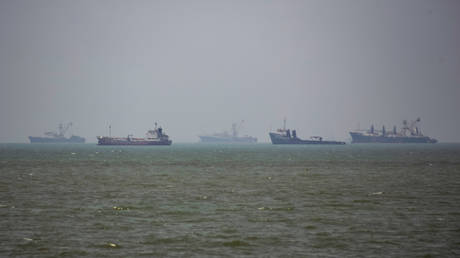
To survive, the IRGC has attempted to enforce a brand-new toll system on ship traffic passing through the Strait of Hormuz. They need cash to rebuild their war industry and fund their regional proxies. The U.S. has made it clear that tolls are a non-starter. Maritime traffic through the strait is still down dramatically compared to pre-war levels, crippling global shipping networks.
The funeral has forced a temporary pause in these specific negotiations. President Trump recently described the conflict not as a standard war, but as a forced "de-nuking" of Iran. The regime knows that the moment the seven-day funeral period ends on July 9, the pressure from Washington will return with absolute intensity.
What to Watch Next
If you're tracking the stability of the Middle East, don't get distracted by the emotional television broadcasts over the next week. Watch these specific markers instead.
First, look at the public reception of Mojtaba Khamenei if he finally makes an appearance at the burial in Mashhad on July 9. If he remains hidden, the rumors of an IRGC internal coup are likely true.
Second, monitor the shipping data in the Strait of Hormuz. Any attempt by Iran to seize vessels or enforce maritime fees immediately after the funeral rites conclude will collapse the ceasefire instantly.
Third, watch domestic protests. The state has deployed overwhelming security forces across Tehran under the guise of funeral management. The regime is terrified that internal dissident groups will use the logistical chaos to launch fresh anti-government demonstrations, following the brutal crackdowns earlier this year. The heavy security isn't just for foreign dignitaries; it's to keep a lid on a deeply angry population.