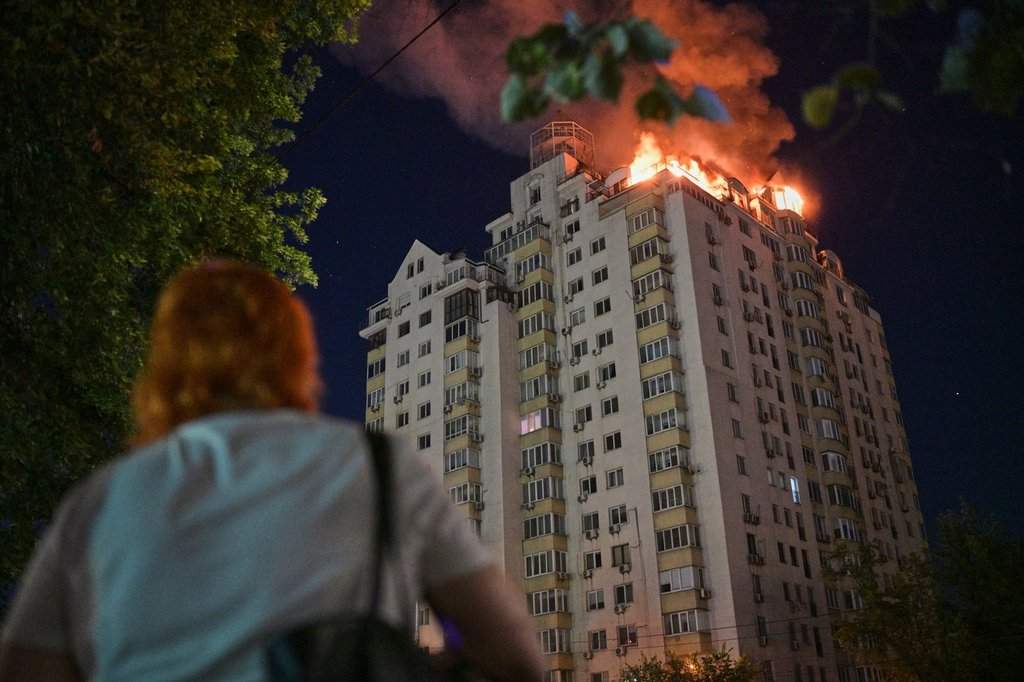
The war in Ukraine just hit a bloody, chaotic inflection point that completely upends the narrative of a stale front line. Overnight, Russia unleashed an unmerciful 11-hour drone and missile bombardment against the Ukrainian capital. The massive Russian attack killed 21 civilians in Kyiv, leaving roughly 90 others wounded as apartment buildings collapsed into piles of smoking rubble.
If you think this was just another routine, cruel terror raid, you are missing the bigger picture.
Moscow is panicking. The Kremlin openly admitted this brutal bombardment was a "retaliatory strike." Why? Because Ukraine’s home-grown drone fleet has spent the last month systematically gutting Russia's energy infrastructure. Kyiv’s 40-day blitz has triggered an unprecedented domestic fuel crisis inside Russia and Russian-occupied Crimea. Long lines at gas stations are frustrating regular Russians, and it is putting massive economic pressure directly on President Vladimir Putin.
The Reality of Ukraine’s Strategic Oil Blitz
While the world focuses heavily on the grueling infantry battles in eastern Ukraine, Kyiv has quietly shifted the rules of engagement. They are hitting Russia where it hurts the most: the wallet and the fuel tank.
Right before the skies opened up over Kyiv, Ukrainian long-range strike drones hammered one of Russia’s absolute largest oil refineries located in the Nizhny Novgorod region, deep east of Moscow. They also took out a critical railway bridge over the Siverskyi Donets River in occupied Luhansk, a key artery used to transport heavy weapons and troops.
This isn't an isolated success. Analysts from the Institute for the Study of War note that Ukraine's drone engineering has become a dominant asymmetric tool in 2026. By starving Russian logistics at the source, Ukraine has initiated the worst fuel crisis in Crimea since its illegal annexation in 2014.
"We were inside the shelter and felt the shelter shaking—the ceiling and floor, everything," said Serhii Budko, a 24-year-old Kyiv resident who survived the barrage.
Anatomy of an 11-Hour Night of Horror
Russia's response to its burning refineries was sheer, unadulterated mass projection. According to the Ukrainian Air Force, the Russian military launched an astonishing 74 missiles and 496 drones during the single overnight operation.
What Russia Fired at the Capital
- 74 Missiles: Roughly a third of these were advanced ballistic missiles, which are notoriously difficult to intercept.
- 496 Drones: Waves of loitering munitions designed to overwhelm localized air defense systems.
While Ukraine's air defenses have grown incredibly adept at knocking down slow-moving drones, ballistic missiles still break through. The results were devastating. In the Darnytskyi district, six entire floors of a nine-story residential building completely collapsed. Over 30 locations across Kyiv reported extensive damage, affecting at least 20 residential structures.
Kremlin spokesperson Dmitry Peskov tried to tell the international press that the military targeted "exclusively military-linked targets." But the reality on the ground—shattered families, rescuers pulling bodies from concrete slabs, and a dead 7-year-old girl in the central Dnipropetrovsk region—tells a completely different story.
Why Air Defense Bottlenecks Still Haunt Ukraine
Here is the frustrating paradox of Ukraine's war effort right now. Ukrainian Foreign Minister Andrii Sybiha recently revealed that domestic weapons factories now produce enough to cover up to 75% of the military's baseline needs. Ukraine is building its own long-range strike weapons at a pace nobody thought possible two years ago.
Yet, they cannot manufacture their own heavy air defense shields.
Ukraine remains entirely dependent on Western allies for elite anti-ballistic protection. They need Patriot missile batteries, and they need them immediately. The recent diplomatic attempts to stall or freeze the war under the changing political climate in the West haven't stopped Putin from ordering the slaughter of civilians.
What Happens Next
If you are tracking this conflict, don't look for a sudden diplomatic breakthrough. Look at the smoke rising from Russian fuel depots. Kyiv’s explicit strategy is to choke off the fuel that feeds the Russian war machine, forcing Putin to the negotiating table out of economic desperation.
Your immediate action items for staying informed on this shift:
- Track the Refinery Data: Watch independent satellite imagery of western and central Russian refineries. The percentage of active Russian oil refining capacity knocked offline is the real metric of Ukrainian success right now.
- Monitor the Western Air Defense Pipeline: Keep a close eye on whether European partners step up anti-ballistic missile deliveries over the coming weeks. Without them, Kyiv remains exposed to these massive retaliatory tantrums.
- Ignore the Front-Line Stagnation Myth: Understand that territorial lines on a map matter far less when one side is successfully destroying the structural economy of the other from a thousand miles away.