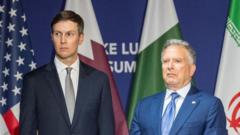
Donald Trump said a meeting was happening. Tehran immediately called it fake news. Now Qatar is stuck in the middle trying to clear up the mess.
If you've been reading the mainstream headlines about US envoys landing in Doha, you're probably confused. One day we're told a historic sit-down is about to end the conflict, and the next day both sides claim they aren't even in the same room. The reality isn't a diplomatic breakthrough, nor is it a total collapse. It's an intricate, messy, and quiet game of telephone happening through middlemen in air-conditioned rooms. In similar news, read about: Why The Chaos After Khamenei True Burial Matters More Than The Crowd Size.
Qatar's Foreign Ministry spokesperson, Majed al-Ansari, had to lay things out clearly this week. US Special Envoy Steve Witkoff and senior adviser Jared Kushner are indeed on the ground in Doha. They are talking to Qatari officials and regional mediators. They are absolutely not sitting across a table from Iranian diplomats.
To understand what's actually happening, you have to look past the political grandstanding in Washington and Tehran. The current diplomatic dance tells us everything about how fragile the June 17 peace memorandum really is, and why a full resolution to the crisis remains so far away. The Guardian has also covered this critical issue in great detail.
The Friction Between Public Posturing and Secret Reality
Politicians love to shape the narrative before they even sit down to negotiate. Trump claimed that Iran requested a meeting and that it would happen right away in Doha. It sounded like a major victory for Washington's pressure campaign. But Iranian Foreign Ministry spokesman Esmaeil Baghaei quickly shot down the assertion, stating that no meeting at any level had been scheduled with the Americans.
This public disagreement isn't an accident. It's standard leverage.
When you look closely at the mechanics of these talks, indirect diplomacy is the only way either side can save face right now. The US and Iran are currently operating under a 60-day interim agreement signed earlier this month. That agreement brought a temporary halt to the hot war that flared up earlier this year, which itself followed the devastating 2025 conflict involving Israel and Iran. Neither administration wants to look weak to its domestic audience by appearing too eager to shake hands.
Instead of high-level political summits, the heavy lifting is being done by technical teams. These mid-level experts are quietly flying into Doha, hammering out highly specific logistical details, and flying back out. They don't hold press conferences. They don't sign historic treaties on lawns. They haggle over uranium isotopes, shipping lane coordinates, and bank accounts.
The Reopening of the Strait of Hormuz is Stalled
The real emergency driving these low-profile meetings isn't ideological. It's economic. The global energy market took a massive hit when the war halted commercial shipping through the Strait of Hormuz. A fifth of the world's oil supply normally flows through that narrow choke point. When the waterway closed, a global energy crisis followed, and fixing it is the top priority for the mediators.
The June 17 agreement stated that Iran would use its best efforts to allow safe, toll-free passage for commercial vessels for 60 days. But executing that promise on the water has been an absolute disaster.
Just last week, the U.S. and Iran traded military strikes after a Singaporean-flagged cargo ship was hit in the waterway. Washington blamed Iran, launched retaliatory airstrikes, and Iran responded by firing drones and missiles toward military positions in Bahrain and Kuwait. Both sides have since agreed to step back from the edge, but the incident proved that the ceasefire is incredibly thin.
The core of the disagreement comes down to who controls the shipping lanes. The traditional commercial route goes right down the middle of the strait, hitting high-risk zones where mines are a constant threat. Washington and its allies are pushing for a new southern maritime corridor running along the coast of Oman. Oman even announced a temporary corridor aligned with the International Maritime Organization to get traffic moving again.
Iran isn't having it. The Islamic Revolutionary Guard Corps navy has warned that all ships must coordinate directly with Iranian forces and use Iranian-approved routes. Iran's Foreign Minister, Abbas Araghchi, made it clear that any attempt to establish parallel shipping arrangements or alternative routes will only complicate the situation and drag out the reopening of the waterway.
When Witkoff and Kushner talk to Qatari mediators, this is the puzzle they are trying to solve. How do you guarantee the safety of merchant ships without making the U.S. Navy look like it's taking orders from Tehran, or vice versa?
The Dispute Over the Six Billion Dollars
If shipping lanes are the immediate military problem, the frozen money is the immediate financial problem. A massive part of getting Iran to agree to dilute its stockpile of highly enriched uranium hinges on sanctions relief and cash.
Tehran sent its own delegation to Doha this week, but their mandate is strictly financial. Baghaei admitted that the Iranian team is in town specifically to talk with Qatari officials about implementing the clauses of the memorandum that deal with unblocking Iran's restricted financial assets.
We're talking about $6 billion in frozen Iranian funds. Tehran expects that money to move as a sign of good faith for complying with the uranium restrictions.
Qatar's financial officials are holding the keys, and they aren't turning them yet. Al-Ansari confirmed that the money hasn't been transferred to Tehran. The funds are staying exactly where they are until the technical negotiations make verifiable progress. This creates a classic chicken-and-egg dilemma. Iran doesn't want to fully cooperate on the nuclear verification front until it sees the cash, and the US doesn't want the cash released until Iran stops harassing ships and slows its nuclear centrifuges.
Why the Mid-August Deadline Changes Everything
Time is running out for this indirect channel. The 60-day ceasefire agreed to on June 17 is set to expire around mid-August. We're halfway through that window, and the technical teams haven't even agreed on basic maritime safety rules, let alone a permanent peace treaty.
If the mid-August deadline hits without a formal extension or a broader breakthrough, the region risks sliding right back into open conflict. The stakes are much higher than they were during the skirmishes of early 2026. The deployment of advanced drone technology and precision missiles during the recent weekend attacks showed that both militaries are ready for immediate escalation.
What we are seeing in Doha isn't a failure, but it's an incredibly high-wire act. The mediators are working around the clock just to keep the two sides talking through separate channels. It's exhausting work, and the room for error is virtually zero.
What to Watch for Next
Forget the political speeches and focus on the practical indicators on the ground. If you want to know whether these indirect talks are succeeding, ignore what the leaders say on social media and watch these three specific factors.
First, track the movement of commercial oil tankers through the Strait of Hormuz. If major international shipping firms start routing their fleets through the southern Omani corridor without drawing Iranian fire, it means a quiet deal on maritime safety has been struck in Doha. If tankers continue to avoid the strait or get targeted by drones, the talks are failing.
Second, look for any official confirmation of asset movement from Qatari banks. The moment even a fraction of that $6 billion moves toward an account Iran can access for humanitarian goods, you'll know Tehran has offered a major concession on its uranium stockpile.
Third, watch the calendar. As we approach the mid-August expiration date, look for statements regarding a 30-day or 60-day extension of the original memorandum. An extension won't mean peace, but it will mean both Washington and Tehran realize that going back to open warfare is worse than staying at the negotiating table.
The diplomats are doing their jobs behind closed doors. Now we wait to see if the leadership on both sides has the discipline to let them finish.