Fourteen children are dead because a roof couldn't hold its own weight. The recent Pakistan roof collapse at an unregistered tutoring centre in Lahore is not just a localized tragedy. It's a direct result of regulatory failure and predatory infrastructure. On June 30, 2026, the ceiling of a private after-school facility in the tightly packed Kahna Nau area of Lahore caved in completely. It trapped dozens of students under heavy debris. Rescue workers used their bare hands and shovels to pull limp bodies from the dust. Most of the victims were under nine years old.
This disaster brings a horrific reality to light. Thousands of unsafe residential buildings across Pakistan operate as unregulated schools every single day. Parents send their kids to these tuition academies to give them a fighting chance at a decent education. Instead, these buildings have become death traps. The media treats these building failures like natural disasters. They aren't. They're entirely man-made, preventable structural crimes.
The anatomy of the Lahore tutoring centre disaster
The incident occurred during an ordinary afternoon session. More than 30 children were crammed into a residential room in the Basti Eid Gah locality of Kahna Nau. Laborers were actively working on the upper floor, repairing heavy tiles. The structure was already weak. According to local witnesses and family members, the building was visibly dilapidated before the workers even started. The added weight of the construction materials and the vibration from the tools caused the structure to fail.
The roof gave way in an instant. It dropped concrete, bricks, and mortar directly onto the crowded classroom below.
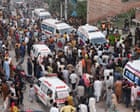
Punjab’s emergency services rushed to the scene. Uniformed rescuers struggled alongside local volunteers to clear the heavy rubble in narrow, crowded streets. They recovered the bodies of 14 children aged between five and 16. Alongside them, a 30-year-old female teacher and 20 other students suffered severe injuries. The survivors were taken to Lahore General Hospital. Some remain in critical condition.
The police have arrested the building contractor and another individual. Punjab Information Minister Azma Bokhari promised strict legal action if negligence is proven. But anyone who knows how the local administrative machinery works knows that arrests don't fix the core issue.
The multi-billion dollar shadow education industry
You have to understand why these academies exist in the first place. Pakistan's public education system is heavily underfunded. Classrooms are overcrowded, and the curriculum is often outdated. To pass standardized exams, millions of families rely on private tuition centres. This has created a massive, highly profitable shadow education industry.
Most of these centres operate in the gray market. They don't register with the government. They don't pay commercial taxes. They avoid safety checks completely.
- Residential conversions: Owners routinely turn old living rooms or basements into packed classrooms.
- Zero ventilation: Dozens of kids sit in tiny, unventilated spaces under heavy fan fixtures.
- Overloading: Landlords build extra floors on top of weak structures without adding structural pillars.
The Lahore District Education Authority confirmed that the facility involved in the Pakistan roof collapse was completely unregistered. It operated out of a private home with zero institutional oversight. This is standard practice, not an exception. Entrepreneurs rent cheap rooms in low-income neighborhoods, put up a whiteboard, and call it an academy. They profit off the desperation of parents who want their children to learn.
Why building codes don't work in Pakistan
Building codes exist on paper in Pakistan. In reality, enforcement is non-existent in low-income urban areas. The local municipal authorities rarely inspect residential properties unless someone pays a bribe or files a formal complaint.
Structural integrity is routinely sacrificed to save money. Builders use substandard cement mixed with too much sand. They use thin, recycled steel rebar instead of high-grade reinforcement bars. When a building owner decides to remodel or add a new floor, they rarely hire a qualified structural engineer. They hire cheap day-laborers and contractors who guess the weight tolerance.
The upcoming monsoon season makes this structural neglect even more dangerous. Heavy rains soak into unsealed concrete roofs. The water adds thousands of pounds of extra weight while rusting the internal steel support beams. The roof in the Lahore disaster was already in terrible shape. Adding heavy tiling work on top of a water-weakened slab during humid weather was a recipe for catastrophe.
This isn't an isolated event. Just last year, a five-storey building collapsed in the Lyari district of Karachi, killing 27 people. The root cause was exactly the same: illegal construction, terrible materials, and zero government inspections.
The empty promises of political oversight
Following the tragedy, Prime Minister Shehbaz Sharif and President Asif Ali Zardari issued standard statements of grief. They promised transparent investigations. They told officials to give the injured the best medical care. Punjab Chief Minister Maryam Nawaz ordered immediate criminal proceedings against the builders.
We have seen this cycle before. A building falls. Politicians express shock. The police arrest a low-level contractor. The media moves on. The underlying system remains untouched.
True accountability requires looking at the regulatory bodies. Who allowed an illegal school to run in a residential zone? Which local inspector turned a blind eye to the ongoing, unpermitted construction work? Until the state punishes the bureaucrats who tolerate these illegal schools, these tragedies will keep happening.
Structural danger signs every property owner must look for
If you manage a building or send your children to a local school, you can't wait for a government inspector to protect you. You need to know how to spot a structurally compromised roof yourself.
Look out for deep, diagonal cracks in walls and ceilings. Hairline cracks are normal as concrete settles, but wide cracks that run at a 45-degree angle mean the foundation or the support beams are shifting. Watch for sagging ceilings. If a plaster or concrete ceiling looks bowed or uneven, it means the internal reinforcement has failed.
Water damage is another major red flag. Persistent dampness, peeling paint, or mold on a ceiling means water is trapped inside the slab. That water is actively eating away at the steel skeleton of the building. Never allow heavy renovations, like tile laying or brick stacking, on an upper floor while people are using the rooms directly below.
Immediate steps to fix the system
Fixing this problem requires immediate, aggressive action from provincial governments. The Punjab government must take concrete steps right now.
First, the state needs to launch an immediate audit of all private tutoring centres. If an academy cannot produce a structural safety certificate from a certified engineer, the authorities must shut it down instantly. No exceptions.
Second, the government must simplify the registration process for small educational facilities. When regulation is too expensive and bureaucratic, business owners choose to hide in the shadows. Make registration free and fast, but make structural safety non-negotiable.
Third, municipal enforcement needs a complete overhaul. Local building inspectors must face criminal negligence charges whenever an illegal commercial structure collapses under their watch. Fear of jail time is the only thing that will stop inspectors from taking bribes.
Families in Lahore are burying 14 children this week. Those kids died with their notebooks open, trying to get an education. If Pakistan doesn't fix its broken building laws and crack down on illegal schools, more roofs will fall. It's that simple.
Inspect your local facilities. Demand to see building safety permits. Don't assume a building is safe just because its doors are open.