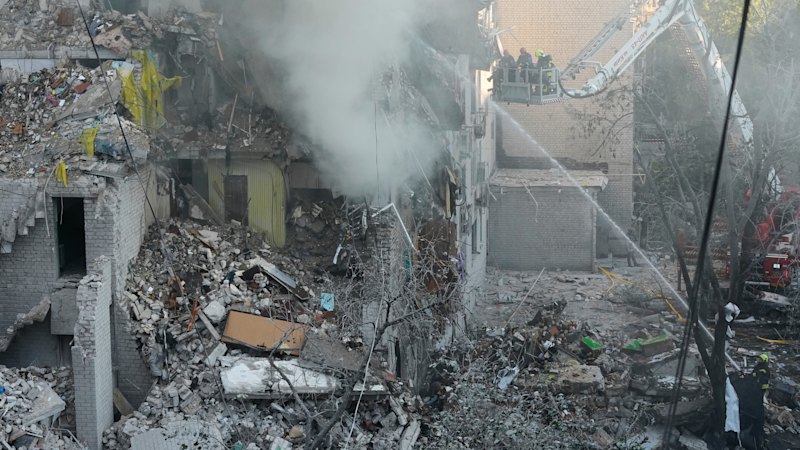
The sirens didn't just wail over Kyiv last night. They screamed for eleven hours straight. As a brutal Russian attack on Kyiv left at least 17 people dead and over 90 injured, the sheer scale of the bombardment made one thing undeniably clear. This isn't the same war we watched a year ago. The strategy has shifted, the stakes are higher, and the Kremlin is growing increasingly desperate as its own internal infrastructure begins to fracture.
If you're trying to understand why Russia just unleashed its most massive combined missile and drone assault on the Ukrainian capital to date, you have to look beyond the immediate tragedy of the burning high-rises. This wasn't a random act of terror. It was a direct, furious reaction to a highly effective, under-reported military campaign that is currently crippling Russia's domestic fuel supplies. Moscow is bleeding oil, and Kyiv is paying the price in civilian lives.
Inside the Night of Horror That Shook the Capital
The assault began under the cover of total darkness. Residents who have grown dangerously accustomed to the distant thuds of air defenses found themselves thrown from their beds as multi-story apartment buildings took direct hits. Kyiv Mayor Vitali Klitschko described the onslaught as the most massive of the war on the capital. It hit everywhere. Debris and direct strikes caused severe damage across 30 separate locations, spanning all ten districts of the city.
The sheer volume of ordnance fired into a single airspace is staggering. According to Ukrainian Air Force spokesman Yuriy Ignat, Russian forces launched 74 missiles and a staggering 496 long-range drones across the country, with the vast majority aimed squarely at Kyiv. While air defense teams managed to bring down 48 missiles and 476 drones, the defensive line was simply overwhelmed by sheer numbers. Crucially, Russia utilized 28 ballistic missiles in the Kyiv attack alone. That is a record number for a single assault on the capital. Ballistic missiles travel at extreme speeds and leave civilians with mere minutes to find safety.
The physical toll is horrific. In the Darnitskyi district, the first through sixth floors of a nine-story residential building completely collapsed. Emergency workers deployed nearly 500 personnel, 100 specialized vehicles, and a helicopter to pull survivors out from under concrete slabs. A hotel on one of Kyiv's central boulevards was heavily damaged. An ambulance station, a scientific institute, and dozens of private homes were reduced to charred ruins. Among the 90 injured, two are children, and a paramedic remains in critical condition.
The Oil Blitz Driving the Kremlin's Fury
Moscow claims these strikes targeted military facilities and energy infrastructure. That's a lie. Kyiv authorities confirmed that no critical energy infrastructure was knocked out in the capital. The targets were ordinary residential neighborhoods. So, why did Vladimir Putin order an 11-hour barrage that cost tens of millions of dollars in advanced weaponry just to smash apartment blocks?
The answer lies in Russia's failing fuel sectors. For the past 40 days, Ukraine has carried out a relentless blitz of long-range drone strikes targeting oil refineries and fuel depots deep inside Russian territory. It's a calculated strategy to force Putin to the negotiating table by hitting Russia where it hurts most: its wallet and its supply lines.
And it's working. The Ukrainian drone campaign has caused widespread fuel shortages inside Russia. Multiple Russian regions have been forced to introduce strict petrol rationing. In occupied Crimea, which serves as the primary logistical hub for the southern occupation forces, local Russian authorities have been forced to declare a state of emergency. By striking Kyiv so viciously, the Kremlin is trying to signal that the cost of hitting Russian oil refineries will be the complete destruction of Ukraine's capital.
Moving Past the Retaliation Myth
Ukrainian Foreign Minister Andrii Sybiha didn't mince words when addressing the international community from Japan. He stated flatly that it is completely immoral to frame these Russian strikes as "retaliation." Ukraine is exercising its legal right to self-defense under Article 51 of the UN Charter. Russia is the invading aggressor.
Framing this as a game of tit-for-tat ignores the core reality of strategic bombing. Putin relies on the assumption that Western support will eventually dry up, and that the Ukrainian population will collapse under the psychological weight of constant terror. This latest attack was designed to break civilian morale and show that nowhere is safe, even a city protected by advanced Western air defense systems like Patriot batteries.
The ripples of the attack are already felt across Europe. Poland scrambled fighter jets to protect its airspace as missiles flew close to its border. Finland implemented temporary aviation restrictions over the eastern Gulf of Finland. The war is creeping closer to NATO's edges, and the current defensive assistance is no longer enough to keep a lid on the crisis.
What Needs to Happen Next
Condemnation won't stop ballistic missiles. If Western allies want to prevent Kyiv from being systematically leveled, the strategy must change immediately.
First, the restriction on using Western-supplied long-range weapons to strike military airfields inside Russia must be lifted entirely. Stopping a missile requires destroying the bomber or the launcher on the ground before it ever fires.
Second, the delivery of air defense interceptors must be accelerated. Kyiv used an immense amount of defensive ammunition to stop hundreds of drones and missiles last night. If those stockpiles aren't replenished within days, the next wave of strikes will cause exponentially more casualties.
Kyiv has declared July 3 a city-wide day of mourning. The rubble is still smoking, and rescue teams are still digging. The capital isn't backing down, and the drone strikes on Russian oil infrastructure won't stop. Expect the coming weeks to be some of the bloodiest of the conflict.