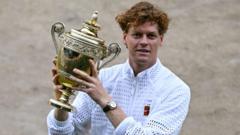
Everyone thought Jannik Sinner was broken. Just a few weeks before stepping onto the pristine lawns of SW19, the Italian suffered what looked like a career-altering mental collapse at the French Open. Leading by two sets and a massive 5-1 in the third against Juan Manuel Cerúndolo, he completely disintegrated. He lost. The tennis world shook its head, assuming the world number one had let his demons win. Critics said his mental toughness was a myth.
They were dead wrong. Sinner didn't just bounce back at Wimbledon. He dominated the entire fortnight, culminating in a spectacular 6-7 (7), 7-6 (2), 6-3, 6-4 victory over a red-hot Alexander Zverev to retain his crown. By doing so, he captured his fifth grand slam singles title and reminded everyone exactly why he sits at the apex of men's tennis.
It takes a rare breed of athlete to take a humiliating defeat and turn it into fuel within days. Honestly, most players would still be sulking or overthinking their technique in their Monaco training camps. Sinner just put his head down, ground out long days on the practice courts, and adjusted his tactical blueprint. Let's unpack the reality of how this modern giant conquered his recent demons to become an unstoppable force on grass.
The Mental Shift From Paris Disaster to London Glory
You can't understand Sinner's Wimbledon triumph without looking at the scar left by his French Open exit. Losing from two sets and 5-1 up isn't just a regular loss. It's the kind of trauma that can linger for months or even years. The pressure on the Italian was immense when he arrived in London. The public expected another collapse.
Sinner took a completely different approach. Instead of hiding from the failure, he openly admitted it hurt, then he let it go. He spent brutal, grueling hours in Monaco working with his team on specific grass-court movements. He sacrificed his free time entirely. He knew his lateral movement on clay had betrayed his stamina, so he adjusted his posture for the low-bouncing, slick grass courts.
When you watch him play, it's clear he treats tennis as a series of isolated events. He mentioned after the final that a grand slam is just a collection of a few specific days out of a long year. If you lose, it's still just one day. That perspective took the crushing weight off his shoulders. It allowed him to play with absolute freedom when the stakes were highest.
Dismantling Alexander Zverev in a War of Serves
The final against Alexander Zverev was expected to be a brutal baseline slugfest, but it quickly transformed into an old-school exhibition of raw serving power. Zverev arrived with immense confidence after winning the French Open. He wanted to prove he wasn't just the third wheel of the tour. The German was landing 76% of his first serves, hammering them at an average of 132mph. His second serve was frequently crossing the 114mph mark. On paper, that's unplayable.
Sinner simply refused to blink.
Throughout the entire three hours and 46 minutes of high-octane tennis, the Italian didn't drop his serve a single time. He faced just one break point the whole match. Think about that for a second. Facing one of the most aggressive returners and biggest servers on the planet, Sinner held his nerve on every single service game.
The turning point came in the second set tie-break. Zverev had snatched the first set after an incredibly tight battle and started the second with a couple of loose forehand errors on his own serve. A younger Sinner might have let those opportunities slide, but the 2026 version of the world number one is a ruthless predator. He pounced on those errors, swept the tie-break 7-2, and completely broke Zverev's spirit.
From that point on, Sinner's variety shone through. He started mixing up his baseline power with delicate drop shots, perfectly disguised lobs, and scrambles that forced Zverev into making crucial mistakes. The first actual break of serve didn't happen until two hours and 54 minutes into the match, when Zverev double-faulted at 3-4 in the third set and sprayed consecutive forehands wide under Sinner's relentless deep returning pressure. Once Sinner got his nose ahead, the match was essentially over.
The Flawless Run Through the Wimbledon Draw
Sinner's path to the trophy wasn't a fluke. It was a methodical demolition of everyone put in front of him. In the opening round, Miomir Kecmanović managed to push him to five sets in a weirdly erratic match where Sinner fired 31 aces to survive 4-6, 6-3, 6-6, 6-2, 6-3. That early scare woke the top seed up.
After that opening hiccup, Sinner looked completely unbeatable. He rolled through Nuno Borges in the second round with consecutive tie-break wins before taking the third set easily. Then came Jenson Brooksby in the third round, who was brushed aside in straight sets 6-4, 6-3, 6-4. In the round of 16, Japan's Shintaro Mochizuki tried to change the rhythm, but Sinner's serve was too precise, resulting in another straight-sets win.
The quarter-final against Jan-Lennard Struff was a masterclass in handling traditional grass-court power. Struff threw everything at him, blasting 12 aces, but Sinner responded with 16 of his own and won 7-5, 7-7, 6-3.
Then came the semi-final against Novak Djokovic. Many fans expected a monumental five-set war between the veteran king and the young heir. Instead, Sinner put on a clinic. He broke the Serbian master repeatedly, winning 6-4, 6-4, 6-4 without even facing serious trouble. He won 88% of his first-serve points and didn't offer Djokovic a single break point. It was an ominous warning to Zverev before the final.
Entering the Elite Club of True Tennis Legends
Retaining a Wimbledon title is one of the hardest achievements in all of modern sports. The grass changes daily, the bounces become unpredictable, and the pressure builds with every round. By defending his title, Sinner became only the 10th man in the Open Era to achieve back-to-back Wimbledon victories.
The list of players who have done this before him is legendary. We are talking about Rod Laver, John Newcombe, Björn Borg, John McEnroe, Boris Becker, Pete Sampras, Roger Federer, Novak Djokovic, and Carlos Alcaraz. That's it. That is the entire list. Sinner is now firmly entrenched in that pantheon of greats.
What makes this terrifying for the rest of the ATP tour is his age. Sinner is still only 24 years old. He already possesses five grand slam titles. With Djokovic turning 40 next year and Alcaraz currently managing a persistent wrist injury, Sinner has a massive golden opportunity to dominate the sport for the next five years. His game has evolved from a one-dimensional baseline power strategy into a highly complex, multi-layered tactical system perfectly suited for fast grass.
The Blueprint for Grass Court Success
If you want to emulate Sinner's success on fast grass surfaces, you need to focus on three distinct areas that he completely overhauled in his game over the past two seasons.
First, fix the mechanics of your serve. Sinner used to have a rhythmic hitch that exposed him to big returners. He flattened out his ball toss, shortened his backswing, and focused on spot-serving rather than pure pace. Even when trailing 15-30 in crucial games against Zverev, he could rely on three consecutive unreturnable service winners to bail himself out.
Second, master the art of sliding on grass. Traditional tennis players hate sliding on turf because they fear slipping or injuring their ankles. Sinner uses his background as a teenage ski champion to perfectly balance his weight, allowing him to slide into defensive forehands and recover his position in the center of the court faster than anyone else alive.
Third, embrace tactical variety. You cannot win on modern grass by just hitting hard from the baseline. Sinner hit beautiful drop shots and lobs to draw Zverev forward, exposing the German's weaker volleys.
The next time you face a devastating setback in your own competitive endeavors, remember Sinner's June meltdown in Paris. He didn't reinvent the wheel. He went back to Monaco, put in the grueling physical hours, adjusted his technical footwork, and trusted his process. Go look at your own recent failures, pick out the exact technical flaw that caused the collapse, and spend the next two weeks drilling that specific weakness until it becomes your greatest weapon. That's how champions are made.