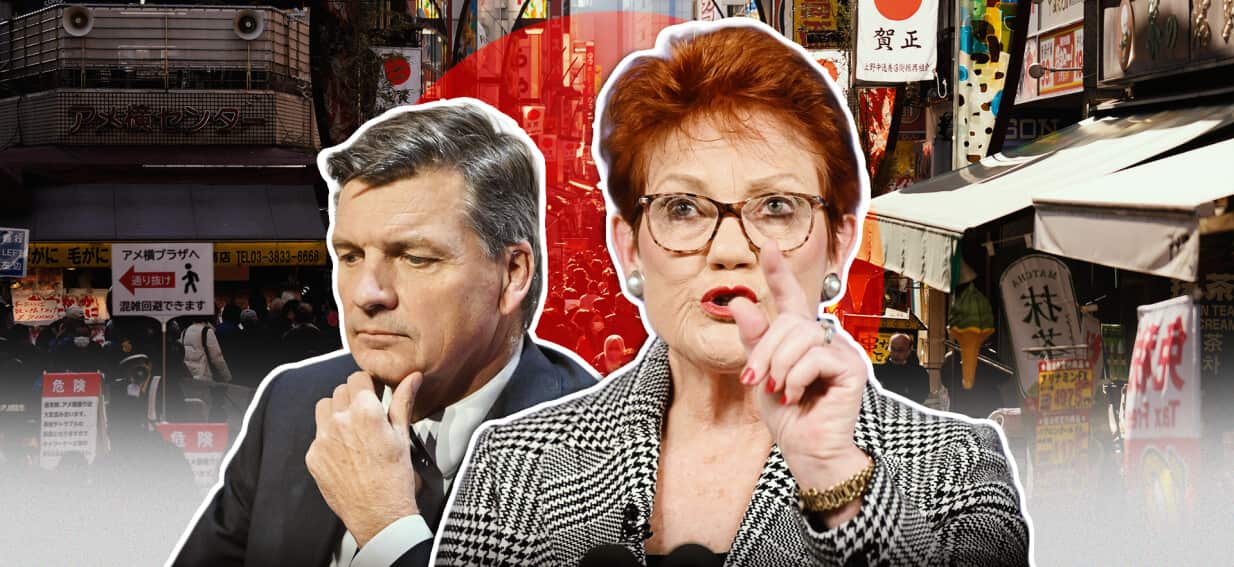
Politicians love looking overseas to find a perfect template for their home-grown ideas. When One Nation leader Pauline Hanson took the stage at the National Press Club recently, she didn't just target multiculturalism. She pointed a finger at Tokyo and asked why Australia can't simply replicate Japan. To her, Japan represents a monoculture that works, an idealized society operating under one neat cultural umbrella.
It is a comforting fantasy for anyone panicked by surging immigration, housing shortages, and the rapid pace of social change. But it relies on an understanding of Japan that is decades out of date. For another perspective, consider: this related article.
The idea that Japan is a completely closed, homogeneous paradise is a myth. Using it as a weapon against Australian diversity ignores the massive demographic shift happening right now across the Japanese archipelago. If you look closely at the numbers, Japan isn't a blueprint for keeping a society closed. It is a cautionary tale of what happens when you try to delay the inevitable.
The Reality of Japan's Exploding Foreign Workforce
Step into a convenience store in central Tokyo, a manufacturing plant in Aichi, or a farm in rural Hokkaido. You won't just see Japanese workers anymore. You will meet young people from Hanoi, Manila, and Kathmandu. Similar insight regarding this has been provided by USA Today.
The data paints a clear picture. By the end of 2025, the number of foreign residents living in Japan smashed through the four million mark for the first time in history. According to official data from the Health, Labor and Welfare Ministry, the country's foreign workforce reached an all-time high of 2,571,037 people. That number has been climbing for thirteen consecutive years. It has nearly tripled over the last decade.
This is not a society maintaining a monoculture. This is an economy actively trying to survive an acute labor shortage. Japan's native population is shrinking and aging at a terrifying rate. The country's birth rate hovers around 6.9 births per 1,000 people, while its death rate sits much higher at 11.9. Think tanks like the Recruit Works Institute predict that Japan will face a shortage of eleven million workers by 2040.
To keep the lights on, the Japanese government has been quietly rewriting its immigration laws. They introduced the Specified Skills Visa to fast-track blue-collar workers. They are expanding permanent residency pathways. Vietnamese workers make up the largest chunk of this workforce at over 610,000 people, followed closely by hundreds of thousands of citizens from China and the Philippines.
When populists tell you that Japan is a pristine monoculture, they are ignoring these four million people who are keeping the Japanese economy from collapsing.
The Myth of the Flat Society
Even if you look past the modern influx of migrant workers, the idea that Japan historically possessed a single, unified culture is historically flawed. Anthropologists and historians have spent years dismantling this exact notion.
Japan has always had internal diversity. The Ainu people of Hokkaido and the Ryukyuan people of Okinawa possess their own distinct languages, spiritual traditions, and cultural practices. For centuries, these groups were subjected to forced assimilation policies by the central government in Tokyo, an effort to manufacture the very image of homogeneity that foreign observers praise today.
You also have the Zainichi Korean community, hundreds of thousands of ethnic Koreans whose ancestors came to Japan during the colonial era. For generations, they lived in a legal limbo, preserving their distinct identities despite intense systemic pressure to blend in completely.
When a politician says a country is monocultural, they usually mean that the state has successfully suppressed minority identities under a dominant national identity. That isn't a natural harmony. It is the result of deliberate political enforcement.
Why Australia's History Makes a Monoculture Impossible
Trying to overlay a Japanese cultural model onto Australia is a fundamental category error. The two nations sprouted from entirely different historical soil.
Australia has never been a monoculture. Before the arrival of the First Fleet in 1788, the continent was home to hundreds of distinct Indigenous nations, each with its own language, law, and social system. The British settlement didn't create a singular culture either. The early European population was deeply fractured along class, regional, and religious lines, particularly between English Protestants and Irish Catholics.
The post-Second World War era changed the game entirely. The "Populate or Perish" policy brought millions of migrants from Italy, Greece, Malta, and later from across Asia and the Middle East. Over half of all Australians today were either born overseas or have at least one parent who was.
You can't undo eighty years of deep structural demographic history with a speech. Our neighborhoods, our food, our major corporations, and our family trees are built on global connections. Demanding that Australia become a monoculture is a call for an idealized past that never existed.
The Real Problem Behind the Resurgence of Populism
We need to look at why these arguments are gaining traction right now. One Nation is climbing in recent Roy Morgan polls, and support for multiculturalism dipped about ten percent since its peak in 2020.
People aren't necessarily turning against their neighbors because of racial purity arguments. They are stressed about their bank accounts. Australia's net overseas migration sat at 301,000 people for the twelve months leading into December 2025. While that is a big drop from the post-pandemic peak of 556,000, it still puts massive pressure on a housing market that hasn't built enough homes for years.
When you couple high migration numbers with rapid inflation, surging interest rates, and soaring rents, people look for someone to blame. Populists provide an easy target. They connect the genuine misery of the housing crisis to a loss of national identity.
Prime Minister Anthony Albanese attempted to counter this narrative by pointing to the Socceroos. He noted that the national football squad features players from fifteen different cultural backgrounds, including players born in African refugee camps. He argued that our diversity is an economic and social strength.
But symbolic wins on a football pitch don't pay the rent. If mainstream political parties want to defeat monocultural arguments, they have to fix the material infrastructure. They need to build houses, lower the cost of living, and manage immigration intakes so that local infrastructure can actually keep pace. If the system feels broken, people will buy into the illusion of a simpler, closed-off world.
The Practical Limitations of the One Cultural Umbrella
In her defensive media appearances following the National Press Club address, Hanson argued that a monoculture doesn't mean forcing people to abandon their heritage. She claimed it is about living under "one cultural umbrella" with one set of laws and values. She famously declared that you can keep your Greek salad and your Indian curry, as long as "Vegemite is the glue that holds it all together."
It sounds folksy, but it breaks down under the slightest scrutiny. Who gets to decide what goes under the umbrella?
Culture isn't a static list of foods and flags. It is how we view family, how we manage work-life balance, how we worship, and how we communicate. Even within an Anglo-Celtic framework, there is no single culture. A corporate lawyer living in Sydney's eastern suburbs has a completely different cultural reality than a FIFO miner in Western Australia or a retired farmer in regional Queensland. They value different things, speak differently, and hold different political beliefs.
When we try to define a single national culture, we end up with a cartoon version of reality. True national unity doesn't come from forcing everyone into an artificial cultural mold. It comes from a shared commitment to democratic institutions, the rule of law, and a fair go for everyone under that legal framework.
Next Steps for Thinking About Immigration and Identity
If you want to look at this debate rationally instead of emotionally, you need to separate infrastructure planning from cultural panic. Here is how we can think about moving forward without falling into the monoculture trap.
- Look at the economic data instead of the rhetoric. Economists and the Reserve Bank of Australia routinely show that controlled immigration has driven our long-term economic prosperity, filling crucial skills shortages in healthcare, engineering, and construction.
- Track Japan's ongoing policy shifts. Watch how Tokyo manages its four million foreign residents over the next few years. You will see that even the most traditionally closed societies are being forced to adapt to a globalized world to avoid economic stagnation.
- Focus on regional infrastructure. Support policies that direct migration and infrastructure spending into regional hubs rather than cramming everyone into Sydney and Melbourne. This relieves pressure on capital city housing markets while revitalizing aging country towns.
- Demand transparency on housing builds. Hold state and federal governments accountable for housing supply targets. High immigration is only a crisis if governments fail to build the apartments, transport links, and schools needed to accommodate growth.
The debate about how many people Australia should welcome is totally legitimate. We should have a fierce, open conversation about migration caps, infrastructure capacity, and economic planning. But let's leave the historical fantasies out of it. Japan isn't a shield to protect us from the modern world. It is a country facing the exact same global realities we are, just from a different starting line.