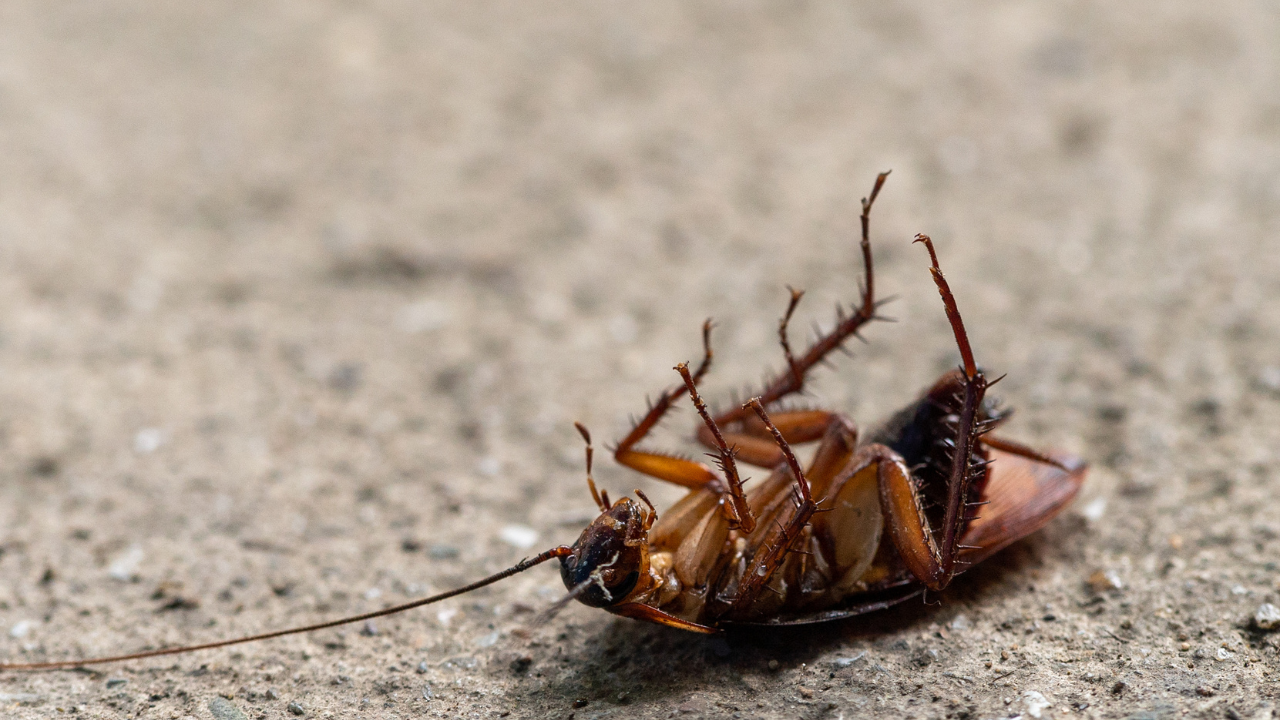
You have probably heard the rumor. It sounds like a trashy urban legend designed to make you squirm before you sleep. You smash a cockroach, or maybe you manage to clip its head off, and someone tells you it is still alive.
Honestly, it is not a myth. It is factual.
A cockroach can lose its head and spend the next seven to nine days casually wandering around your baseboards. It does not panic. It does not go into shock. It simply carries on with its day until a very basic biological limitation catches up with it.
If you are dealing with an infestation, this is terrifying news. If you are a biologist, it is a masterclass in survival engineering.
To understand why these critters are virtually unkillable, you have to look at how completely different they are from us. We look at them and see a pest. Nature looks at them and sees a design that has worked flawlessly for hundreds of millions of years.
The Messy Reality of Human Vulnerability
Humans are fragile. If a person loses their head, death is instantaneous.
Our survival relies on an incredibly high-pressure circulatory system. Your heart has to pump blood through miles of tiny, restrictive capillaries. This requires massive arterial pressure.
When a mammal is decapitated, that pressure drops to zero immediately. You bleed out in seconds. Oxygen stops reaching the brain, cells die, and everything shuts down.
On top of that, humans are completely dependent on the brain to breathe. Your brain stem monitors carbon dioxide levels and forces your lungs to expand and contract. No head means no breathing, period.
Cockroaches operate on a completely different blueprint. They do not care about blood pressure, and they definitely do not care about lungs.
No Blood Pressure Means No Bleeding Out
When you cut off a cockroach's head, it does not bleed out.
Insects have what is called an open circulatory system. They do not have a vast, tight network of blood vessels or high-pressure capillaries. Instead, they have a single long tube running along their back that acts as a basic heart. This tube sloshes a fluid called hemolymph directly into the body cavity.
The fluid just bathes the organs directly. Because there is no intense pressure pushing this fluid around, losing a limb or even a head does not cause a catastrophic hemorrhage.
Physiologist Joseph G. Kunkel from the University of Massachusetts Amherst spent years studying this exact phenomenon. He noted that when a cockroach is decapitated, the wound at the neck seals off through basic clotting within a few minutes.
The neck simply closes up. The internal pressure stays stable. The remaining body just keeps right on ticking as if nothing major just happened.
Breathing Through Their Sides
If you cannot bleed to death, your next immediate threat should be suffocation. Except roaches figured out a way around that too.
Cockroaches do not use their mouths or noses to breathe. They do not even have lungs.
If you look closely at the side of a roach's body, you will find tiny, microscopic openings along each segment of its thorax and abdomen. These holes are called spiracles.
The spiracles connect directly to a massive, branching network of internal pipes called the tracheal system. This network delivers oxygen from the outside air directly to every single cell and tissue in the insect's body.
The roach brain has zero involvement in this process.
Air enters through passive diffusion. The insect can also use its body muscles to rhythmically pump the abdomen, forcing air through the pipes without needing a single command from a centralized brain.
A headless roach sits in a corner and respires perfectly well. It gets all the oxygen it needs to keep its muscles fueled and its reflexes sharp.
A Decentralized Brain Network
You might wonder how a headless body knows how to move. If you poke a headless cockroach, it will run away. If you flip it onto its back, it will frantically wave its legs to right itself.
This happens because the cockroach nervous system is decentralized.
Instead of one massive brain in the head ruling over everything, the roach has a chain of nerve tissue clusters distributed all the way down its body. These clusters are called ganglia.
Each major segment of the cockroach has its own pair of ganglia, which essentially act as independent mini-brains.
The ganglia in the thorax take care of the legs. They control walking, running, standing, and fundamental reflex loops.
The head brain is mostly there to handle sensory data from the eyes and antennae, and to coordinate feeding behaviors.
When you remove the head, you take away its ability to see, smell, or taste. But you do not take away its ability to move. The mini-brains in the chest and abdomen are perfectly capable of executing complex escape behaviors all on their own. They do not need permission from the head to survive.
What Kills the Headless Roach
If they can breathe, circulate fluid, and move around, why do they eventually die after a week?
The answer is incredibly mundane. They die of thirst.
A cockroach is a cold-blooded creature, meaning its metabolic rate is exceptionally low compared to ours. They do not waste energy generating their own body heat. Because of this slow metabolism, a healthy roach can survive for up to a month on a single meal it ate weeks ago.
Water is a completely different story.
Without a mouth, the headless cockroach has absolutely no way to drink. Under average household conditions, dehydration will claim the insect's life in about seven to nine days. If you put a headless cockroach in a highly humid environment or a chilled lab setting, it can sometimes stretch its survival closer to two weeks simply because its body loses moisture at a slower rate.
It never dies from the trauma of the wound. It dies because it gets thirsty.
The Severed Head Lives Too
Here is a detail that most people find truly grotesque. The body is not the only part that survives the separation.
The severed head can keep living for several hours on its own. If you look at a detached cockroach head under a magnifying glass, you will see the antennae twitching and waving around. It is still trying to sense its environment, processing olfactory and tactile inputs from a body it no longer possesses.
In research settings, scientists have actually managed to keep these isolated heads alive for days. By keeping the head in a cooled environment and feeding it a steady supply of sugar water through a tiny capillary tube, the brain tissue remains functional and responsive.
This level of resilience makes cockroaches highly valued in scientific research. Entomologists use decapitation as a tool to study insect endocrinology.
The glands inside a cockroach's head produce critical hormones that regulate maturity, molting, and reproduction. By removing the head, researchers can completely isolate the body from these specific head glands. This allows them to see exactly how the rest of the body develops without hormonal interference from the brain, giving us a clearer understanding of how pest development works.
Why This Matters for Pest Control
This biological nightmare explains exactly why amateur pest control efforts fail so spectacularly.
Many people think stepping on a roach or hitting it with a broom is enough. If you do not completely crush the thorax and abdomen, you have not actually killed it. You might just break off its head or damage its mouthparts, leaving a highly mobile, living pest that will crawl back into your walls to hide.
Once hidden away in a wall void or behind an appliance, that headless roach can still deposit eggs if it was a pregnant female close to her cycle. The nervous system can still trigger the release of an egg case even under immense physical duress.
Mechanical destruction is highly inefficient unless it is absolute.
To actually eliminate an infestation, you have to target their systemic vulnerabilities, not just try to decapitate them one by one with a shoe.
Your Actionable Next Steps
Stop relying on physical swatting to handle a roach problem. Use their biology against them instead.
- Cut off the water source: Since dehydration is their ultimate weakness, fix every leaking pipe under your sink immediately. Wipe down your sinks before bed. A roach cannot survive long without access to standing water.
- Use slow-acting gel baits: Roaches are communal and will eat their dead. Gel baits introduce a slow poison that they carry back to their hiding spots, ensuring the chemical destroys the entire colony from the inside out.
- Apply Insect Growth Regulators (IGRs): These chemicals mimic the very hormones scientists study in headless roaches. IGRs disrupt their molting cycles, preventing young roaches from ever reaching reproductive age, effectively sterilizing the population.
Forget about trying to break their necks. Clean up the moisture, bait the dark corners, and let their own physiology do the heavy lifting.