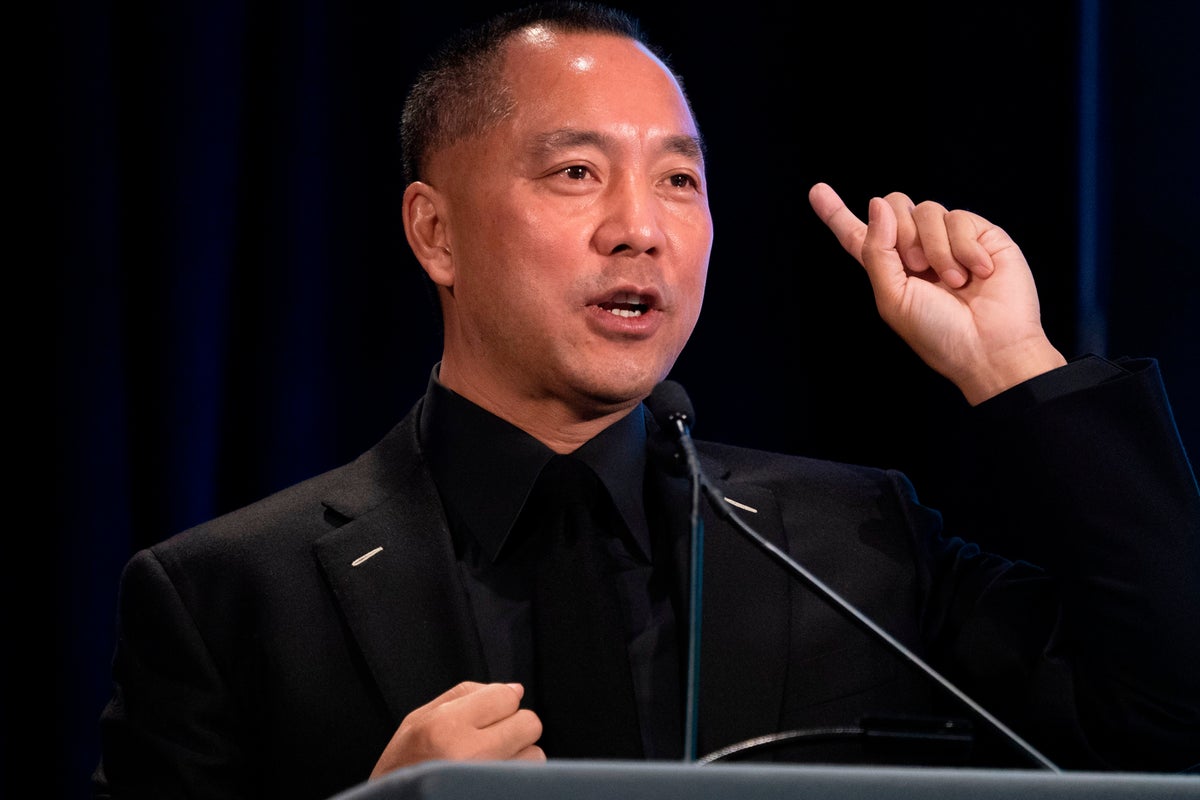
A federal judge in Manhattan just handed down a massive 30-year prison sentence to Guo Wengui, the self-exiled Chinese property tycoon who morphed into an online anti-communist folk hero. For years, Guo convinced thousands of diaspora followers that he was the ultimate weapon against the Chinese Communist Party. Instead, federal prosecutors proved he was just running a massive, billion-dollar financial scam to fund a life of obscene luxury.
If you are trying to understand how a regular real estate developer escaped China, allied himself with Donald Trump's inner circle, and managed to swipe hundreds of millions from everyday people, you need to look past the political theater. This case isn't really about international espionage or high-level dissidents. It's about a classic financial scam dressed up in internet-era populism.
On Monday, June 29, 2026, U.S. District Judge Analisa Torres stripped away Guo's political shield. She ordered him to forfeit $889 million in restitution, stating plainly that he preyed on people who genuinely wanted democracy for China. Guo used their political hopes to buy mansions, custom sports cars, and a luxury yacht. He didn't build a resistance network. He built a personal kingdom on the backs of his followers' life savings.
From Beijing Real Estate to Manhattan Penthouses
To understand the scale of this deception, you have to look at where Guo started. He wasn't always an internet personality. In China, he operated under the name Miles Guo or Ho Wan Kwok, building a fortune in the cutthroat Beijing real estate market. He gained immense power by playing the system, securing prime land deals, and working closely with intelligence officials.
When his political patrons in Beijing fell from grace during a massive anti-corruption sweep in 2014, Guo didn't stay to face the music. He fled. By 2017, he landed in a $67 million apartment overlooking Central Park in New York.
Most exiled billionaires keep a low profile. Guo did the exact opposite. He turned himself into a brand. He started broadcasting live video streams, claiming he held explosive, unverified secrets about the inner workings of top Chinese leaders. For a diaspora community starved for aggressive opposition to Beijing, Guo looked like the real deal. He was loud, wealthy, and seemingly untouchable.
The Political Alliance With Steve Bannon
Guo understood that to stay safe in America, he needed serious political muscle. He found his perfect match in Steve Bannon, the former chief strategist for Donald Trump. The two formed an immediate partnership, appearing constantly in online videos to rail against the Chinese state.
By 2020, Guo and Bannon announced the creation of the "New Federal State of China," a shadow government supposedly dedicated to overthrowing the regime in Beijing. This wasn't just political posturing. It was a marketing machine. The alliance gave Guo instant credibility with right-wing American populists and anti-CCP activists worldwide.
The relationship became so intertwined that when federal agents arrested Bannon on separate, unrelated fraud charges in August 2020, they literally pulled him off Guo’s 152-foot luxury yacht, the Lady May, which was anchored off the coast of Connecticut.
The Mechanics of a Billion Dollar Scam
Once Guo built his massive base of loyal online followers, he started monetization. He didn't ask for small donations. He pitched complex, exclusive investment opportunities. He told his followers they were investing in the future of a free China. In reality, they were funding a massive personal piggy bank.
According to the evidence presented during his seven-week federal trial, Guo used a network of interconnected entities to siphon cash. He raised funds through GTV Media Group Inc., a conservative-leaning video platform. He pushed the Himalaya Farm Alliance, a network of regional fan groups. He even launched his own digital currency ecosystem called the Himalaya Exchange.
Thousands of ordinary people poured their money into these ventures. Prosecutors revealed that between 2018 and 2023, Guo managed to bring in over $1 billion from his followers.
What did he do with that cash? He didn't fund democracy initiatives. He went on a shopping spree. The government proved that the stolen money bought a 50,000-square-foot mansion in New Jersey, a $3.5 million Ferrari, a couple of $36,000 mattresses, and a custom luxury yacht.
The Human Cost in the Courtroom
During the sentencing, Judge Torres read aloud from letters submitted by Guo’s victims. These weren't institutional investors or wealthy venture capitalists. They were ordinary citizens, many of them Chinese immigrants who trusted Guo because he spoke their language and echoed their anger toward Beijing.
Victims described losing everything. Families fractured over the investments. Some people experienced severe anxiety and shame as their life savings disappeared into Guo's luxury purchases. One victim, Wei Chen, testified directly in court that Guo’s actions destroyed her life and devastated her family financially and emotionally.
Despite the overwhelming evidence, Guo refused to show remorse. In a chaotic courtroom scene, he tried to delay the proceedings by claiming he was too sick to attend, forcing a five-hour delay while doctors evaluated him. When he finally spoke through an interpreter, he focused on his physical discomfort, claiming he had been vomiting, and briefly asserted that his only goal in America was to destroy the Chinese Communist Party.
The Psychology of the Cult of Personality
How did so many people fall for this? The answer lies in how Guo blended politics with modern influencer culture. He didn't act like a traditional corporate fraudster. He ran his operation like an online cult.
He convinced his followers that any criticism of him was a coordinated attack by Chinese intelligence operatives. If an independent journalist questioned his finances, Guo told his fans that the writer was a spy. Judge Torres noted that Guo actively encouraged his base to harass, dox, and intimidate anyone who dared to speak out against his schemes.
Even on the day of his sentencing, more than a hundred die-hard supporters lined up outside the Manhattan courthouse as early as 5:00 AM. Many wore custom apparel branded with the New Federal State of China logo. They genuinely believed the entire American justice system had been infiltrated and weaponized by Beijing to silence their leader. That is the power of a modern disinformation echo chamber.
The Broader Impact on Chinese Dissidents
The tragic fallout of the Guo saga extends far beyond the financial wreckage. His conviction deals a massive blow to legitimate Chinese dissident movements in the West.
For decades, real activists have worked tirelessly to expose human rights abuses and advocate for political reform in China. They do this under constant threat of surveillance and transnational repression. Now, because of Guo’s high-profile greed, the entire movement faces a credibility crisis.
Guo's defense attorneys tried to argue that a long prison sentence would chill dissident activity and validate Beijing's global efforts to discredit its critics. They noted that Guo had scars from physical torture he endured in China decades ago. But prosecutors countered that his history didn't give him a license to rob ordinary people under the guise of philanthropy.
A Wild Ending in a Federal Jail
Guo’s bizarre attempt to maintain his high-society connections didn't stop when he went behind bars. While awaiting his sentence at the Metropolitan Detention Center in Brooklyn, he ended up housed near music mogul Sean Combs.
In a bizarre twist, Guo actually filed a letter to the judge intervening in Combs' case, suggesting that the two men had spent their time behind bars discussing the creation of a brand-new AI platform together once they were released. It was a classic Guo move. Even in a jumpsuit, he was still pitching the next big thing.
The 30-year sentence essentially guarantees that Guo, who is currently in his fifties, will spend the remainder of his active life behind federal bars. His chief of staff, Yvette Wang, already received a 10-year sentence last year for her role in coordinating the fraud.
Protect Your Finances From Political Scams
The conviction of Guo Wengui serves as a warning for anyone navigating online political spaces. Scammers know that emotion drives financial decisions. When you combine intense political anger with promises of exclusive wealth, people drop their guard.
If you want to avoid falling victim to ideological financial schemes, you need to implement strict boundaries between your political beliefs and your investment portfolio.
First, treat any investment opportunity tied to a political cause with extreme skepticism. If a prominent activist or influencer starts pitching a proprietary cryptocurrency, an unlisted media company, or a private investment club, walk away. Legitimate political advocacy relies on transparent donations, not complex financial products that promise high returns.
Second, verify regulatory filings independently. Guo managed to keep his schemes running because his followers relied entirely on his internal apps and closed social media ecosystems. Always check if a financial asset is registered with the Securities and Exchange Commission or relevant financial authorities. If the numbers only exist inside a proprietary platform, the money probably isn't real.
Finally, remember that true advocacy rarely requires you to hand over your life savings to a single billionaire. True movements are built on collective action and community organization, not the enrichment of an individual living in a Central Park penthouse. Keep your eyes on the data, ignore the online theater, and protect your capital from creators who weaponize your values for personal gain.