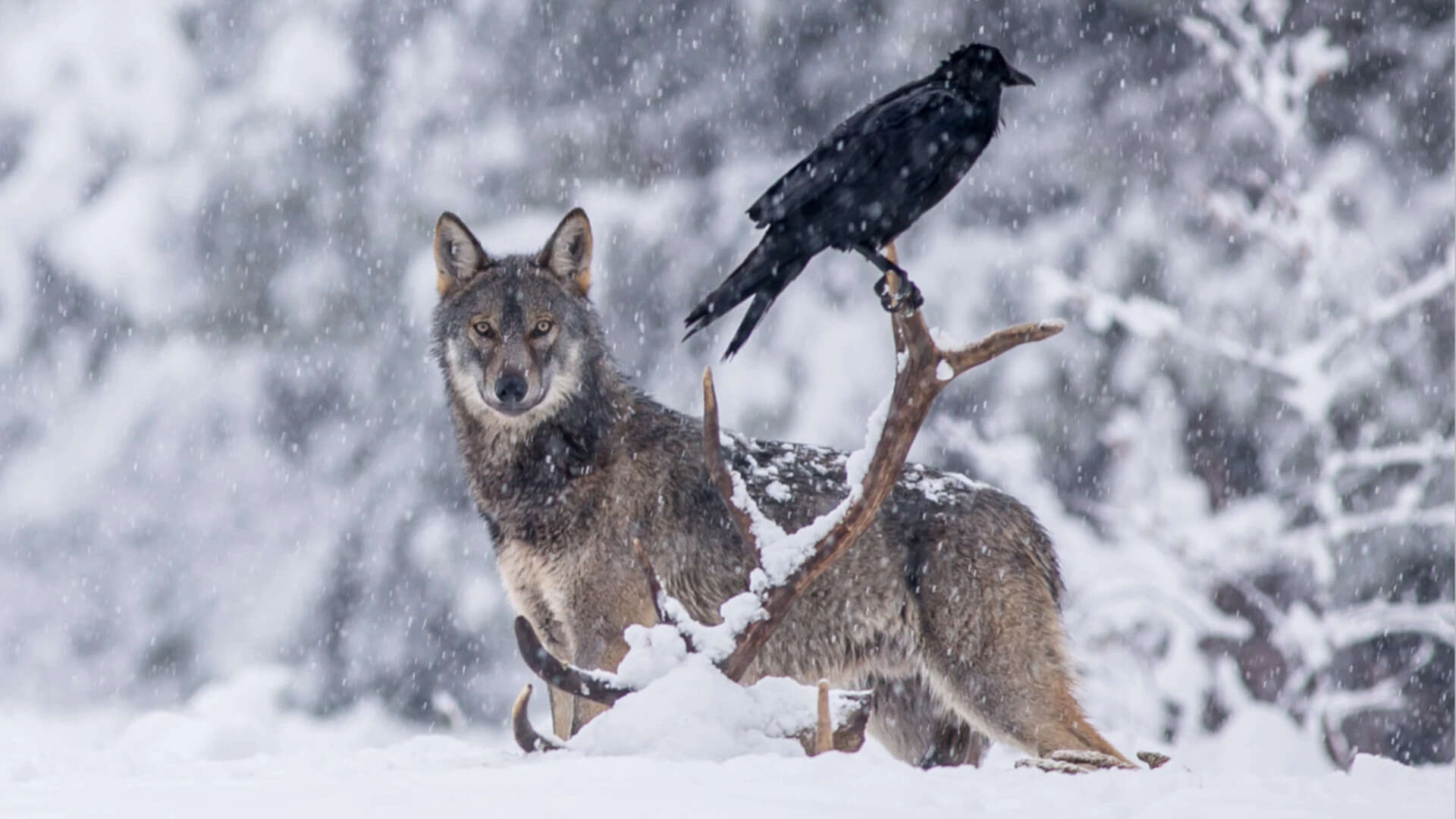
For decades, wildlife biology had a favorite story. It's a tale told in textbooks, nature documentaries, and around campfires. The story says that ravens are the ultimate freeloaders of the animal kingdom, acting as literal shadows to wolf packs. Walk into any northern forest, and people will tell you that ravens fly above wolves, waiting for them to hunt so they can swoop in for the leftovers.
It makes perfect sense on paper. Wolves are apex predators. Ravens are highly intelligent scavengers.
But a massive, two-and-a-half-year GPS tracking study just proved this entire belief is wrong.
Ravens don't actually follow wolves. They don't trail them through the woods like feathered spies. The real relationship between these two species is much more complex, far more chaotic, and shows that ravens are way more independent than we ever gave them credit for.
Let's look at what scientists actually found when they strapped GPS collars to both animals at the same time.
The Myth of the Aerial Shadow
If you've watched a nature show in the last thirty years, you've probably heard the term wolf-bird. This nickname implies a tight, codependent bond. The assumption was that ravens spend their days scanning the ground for moving fur, tracking the pack's movements in real time to secure their next meal.
Wildlife researchers decided to finally test this theory using modern satellite telemetry. They captured both wolves and ravens in the same ecosystem, fitting them with high-precision GPS transmitters. For thirty months, these devices pinged location data at regular intervals.
The goal was simple. If the old theory held up, the data points for the ravens would mirror the data points for the wolves. They would move when the wolves moved. They would rest when the wolves rested.
The actual data charts looked completely different.
Instead of moving in tandem, the paths of the ravens and wolves rarely overlapped during daily travel. The birds weren't following the packs at all. For the vast majority of the day, ravens were busy doing their own thing, flying miles away from the wolves in entirely different directions.
This blows a hole in the classic ecological narrative. Ravens aren't passive sidekicks. They're highly active, independent foragers running their own operations.
How Ravens Actually Find Food
If the birds aren't following the predators, how do hundreds of them miraculously appear at a fresh kill site within minutes?
The answer comes down to incredible spatial memory and raw acoustic awareness.
Ravens possess massive brains relative to their body size. They don't need to babysit a wolf pack all morning to find dinner. Instead, they monitor the environment using a highly sophisticated mental map of their territory. They know the terrain. They know where prey animals tend to gather, and they know the specific areas where wolves are most successful at hunting.
They also listen.
The forest isn't quiet when a hunt happens. Wolves howl, elk cry out, and bones snap. Ravens have exceptional hearing and can pinpoint these sounds from miles away. When one raven spots or hears a kill, its behavior changes. It flies directly toward the food.
Other ravens notice this sudden change in flight path. They watch each other constantly. If Raven A suddenly stops circling and flies in a straight, purposeful line toward a specific valley, Raven B, C, and D notice immediately. They follow the bird, not the wolf. It's a chain reaction of visual cues that creates the illusion of a coordinated arrival.
The Problem With assuming Symbiosis
We love to project human traits onto wildlife. We see cooperation where there's actually just brutal competition.
The idea that wolves and ravens share a neat, mutualistic relationship ignores the reality of the kill site. It's not a friendly gathering. It's a high-stress scramble for survival.
When ravens arrive at a carcass, they aren't welcomed guests. Wolves actively try to snap at them. Ravens have to develop precise, risky maneuvers to grab chunks of meat without getting their heads bitten off. They often jump backward or pull the tails of wolves to distract them long enough to steal a bite.
This isn't teamwork. It's opportunistic theft.
The GPS data confirms that the connection between these animals is strictly localized. The birds only care about the wolves when there is an active, open carcass on the ground. Once the meat is gone, the tie breaks instantly. The wolves move on to find a place to sleep or travel to a new territory, and the ravens scatter to forage for berries, insects, or small rodents on their own terms.
What This Teaches Us About Science
This study highlights a major issue in how we study nature. Observational bias is incredibly powerful.
For a long time, scientists only noticed ravens when they were sitting in trees above a wolf pack or eating a dead deer. Nobody was tracking the single raven flying across an open field five miles away from the nearest predator. Because humans saw them together at the food source, we assumed they stayed together during the journey.
Technology changes the game. By looking at continuous data rather than isolated sightings, researchers can see the full picture. It reminds us that nature rarely fits into the neat, tidy boxes we try to draw for it.
Animals are smarter and more adaptable than our theories suggest. The raven doesn't need the wolf to survive, and the wolf certainly doesn't want the raven around. They are two separate survival machines that happen to crash into each other at the dinner table.
Next Steps for Nature Enthusiasts
If you want to observe this dynamic yourself without relying on outdated textbook myths, here is what you should do next time you're in the field.
- Watch the flight paths. Don't just look for ravens sitting still. Look at birds flying in a straight, rapid line across the sky. They are likely following another bird's cue, heading toward a food source.
- Listen for the corvid alarm. Ravens make distinct, loud calls when they discover food. These aren't random noises. They are signals that draw in other birds to help overwhelm the wolves or other predators at the site.
- Observe the spacing. If you are lucky enough to see wolves in the wild, check the skies. You'll notice that unless the wolves are actively feeding or resting at a known kill site, the skies around them are usually empty.
Stop thinking of the raven as a helper or a shadow. Start viewing them as the highly capable, independent masterminds they actually are.