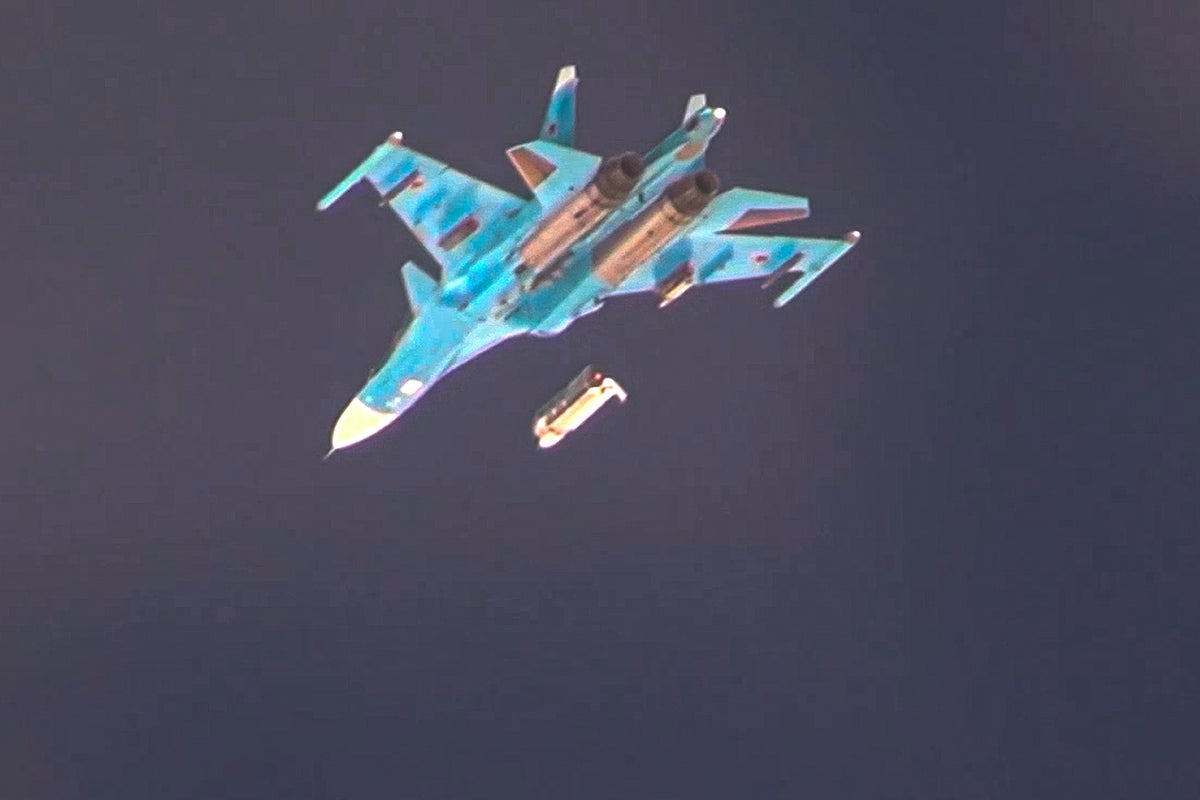
Drones killed the artillery piece. That is the brutal reality of the frontlines right now. For decades, military planners assumed big guns would decide long wars of attrition. They were wrong. Today, skies filled with first-person view drones hunt down traditional howitzers within minutes of their first shot.
With traditional artillery piece numbers depleted on both sides, a crude and terrifying substitute has filled the void. Glide bombs are reshaping the entire theater of war. These are not fancy, multi-million-dollar stealth missiles. They are massive, decades-old blocks of Soviet steel fitted with cheap pop-out wings and basic satellite guidance kits. They are dumb weapons made smart, and they are currently breaking the military deadlock.
Look at what happened in Zaporizhzhia just days ago. On Tuesday, Russian Su-34 bombers dropped seven massive glide bombs on the city within a single 90-minute window. The attack killed two people, injured at least 15 others, and left emergency crews tearing through collapsed apartment rubble. This is the new face of modern siege warfare.
The Logistics of Cheap Destruction
To understand why these weapons dominate the battlefield, look at the math. A cruise missile costs millions of dollars to build and requires specialized high-tech components that are hard to procure under global trade sanctions. A standard FAB-500 or FAB-1500 unguided bomb sits in a warehouse by the thousands, left over from the Cold War.
By bolting on a cheap wing kit and a satellite receiver, engineers create a weapon that can glide for 40 to 50 miles after being released from a high altitude.
[Unguided Bomb Stockpile] + [Cheap Wing Kit & GPS] = Long-Range Stand-off Weapon
The financial efficiency is staggering. It allows a military to rain down tons of high explosives every single day without emptying its treasury. Drones carry small payloads, often just a few pounds of explosives. A FAB-3000 glide bomb carries over three thousand pounds of explosives. The sheer kinetic force can turn reinforced concrete bunkers, trenches, and entire multi-story buildings into dust. Ukrainian troops on the frontline have repeatedly noted that while they can hide from artillery or shoot down incoming drones, there is simply no surviving a direct glide bomb hit. The blast wave alone collapses lungs and shatters defensive lines.
Ukraine Secret Response to the Weapon Gap
For over a year, Kyiv had to simply endure this aerial pounding. Western allies provided some high-tech glide weapons, like the American-made JDAM-ER and the French AASM Hammer. But the supply was a trickle. Western capitals worried about escalation or lacked the manufacturing depth to send what Ukraine actually needed to balance the scales.
Kyiv grew tired of begging. Over 17 months of quiet, domestic development, Ukrainian engineers built their own solution.
The weapon is called the Vyrivniuvach, which translates directly to the Equaliser. It is a Ukrainian-designed glide kit attached to domestic stockpiles of ordnance. This gives Ukraine its own stand-off capability, allowing its smaller air force to strike Russian logistics nodes and command posts from a safe distance without flying directly into dense air defense networks.
The deployment of the Equaliser means the glide bomb monopoly is officially over. We are entering a phase where both sides can drop massive, low-cost precision ordnance from dozens of miles away. It turns the airspace near the frontlines into an incredibly lethal zone for ground forces and air defense units alike.
The Air Defense Dilemma
A common question people ask is why standard air defense systems like the Patriot, NASAMS, or S-300 cannot just shoot these bombs out of the sky. The answer comes down to physics and radar cross-sections.
A glide bomb is essentially a heavy chunk of solid metal. It does not emit heat signatures like a cruise missile or a jet engine. It has no complex electronics to jam easily once it is on its flight path. Targeting a flying five-hundred-kilogram steel casing with a million-dollar air defense missile is a losing proposition. Even if you hit it, you are trading an expensive, limited interceptor for a cheap piece of retrofitted iron.
The only effective way to counter this threat is to destroy the aircraft carrying the bombs before they ever pull the trigger. This requires long-range air defense systems to sit dangerously close to the frontlines to catch Russian Su-34 bombers before they release their payloads 40 miles away.
But moving a Patriot battery close to the mud of the frontline makes it a prime target for Russian surveillance drones and ballistic missiles. It is a constant, high-stakes game of cat and mouse. Ukraine has used this aggressive ambush tactic to down several Russian jets, but it risks losing irreplaceable western equipment in the process.
How the Fight Evolves Next
The battlefield will not stay static. Now that both sides possess deep stocks of low-cost guided weapons, military strategies must pivot quickly to survive the summer campaigns.
First, expect a massive push toward underground manufacturing and deeply buried command bunkers. Traditional surface fortifications offer zero protection against multi-ton munitions. Units that stay exposed in standard trench lines will not survive. Survival means digging deeper than ever before.
Second, the target list is shifting toward airfields. Since you cannot easily shoot down the bombs, you must destroy the planes on the tarmac and blast the logistics networks supplying the wing kits. Ukraine has already accelerated its long-range drone campaign against deep Russian rear areas, striking oil refineries and airbases to starve the bombers of fuel and parts.
Keep an eye on how effectively Ukraine integrates its newly produced Equaliser bombs with its remaining fighter fleet. If Kyiv can scale up domestic production of these wing kits, they can systematically degrade Russian assembly areas behind the lines, slowing down the creeping infantry advances that have plagued the Donbas region for months. The side that manages its industrial output of these cheap guidance kits best will hold the ultimate tactical advantage.