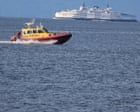
You think a quick fishing trip near Metro Vancouver is safe because you can see the shoreline. It's a common mistake. On June 28, 2026, ten people found out just how unforgiving the Pacific Northwest waters can be when their charter boat vanished into the Georgia Strait.
Six people are missing and presumed dead after the vessel abruptly took on water and sank near Roberts Bank, about 18 kilometers southwest of Vancouver International Airport. There was no frantic voice over the radio. No mayday call came from the captain. The vessel went down so fast that the ocean swallowed it whole before anyone on board could grab a life jacket.
The disaster has turned from a desperate rescue into a grim recovery mission. The Richmond RCMP Underwater Recovery Team is deploying sonar and underwater drones to locate the wreckage. They face a massive hurdle: the boat rests in a freezing trench between 150 and 180 meters deep.
Why the Roberts Bank Area is a Mariner's Trap
If you talk to local sailors, they'll tell you that the stretch of water off Richmond looks deceivingly calm from a distance. It's not. The sinking happened right where fresh river water slams into the heavy salt tides of the ocean. This creates a chaotic washing-machine effect.
Major Gregory Clarke of the Joint Rescue Coordination Centre noted that the area is incredibly tough to negotiate. When you combine massive underwater drop-offs with heavy commercial traffic from BC Ferries and container ships, the currents become entirely unpredictable. A boat can hit a "deadhead"—a waterlogged log floating vertically just below the surface—and suffer catastrophic hull failure in seconds.
The speed of this sinking suggests something sudden and violent. Because the crew couldn't send a distress signal, authorities are looking at every angle. The RCMP's major crimes unit is actively investigating whether a collision or criminal behavior played a role in the sudden disappearance.
The Razor-Thin Margin of Survival
We need to talk about what happens when you hit 10°C water without protection. Your body panics. The initial shock triggers an involuntary gasp reflection. If your head is underwater, you drown immediately.
The four survivors in this tragedy didn't escape unscathed. Two have been discharged, but a 33-year-old man and a 28-year-old woman remain in critical condition in the hospital. They survived only because a passing sailboat happened to spot them floating spread-eagle on their backs to stay alive.
Brian Angus, a retired pilot, and Dorothy Stauffer, an active flight attendant service director, were sailing toward Saturna Island when they spotted heads in the water. They didn't see a boat. They just saw five freezing people fighting the chop.
Stauffer used her emergency training to coordinate the rescue, towing a small dinghy behind their sailboat and shouting commands to the hypothermic survivors. They managed to pull three people to safety, while a Canadian Coast Guard hovercraft retrieved a fourth. But the ocean is cruel. In the time it took to maneuver, the couple watched two people slip beneath the surface.
The Unforgiving Reality of Charter Safety
This tragedy highlights a glaring truth that many weekend tourists ignore: having life jackets on a boat is useless if you aren't wearing them. Canadian law requires vessels to carry personal flotation devices (PFDs) for everyone on board, but it doesn't force adults to wear them at all times.
That needs to change. Major Clarke pointed out that a person wearing a PFD can survive up to 10 hours in these waters while waiting for a grid search to find them. Without one, exhaustion and hypothermia cut that survival window down to minutes.
If you are booking a charter fishing trip or taking a boat out this summer, you have to manage your own safety. Don't assume the captain has everything covered.
- Put the PFD on before leaving the dock. Don't store it under a bench. If a hull ruptures, you won't have time to dig it out.
- Verify the emergency tech. Ask the operator if the vessel has an automatically deploying Emergency Position Indicating Radio Beacon (EPIRB). If the boat sinks instantly, an EPIRB automatically blasts your exact coordinates to search satellites.
- Watch the water boundaries. Be hyper-aware when navigating river mouths and tidal rapids where the water density shifts rapidly and creates steep, unnatural swells.
The search for the four missing men and two women was called off after crews exhausted all surface options. As the RCMP continues its deep-water recovery operation, the lesson for the rest of us is written in the cold water of the strait: the ocean doesn't care about your plans, and it never gives previews before it turns sideways.


