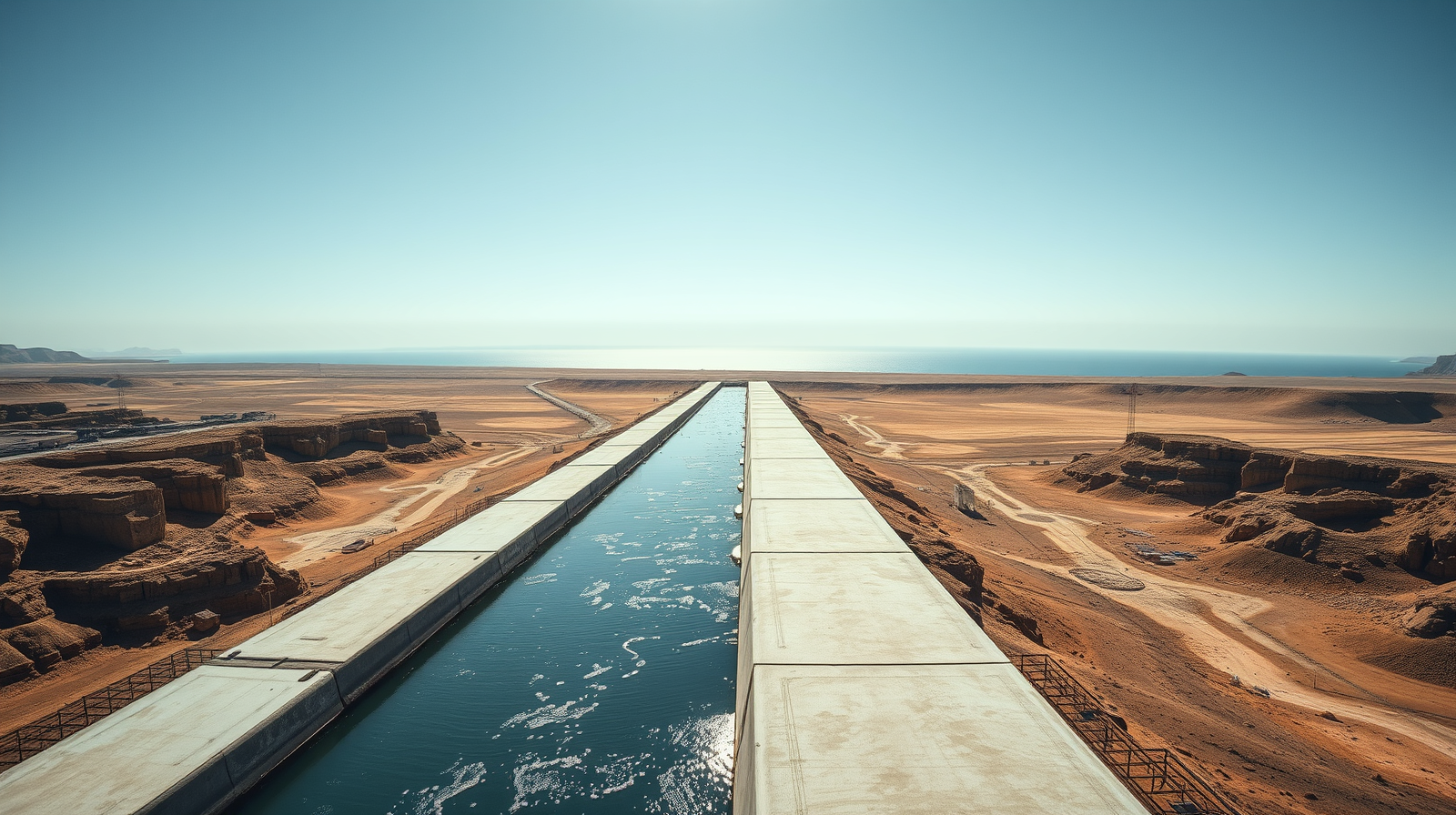
Imagine carving a trench across 50 miles of scorching North African terrain to let the Mediterranean Sea flood into a giant desert bowl.
That was the core plan behind Egypt's Qattara Depression hydroelectric scheme. It sounded brilliant on paper. The depression sits up to 133 meters below sea level, covering an area roughly the size of Lake Ontario. By cutting a canal or tunnel from the coast to the basin, engineers hoped to harness gravity. Water would plunge down the conduit, spin massive hydro turbines, and flow into the dry desert floor. Because the region experiences extreme heat, solar radiation would continuously evaporate the trapped seawater, preventing the basin from filling up completely. That continuous evaporation meant water could keep flowing in from the sea indefinitely, generating steady renewable energy day and night. Discover more on a similar subject: this related article.
It was touted as a infinite power loop. Yet, after more than 110 years of proposals, technical recalculations, and wild engineering proposals—including a Cold War scheme to detonate over 200 hydrogen bombs—Egypt formally shut the door on the concept in May 2026.
The decision was long overdue. While the physics of water dropping into a desert basin works on a blackboard, the practical realities on the ground tell a very different story. More reporting by Reuters highlights comparable views on this issue.
How a Natural Anomaly Sparked a Century of Megaproject Dreams
The Qattara Depression isn't just an empty patch of dirt. It's a massive geological hollow in Egypt's Western Desert, created over millions of years by a combination of salt weathering and wind erosion.
German geographer Albrecht Penck first spotted the potential of this unusual terrain back in 1912. He realized that a basin sitting far below sea level, situated relatively close to the Mediterranean coast, offered a rare topoid setup for hydro power.
Detailed mapping didn't happen until the late 1920s. Dr. John Ball, an English director for the Survey of Egypt, led a team into the uncharted terrain to triangulate its precise depth and boundaries. Ball wasn't just measuring sand. He calculated that if seawater flowed into the depression at a rate equal to its natural evaporation rate, the project could output anywhere from 125 to 200 megawatts of continuous power. In 1933, Ball published his formal technical proposal in The Geographical Journal, laying out the initial math for a project that would captivate planners for the next century.
World War II temporarily halted all talks. The depression itself became a natural impassable barrier for heavy military armor during the battles of El Alamein, forcing tank commanders to navigate around its steep northern cliffs and treacherous mud flats. But as peace returned, so did the fascination with engineering the desert.
The Cold War Strategy to Nuke the Desert
By the 1950s and 1960s, the scale of the required excavation began to sink in. Cutting a canal through the elevated ridge between the Mediterranean coast and the Qattara basin meant digging through 55 to 100 kilometers of solid rock and tough terrain. Standard mechanical digging with 1950s equipment was prohibitively expensive and excruciatingly slow.
That's when international actors entered the scene with radical alternatives.
In 1957, the U.S. Central Intelligence Agency submitted a proposal to President Dwight Eisenhower. The CIA suggested that flooding the depression into a massive lagoon could serve multiple geopolitical purposes. It would create thousands of construction jobs, change the local microclimate, and give Egyptian President Gamal Abdel Nasser a signature infrastructure project to focus on, pulling his attention away from Soviet alliances.
Eisenhower didn't act on the CIA memo, but the idea of using non-traditional construction techniques gained traction. Enter Friedrich Bassler, a West German hydraulic engineer who took charge of the planning board for the project starting in 1964.
Bassler ran the numbers on conventional earth-moving methods and realized the cost rendered the project dead on arrival. His team came up with a wild solution: nuclear excavation.
Under the umbrella of peaceful nuclear explosions—a trend pushed by both the U.S. "Atoms for Peace" initiative and Soviet engineering programs—Bassler proposed lining up 213 nuclear devices in deep boreholes along the canal path. Each device would have a yield between 1 and 1.5 megatons, roughly 100 times the yield of the bomb dropped on Hiroshima.
The plan was simple on paper and terrifying in practice.
- Detonate 213 thermonuclear charges along the channel route.
- Blast out millions of tons of bedrock instantly.
- Evacuate at least 25,000 residents from surrounding settlements.
- Allow the radioactive fallout to clear before lining the newly created trench.
Unsurprisingly, the Egyptian government backed away from Bassler's nuclear option. Beyond the obvious hazards of local radiation, scientists raised red flags about seismic stability. The site sat just 450 kilometers from the active Red Sea Rift. Triggering hundreds of megatons of underground shockwaves risked inducing earthquake activity across the region.
Why Egypt Abandoned the Flooding Strategy in 2026
Even after the nuclear plan fell through, Egypt kept the Qattara file open. Joint venture studies in the late 1970s and renewed feasibility assessments throughout the 2010s and early 2020s kept re-evaluating conventional tunneling, pipeline conduits, and mixed-use development schemes. A ministerial review committee set up in 2016 spent a decade analyzing modern engineering options, cost-to-benefit ratios, and environmental risks.
In May 2026, the Egyptian cabinet officially announced the total abandonment of all seawater-flooding proposals for the Qattara Depression.
The rationale behind the cancellation comes down to five hard facts that simple hydroelectric calculations ignored for decades.
1. Groundwater Contamination and Salinization
The floor of the Qattara Depression isn't an insulated bowl. It's connected to underlying aquifer systems, including freshwater bodies that supply nearby oases like Siwa. Flooding the basin with billions of cubic meters of salt water creates enormous pressure heads. Hydrological modeling confirmed that saline water would seep down into the surrounding rock, permanently poisoning underground freshwater reserves that local agriculture depends on.
2. The Accumulating Salt Problem
The main feature of the project—rapid evaporation—is also its long-term fatal flaw. When seawater evaporates, it leaves its salt behind. Over time, the created lake wouldn't remain normal seawater; it would transform into a hyper-dense, toxic brine sink, similar to the Dead Sea but on a far larger scale. Eventually, thick salt crusts would choke the lower intakes, stall natural circulation, and ruin any attempt at local marine ecosystems or fisheries.
3. Oil and Gas Operations
Back in Dr. John Ball's day, the Western Desert was viewed as empty sand. Today, the Qattara region and its surroundings are active producing zones for Egypt's domestic oil and natural gas sector. Flooding nearly 20,000 square kilometers of terrain would submerge existing wellheads, pipelines, and exploration fields. Relocating that critical energy infrastructure would cost billions and destroy existing national fuel production.
4. Explosive Legacy of World War II
Before anyone can dig a canal across northern Egypt, they have to clear the ground. The corridor between the coast and the depression is one of the most densely mined areas on Earth, scattered with millions of unexploded artillery shells and landmines left behind by Allied and Axis armies in the 1940s. Clearing these ordnance fields safely to allow mega-scale earthworks added a staggering overhead to the project budget.
5. Solar and Wind Made Hydropower Obsolete
The economic argument for Qattara was built when solar power didn't exist as a commercial option. In 1933 or 1970, running water through a turbine was the only way to get high-volume renewable power in a desert. Today, photovoltaic panels and wind turbines have fundamentally changed energy economics.
Building modern solar farms across the flat edges of the Western Desert costs a fraction of digging a 60-mile sea canal. Solar requires no nuclear blasting, creates no salt brine, leaves the groundwater intact, and doesn't threaten oil fields.
Comparing the Qattara Plan to Real Energy Alternatives
To understand why the seawater project lost its appeal, look at how the physical numbers compare to modern renewable infrastructure in Egypt today.
- Seawater Hydro Project: Requires excavating 55-100 km of deep channel through rock, risks polluting aquifers for Siwa Oasis, costs tens of billions of dollars, produces an estimated 200 to 1,000 megawatts depending on flow rates, and takes decades to build.
- Modern Desert Solar Farms: Requires flat ground and mounting racks, uses zero water, leaves underlying aquifers completely untouched, costs a fraction per megawatt-hour to install, produces zero brine, and can be deployed in months rather than decades.
The math simply stopped making sense. Paying tens of billions of dollars to dig a massive ditch to produce electricity using water, only to contend with environmental destruction, couldn't compete with placing solar arrays directly on top of the same sun-drenched desert sand.
What Happens to the Qattara Depression Now
Egypt isn't abandoning the Qattara Depression entirely. The government has shifted to a "dry" development strategy.
Instead of filling the basin with salt water, current plans focus on utilizing the region's solar potential, exploring targeted mineral extractions from existing dry salt pans, and protecting the fragile endemic flora and fauna—such as the endangered slender-horned gazelle and cheetah populations that still use the isolated pockets of the desert floor.
The century-old dream of turning a desert hollow into an artificial sea makes for a fascinating chapter in engineering history. It serves as a reminder that just because a natural feature makes a project theoretically possible doesn't mean it's wise, safe, or cost-effective to build.
If you're studying large-scale infrastructure or renewable energy strategy, drop the century-old megaproject myths. Focus your research on modern utility-scale solar grid integration, hybrid storage systems, and dry-climate energy technologies instead. That is where the real work in North African energy development is happening today.