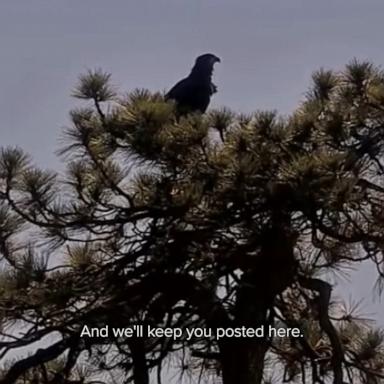
Thousands of live-stream viewers collectively gasped on Sunday morning, June 28, 2026, when one of Big Bear Valley’s famous bald eaglets vanished from the screen in a chaotic tangle of feathers and branches.
If you watch the popular nest cam run by the non-profit Friends of Big Bear Valley, you know exactly what happened. Sandy, the older of the two chicks hatched this spring, took an unexpected plunge. One second she was perched on the edge of the Jeffrey pine tree, and the next, she was tumbling downward.
It looked horrific. The live chat erupted in panic. But if you think this fall means tragedy for the internet-famous eagle family, you are completely misreading the situation. Nature is messy, and young eagles are far tougher than we give them credit for.
Sandy didn't just survive. She turned a clumsy mistake into her first official flight.
The Porch Mishap That Triggered the Fall
This was not a case of a weak chick or poor parenting. It was basic sibling awkwardness at 140 feet in the air.
At exactly 11:24 a.m. local time, Sandy and her younger sibling, Luna, were hanging out on what the camera community calls the front porch. This is a thick branch just outside the main nest bowl where the eaglets practice branching, which is the avian equivalent of a toddler cruising along the furniture.
Luna tried a bold maneuver. He attempted to jump completely over Sandy to get back into the main nest bowl. Eaglets are massive at 12 weeks old, with wingspans stretching over six feet, but their coordination doesn’t always match their size. Luna's talons got tangled, his body bumped Sandy, and Sandy lost her footing completely.
She fell straight down into what viewers call the basement, the dense network of branches beneath the main nest platform.
For a few terrifying minutes, the camera operators scrambled. Viewers could hear faint "squees"—the high-pitched vocalizations young eagles use to communicate. Those sounds weren't cries of pain. They were Sandy telling her parents exactly where she landed. She had snagged on lower branches, which broke her fall, before freeing herself.
Just six minutes later, at 11:30 a.m., a nearby security camera caught Sandy doing something incredible. Instead of crashing to the forest floor, she caught the wind, extended her massive wings, and flew. She glided out of the nest tree area into another section of the forest canopy.
Welcome to the World of the Fludge
Wildlife biologists have a funny, unofficial term for what Sandy did. They call it a "fludge"—a combination of falling and fledging.
True fledging happens when a young bird intentionally takes its first flight from the nest. Sandy’s flight was entirely accidental, but it forced her hand. She had the physical capability to fly, even if she hadn't mentally prepared for it.
Sandy and Luna were right at the 12-week mark. Bald eagles generally fledge between 10 and 14 weeks of age. For weeks, the duo had been wing-serenading the camera, flapping furiously in high winds to build chest muscle and coordination. Sandy had the gear and the strength. She just lacked the grace.
The very next morning, Monday, June 29, Luna decided he wasn't going to be left behind. Shortly before 9:30 a.m., Luna took off from the tree with a much more graceful strategy. He lifted off beautifully and sailed straight to a nearby tree where his father, Shadow, was waiting.
Just like that, both of Jackie and Shadow’s 2026 chicks had officially left the cradle.
What Happens When an Eaglet Leaves the Nest
A common misconception is that once an eagle flies away, the nest life is over. That is wrong.
Fledging is just step one of a long, grueling transition to adulthood. Sandy and Luna are not independent. They cannot hunt for themselves yet. They can barely land safely. Landing is actually the hardest part of flight school for a young eagle, and they routinely overshoot branches or crash-land into bushes during the first few weeks.
Jackie and Shadow are now working overtime. This legendary eagle couple has raised six chicks successfully over the years: Simba in 2019, Spirit in 2022, Sunny and Gizmo in 2023, and now Sandy and Luna. They know the drill.
The parents will follow the chicks through the San Bernardino National Forest canopy. They track them by sound and sight. When Shadow or Jackie catches a fish from Big Bear Lake, they won't bring it to the nest bowl anymore. They will fly it directly to whatever branch the chicks are screaming from.
Over the next month, you will see a fascinating shift in behavior if you keep watching the live feed. The family will still gather at the old Jeffrey pine. Eaglets frequently return to the nest to eat, sleep, or simply hang out with each other because it's a safe, familiar space.
The Long Road to Wilderness Survival
Life gets much harder for these birds by autumn.
Right now, Jackie and Shadow are providing a safety net. They will actively show Sandy and Luna how to spot fish, how to swoop down on waterfowl, and how to scavenge carcasses. But by the time October rolls around, that parental support drops to zero.
Young eagles leave their natal territories by the fall of their first year. Once they leave Big Bear Valley, they are entirely on their own. Data from banded eaglets shows they can travel up to 2,000 miles away during their first year of wandering. They follow river systems and coastlines, learning the harsh realities of winter survival.
The first year is brutal. Mortality rates for juvenile bald eagles hover around 50%. They face threats from starvation, territorial fights with older eagles, and human hazards like lead poisoning from eating gut piles left by hunters or colliding with power lines.
Sandy’s early fall might actually give her a slight edge. By being forced out into the branches and lower canopy a day early, her survival instincts kicked in immediately. She had to navigate the lower forest layers, find secure perches, and rely on her wings to save her life. That is invaluable real-world practice.
How to Avoid Ruining the Eagles Progress
The Friends of Big Bear Valley team issued an urgent directive immediately after Sandy’s fall, and it's one every nature lover needs to follow.
Stay out of the area.
When an eaglet is on the ground or stuck in the lower canopy, human presence is a death sentence. If well-meaning fans flock to the forest to search for Sandy, they will scare her. A frightened juvenile eagle will try to run or fly before she is ready, potentially landing in the path of predators like coyotes or bobcats. It also prevents Jackie and Shadow from coming down to feed her.
The United States Forest Service already keeps strict closures in place around the nesting site for this exact reason. Areas like the Gray’s Peak Trailhead and the Grout Bay Picnic Area are explicitly shut down to public entry during nesting season to give these birds a bubble of safety.
If you want to help Sandy and Luna survive their next critical phase, watch them from your screen. Let the camera operators do their jobs, let the biologists monitor from a distance, and let Jackie and Shadow finish the job they started back when these eggs hatched in April. Your screen time keeps them safe. Your physical presence endangers them. Keep your distance and let nature do what it does best.


:max_bytes(150000):strip_icc()/Sabyasachia-998984251b434f3a9c350c5694ef7f32.jpeg)