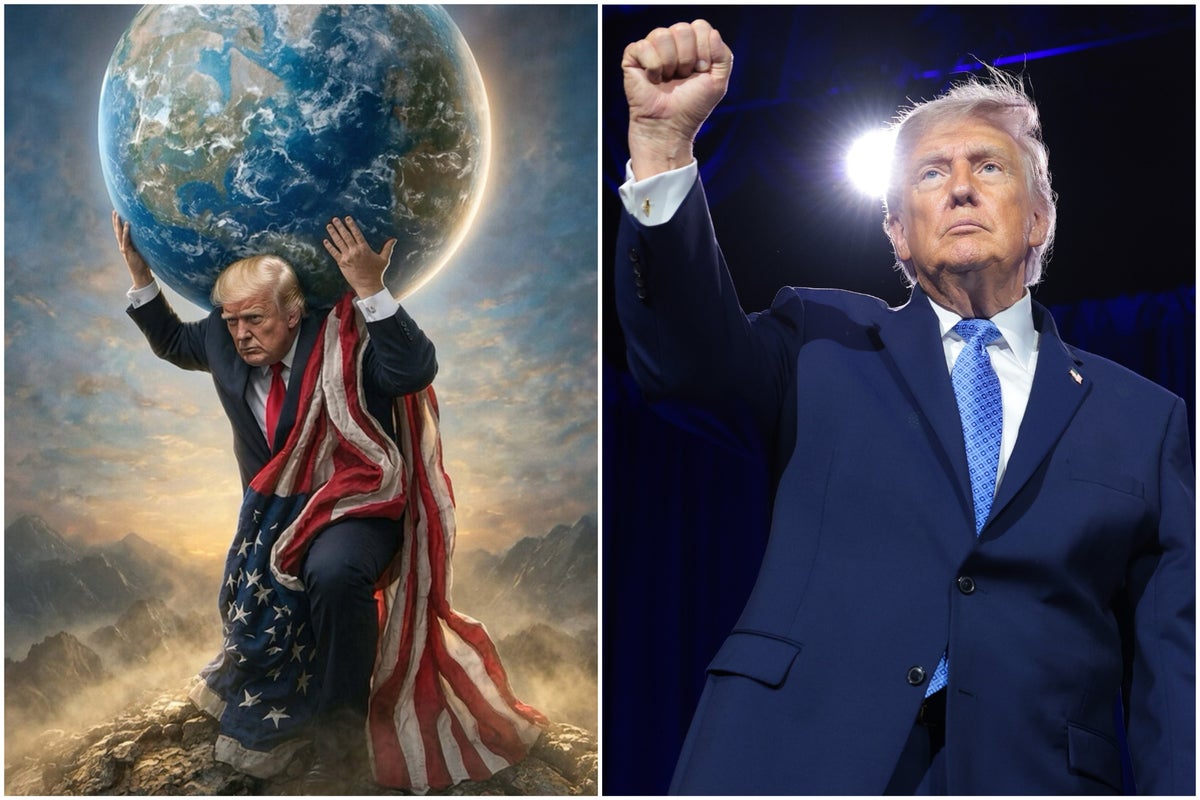
Donald Trump just did it again. Without a single word of explanation, he dropped an AI-generated image on his Truth Social platform that sent political commentators into an absolute tailspin. If you haven't seen it yet, the image portrays the president as a god-like figure standing on a jagged rocky peak. He’s wrapped in an American flag, and his knees are bent under the massive weight of the entire planet Earth. It’s an explicit nod to Atlas, the Titan of Greek myth condemned to hold up the heavens for eternity. This latest stunt proves that Trump posts boastful Atlas-inspired Truth Social image of himself carrying the world on his shoulders not just to get attention, but to construct an entirely new kind of political mythology.
Mainstream outlets scrambled to report the post as just another example of standard internet trolling. They missed the deeper point. This isn't just about ego. It’s about a calculated shift in how political power projects itself in modern America. By analyzing the timing, the artistic style, and the political backdrop of this post, we can understand what his team is actually trying to accomplish.
Why Trump posts boastful Atlas-inspired Truth Social image of himself carrying the world on his shoulders right now
Timing is everything in politics. This image didn't appear in a vacuum. It dropped late at night right after the G7 summit and right on the heels of intense US military actions targeting drone facilities in Iran. The world is tense. The Strait of Hormuz is a powder keg. By presenting himself as the sole protector of the globe, Trump signals to his base that he’s the only thing preventing global chaos.
It’s a classic strongman tactic. You create or highlight a massive, terrifying crisis, and then you position yourself as the exclusive solution. The silent caption makes it even more potent. He didn't write a long paragraph defending his foreign policy. He just let the image do the heavy lifting. It tells his followers that while the media chatters, he’s carrying the heavy burdens of global security on his back.
Critics call it dangerous self-aggrandizement. Supporters see it as an authentic expression of his relentless work ethic and defiance. But looking closely at his recent online behavior shows this is part of a much broader, highly deliberate pattern.
The evolution of the presidential meme feed
We need to look at how we got here. Trump has always used social media as a direct pipeline to his audience, bypassing traditional press rooms entirely. In his first term, it was all about capital letters, exclamation points, and fiery late-night broadsides on Twitter. Now, his communication style relies heavily on synthetic media.
- January 2026: He shared an altered map showing the American flag swallowing Canada, Greenland, and Venezuela. It signaled an aggressive, expansionist foreign policy posture that rattled international allies.
- April 2026: He posted a highly controversial AI image depicting himself as a Christ-like figure healing the sick. That one backfired terribly, drawing sharp rebukes from high-profile conservative Christians who called it blasphemous.
- June 2026: The Atlas image lands. It replaces religious imagery with classical pagan mythology, avoiding the direct theological backlash while keeping the same messianic tone.
This progression shows a clear trial-and-error process. When the Jesus imagery offended his core evangelical base, his strategy shifted toward classical myth. Atlas is safe. Nobody is going to accuse Donald Trump of religious heresy for pretending to be an ancient Greek Titan.
The psychology of the digital strongman
This isn't ordinary political messaging. Standard politicians share crisp photos shaking hands with factory workers or sitting behind the Resolute Desk looking serious. Trump rejects that entirely. He prefers the exaggerated, muscle-bound aesthetic of comic books and classical art.
This visual style appeals directly to an audience that feels traditional institutions are collapsing. If the system is broken, a normal administrator can't fix it. You need a mythic hero. The Atlas image feeds directly into this collective desire for an all-powerful protector. It doesn't matter if the image looks fake or slightly ridiculous to outsiders. The absurdity is part of the appeal. It mocks the serious, buttoned-up decorum of Washington insiders.
Think about the sheer contrast between this image and his actual daily routine. He’s flying on Air Force One, eating fast food, arguing with critics online, and meeting with world leaders. But in the minds of millions of his voters, he’s the lonely titan on the rock. The meme becomes more real than the reality.
The structural mechanics of Truth Social echo chambers
To understand why this content works, you have to look at the platform itself. Truth Social was built specifically to insulate Trump from the immediate pushback he faces on mainstream platforms like X or Facebook. It’s an online ecosystem designed for absolute loyalty.
On a standard platform, a post like the Atlas meme would be instantly flooded with fact-checks, mocking community notes, and brutal counter-memes. On Truth Social, it receives pure validation. The platform amplifies the message without any friction. By the time the image leaks out to the wider internet, his base has already accepted it as a definitive statement of strength.
This creates a massive disconnect. Half the country looks at the image and sees a hilarious, desperate cry for attention from an aging politician. The other half looks at it and sees a profound truth about the heavy burdens of leadership. There’s no middle ground left.
Moving past the superficial media outrage
Every time Trump posts something like this, the media falls into the exact same trap. Network anchors spend segments discussing whether it’s appropriate for a president to post AI-generated art of himself. They miss the tactical victory he just scored.
While journalists complain about his ego, they aren't talking about inflation numbers. They aren't talking about the complexities of the military strikes in Iran. They are talking about his terms, using his visual language. He dictates the national conversation with a single click.
If you want to understand modern political power, you have to stop expecting it to look like a high school civics textbook. Power today is about attention dominance. The person who controls the screen controls the narrative.
Take a look at your own media consumption today. Stop scrolling through the endless, angry reaction threads that offer zero substance. Start looking at the underlying strategies behind these visual campaigns. Pay attention to how political figures use synthetic media to bypass accountability. The next time an image like this drops, don't just react. Analyze the timing, recognize the pattern, and see the play for what it really is.