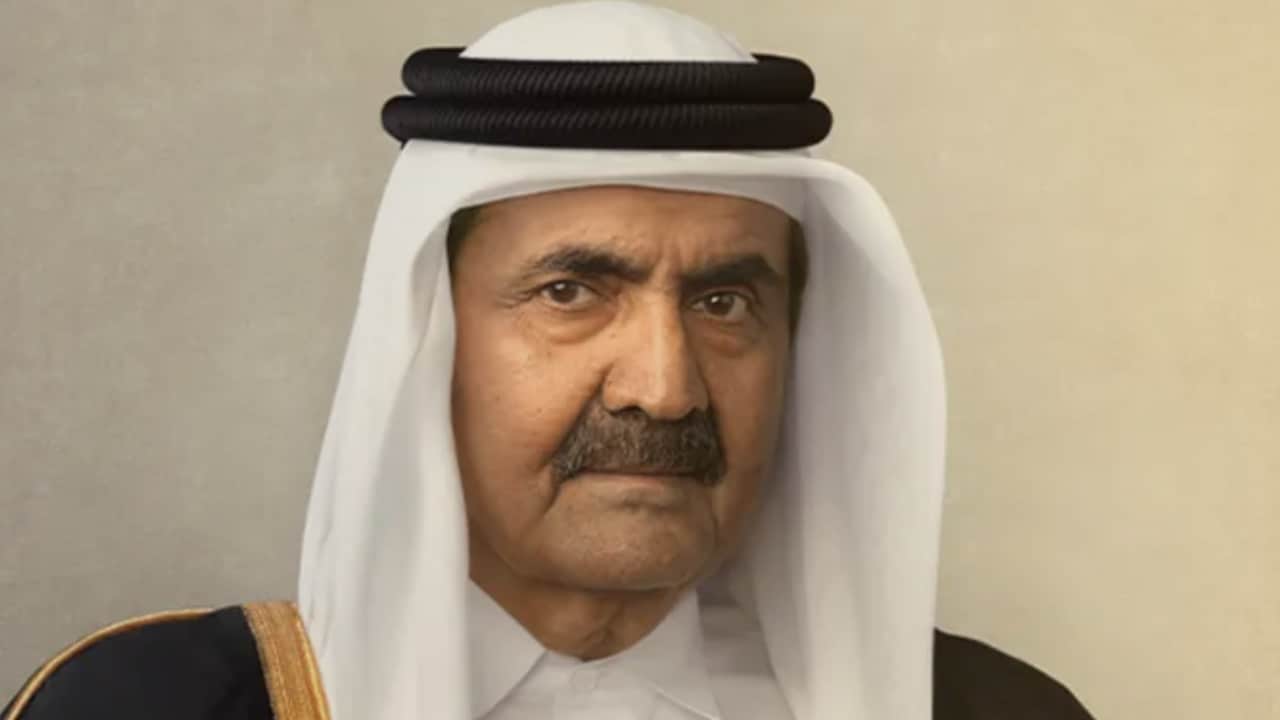
Qatar announced a four-day period of national mourning following the passing of former Emir Sheikh Hamad bin Khalifa Al Thani at age 74. The Amiri Diwan confirmed his death on Sunday morning, July 12, 2026, drawing a final curtain on the life of the absolute architect of modern Qatar. He didn't just rule a country. He completely manufactured its modern identity from thin air.
When he took power in 1995, Qatar was a sleepy, cash-strapped Persian Gulf peninsula completely overshadowed by its larger neighbors. By the time he voluntarily stepped down in 2013, the nation was the world's highest earner per capita, a global sports hub, and a diplomatic heavyweight. His passing isn't just local news. It represents the loss of one of the most audacious, independent, and polarizing political strategists the Middle East has ever seen. Recently making news in this space: Why Iran's Fractured Regime Means Trump's Middle East Plan Will Fail.
Understanding his legacy requires looking past the standard state condolences from world leaders. You have to look at the sheer audacity of how he ran his foreign and economic policy. He broke every rule in the traditional Gulf monarchy playbook, and it worked.
The Cold Reality of the 1995 Palace Coup
Most people don't realize how close Qatar came to financial ruin before Sheikh Hamad took over. In June 1995, he executed a bloodless palace coup while his father, Sheikh Khalifa bin Hamad Al Thani, was vacationing in Europe. It wasn't just a family dispute. It was a desperate necessity for survival. Further insights regarding the matter are detailed by TIME.
The state coffers were basically empty. His father had treated national gas revenue as personal wealth, keeping development frozen. Sheikh Hamad saw that the status quo meant oblivion. He seized the phone lines, secured the military, and declared himself leader. His father spent the next decade in exile in Europe, cut off from the wealth he thought was his.
Sheikh Hamad immediately did something insane. He gambled everything on liquefied natural gas.
At the time, nobody wanted to invest the billions needed to extract and cool gas from Qatar's massive North Field. The technology was unproven on that scale. International oil companies thought it was too risky. He pushed forward anyway, partnering with western energy corporations to build massive infrastructure. In 1996, Qatar shipped its very first container of liquefied natural gas. Within a decade, the country was exporting over 77 million tons annually.
The numbers are staggering. Qatar sits on roughly 13% of the world's proven natural gas reserves. Sheikh Hamad turned that raw material into an economic weapon. The tiny population of fewer than 300,000 citizens suddenly found themselves sitting on top of the world's most lucrative sovereign wealth fund.
How Al Jazeera Weaponized Soft Power
You can't talk about Sheikh Hamad without talking about media. In 1996, he issued a decree that changed global journalism forever by funding the launch of the Al Jazeera satellite network.
Before Al Jazeera, Arab state television consisted of boring, state-approved broadcasts showing ministers shaking hands. Sheikh Hamad funded a network that gave a platform to dissidents, hosted fiery debates, and covered controversial political topics across the region. He gave them a budget of $137 million to start. It was a brilliant, calculated geopolitical move.
The network angered almost every single leader in the Middle East. Saudi Arabia, Egypt, and Jordan repeatedly shut down Al Jazeera bureaus. They begged Sheikh Hamad to censor the channel. He always refused, claiming he didn't control the editorial board. Honestly, it was the perfect shield. He used the network to apply pressure to regional rivals while maintaining plausible deniability.
During the 2011 Arab Spring uprisings, Al Jazeera became the primary megaphone for protestors in Tunisia, Egypt, and Libya. Sheikh Hamad didn't just watch the news; he actively shaped the outcome. He sent Qatari warplanes to support the opposition against Muammar Qaddafi in Libya. He poured billions into Egypt to support the short-lived Muslim Brotherhood government. It was an incredibly aggressive foreign policy that ultimately forced the rest of the world to take Qatar seriously.
The Art of Offending Everyone at the Same Time
The most fascinating thing about Sheikh Hamad's strategy was his ability to hold totally contradictory alliances simultaneously. He built a foreign policy designed to make Qatar indispensable to everyone, even if those parties hated each other.
Look at the evidence. Under his leadership, Qatar built the Al Udeid Air Base, which became the forward headquarters for the United States military Central Command. He hosted thousands of American troops. At the exact same time, he maintained cozy diplomatic ties and a shared natural gas field with Shiite-dominated Iran.
He allowed the Palestinian group Hamas to open a political office in Doha. He even permitted the Afghan Taliban to establish a formal diplomatic presence in Qatar, which later became the exact venue where the United States negotiated its exit from Afghanistan.
Western analysts often criticized this as playing both sides. To Sheikh Hamad, it was survival. He knew that a tiny nation with an incredibly small native military couldn't defend itself by force. It needed to be the ultimate diplomatic venue. If you want to talk to your worst enemy, you have to go through Doha. That security guarantee was far more powerful than any tank or fighter jet.
Buying the World and Winning the World Cup
Money alone doesn't buy security, but it does buy permanence. Sheikh Hamad created the Qatar Investment Authority to park the country's massive gas wealth into concrete global assets.
The strategy was simple. Buy things that western countries would never allow to fail. The fund acquired London's iconic Harrods department store. It bought huge stakes in the German automaker Volkswagen, Barclays bank, and vast swaths of real estate across Manhattan and London. They bought the French football club Paris Saint-Germain, turning it into a European powerhouse.
Then came the ultimate prize. In December 2010, Qatar won the rights to host the 2022 FIFA World Cup.
The decision shocked the sporting world and sparked years of intense scrutiny regarding corruption, labor rights, and the logistics of playing football in the desert heat. But Sheikh Hamad achieved exactly what he wanted. He put Qatar on the map permanently. When the tournament finally kicked off in 2022, he sat in the VIP box, long retired from daily governance, and received a thunderous standing ovation from his citizens. He had delivered on a promise that seemed completely impossible two decades prior.
Breaking Tradition with a Voluntary Handover
In June 2013, Sheikh Hamad did something completely unprecedented for a hereditary ruler in the Gulf. He stepped down voluntarily.
He was only 61 years old at the time and in relatively good health, despite some long-standing kidney issues. He gathered the nation for a televised address and handed complete power over to his 33-year-old son, Sheikh Tamim bin Hamad Al Thani.
Gulf monarchs usually rule until their final breath. Abdications usually happen because of a coup or extreme senility. Sheikh Hamad broke that mold because he recognized a massive demographic shift. The Arab Spring had shown that the region's massive young population wanted leadership that spoke their language. By stepping aside, he allowed a seamless transition of power, ensuring stability while keeping his family firmly in control.
Even as the "Father Emir," his shadow remained large over Qatari politics. When Saudi Arabia, the United Arab Emirates, Bahrain, and Egypt launched a massive diplomatic and economic blockade against Qatar in 2017, the foundations Sheikh Hamad built allowed the country to survive. His economic independence and diverse international alliances kept the nation afloat until the blockade collapsed in 2021.
What Follows the Passing of the Father Emir
With the Amiri Diwan declaring four days of public mourning, all government offices and public institutions across Qatar will close. Flags will fly at half-mast. Funeral prayers are scheduled at the Imam Muhammad ibn Abd al-Wahhab Mosque in Doha, with burial following at the Lusail Cemetery. World leaders, including Indian Prime Minister Narendra Modi and UAE President Sheikh Mohamed bin Zayed, have already sent extensive condolences, highlighting his transformation of the Gulf state.
If you are tracking the future of Middle Eastern geopolitics and energy markets, you need to watch how Qatar handles this transition phase. The loss of its ultimate strategic architect comes at a moment of heightened regional tension.
To analyze what happens next, follow these critical steps:
First, monitor the continuity of Qatar's independent mediation tracks. Look closely at whether Doha maintains its open communication lines with non-state actors like Hamas and the Taliban, or if regional pressures force a shift toward a more traditional, conservative Gulf alignment.
Second, track Qatar's massive LNG expansion projects in the North Field. The state is currently pushing to increase its capacity from 77 million tons to over 140 million tons annually by 2030. Any shifts in leadership dynamics within the state energy apparatus could alter global gas pricing strategies, especially as Europe continues to look for alternatives to Russian fuel.
Sheikh Hamad proved that a small nation doesn't have to accept being a spectator in global affairs. He leaves behind a wealthy, hyper-connected powerhouse that continues to punch far above its weight.