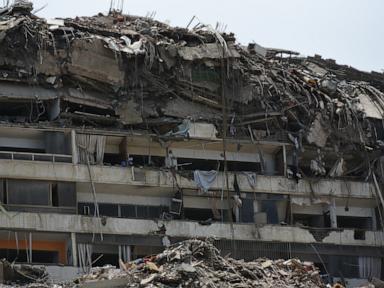
The ground under Latin America doesn't just shake. Sometimes it completely rewrites geography, swallows towns, and alters generations in a matter of seconds. The recent double-strike earthquakes in Venezuela, where a magnitude 7.2 and a magnitude 7.5 quake hit less than a minute apart, served as a terrifying reminder of this reality. When back-to-back seismic shocks hit a coastline, buildings do not just crack. They disintegrate. This rare doublet left hundreds dead or injured, and thousands missing across Caracas and La Guaira. It immediately forced the world to look back at a century of tectonic trauma, highlighting the history of the deadliest earthquakes in Latin America.
Understanding this history requires moving past raw magnitudes. A higher number on the Richter scale does not always mean more bodies to bury. The real tragedy happens when geology meets poor infrastructure, bad timing, and bad luck. The worst disasters on this side of the planet show that the deadliest earthquakes in Latin America are rarely just natural events. They are structural failures on a massive scale.
The Tectonic Trap Behind the Deadliest Earthquakes in Latin America
Latin America is caught in a geological vice. The western edge of the continent rides along the Ring of Fire, an ultra-active belt where oceanic plates violently smash into continental shelves.
Take the South American Plate. It constantly moves westward, running over the heavy Nazca Plate, which plunges underneath it into the mantle. This process is called subduction. It does not happen smoothly. The plates stick, bending and twisting the rock layers above them until something gives. When the rock breaks, decades or centuries of built-up energy scream to the surface instantly.
Further north, the mechanics change but the danger stays high. Central America sits on a chaotic knot involving the Cocos, Caribbean, and North American plates. Instead of neat subduction, you get a mess of strike-slip faults and volcanic fractures right beneath major cities. Guatemala City, San Salvador, and Managua are built directly on top of these shallow fault lines. That proximity turns moderate tremors into historic catastrophes.
When Entire Mountains Melt Away
If you look solely at death tolls, nothing matches what happened in Northern Peru on May 31, 1970. A magnitude 7.9 earthquake struck off the coast of Chimbote. The shaking itself caused vast damage, but the true horror happened miles away on Mount Huascarán, Peru's highest peak.
The intense shaking destabilized a massive glacier on the mountain. A chunk of ice and rock nearly a mile wide tore free, plunging thousands of feet down the vertical slopes. As it raced downward, it gathered loose mud, glacial water, and boulders. It became a fast-moving wall of debris traveling at over 170 miles per hour.
The avalanche completely buried the resort town of Yungay. Over 20,000 people disappeared under a thick layer of mud and ice within minutes. Only a handful of residents survived by running to the town's elevated cemetery or a local hilltop. Across the entire region, the death toll surpassed 66,000 people. The Peru disaster showed that secondary hazards, like landslides and mudflows, can easily outkill the primary shockwaves of an earthquake.
The Scale of Pure Force
Twenty-eight years before the Peru disaster, Chile experienced an event that redefined what scientists thought possible. On May 22, 1960, the Great Chilean Earthquake struck near Valdivia. Registering at magnitude 9.5, it remains the most powerful earthquake ever recorded in human history.
The fault rupture spanned nearly 600 miles along the Pacific coast. The energy released was so immense that it altered the shape of the coastline, dropping some areas by several feet and lifting others. The initial shaking killed over 1,600 people, but the real damage came from the ocean.
A massive tsunami ripped across the Pacific. Waves over 30 feet high pounded the Chilean coast before crossing the ocean to strike Hawaii, Japan, and the Philippines hours later. The tsunami killed dozens of people in Hilo, Hawaii, and over a hundred in Japan. Chile survived a total catastrophe only because its towns were heavily accustomed to shaking, and residents fled to high ground immediately after the ground stopped moving.
Built to Fail in Central Mexico
Magnitude tells you how much energy a fault released, but depth and location dictate how many people die. On September 19, 1985, an 8.1 magnitude earthquake struck deep beneath the Pacific coast of Michoacán, Mexico. The epicenter was over 200 miles away from Mexico City, yet the capital took the brunt of the devastation.
Mexico City is built on the ancient, soft clay bed of Lake Texcoco. When seismic waves from the coast hit that loose sediment, they slowed down and grew massive, a process known as soil amplification. The soft ground began to shake like a bowl of gelatin.
Even worse, the frequency of those amplified waves matched the natural vibration frequency of buildings between six and fifteen stories tall. These structures began to sway violently until their columns snapped. Over 400 major buildings collapsed completely, including hospitals, hotels, and schools. While official estimates placed the death toll around 9,500, independent researchers and rescue workers believe the true number of casualties exceeded 30,000.
The Shallow Tragedies of Central America
Shallow earthquakes are deeply dangerous. Central America knows this better than anywhere else. In Guatemala on February 4, 1976, a magnitude 7.5 earthquake occurred along the Motagua Fault, a strike-slip boundary separating the North American and Caribbean plates.
Because the rupture occurred just miles below the surface, the localized ground acceleration was extreme. Over 22,700 people died. The vast majority of victims lived in poor, mountainous communities where homes were constructed from unreinforced adobe mud bricks. When the ground shook, heavy tile roofs collapsed straight down, crushing families in their sleep.
A similar dynamic destroyed Managua, Nicaragua, on December 23, 1972. A relatively modest 6.2 magnitude quake hit directly beneath the city center. It killed over 6,000 people because the city’s heart was filled with poorly built structures sitting directly over active fault lines.
The True Cost of Modern Shocks
Looking at more recent decades, the pattern of destruction remains tied to building standards and local geology.
- El Salvador (2001): A pair of earthquakes in January and February killed over 1,200 people. The most devastating damage happened in Las Colinas, an upscale suburb of San Salvador, where a massive hillside liquefied and buried hundreds of homes.
- Western Colombia (1999): A 6.0 magnitude quake struck near Armenia. Despite its moderate size, it killed roughly 1,170 people because the region’s traditional coffee-farming towns relied heavily on old, brittle brick masonry.
- Ecuador (2016): A massive 7.8 magnitude quake struck coastal Manabí province, flattening modern concrete hotels and apartment blocks in Pedernales and Manta, killing 673 people and exposing serious gaps in building code enforcement.
Preparing for the Next Big Shift
You cannot stop a fault line from slipping. You can only control how your city reacts when it happens. The historical data from the deadliest earthquakes in Latin America proves that survival is a policy choice, not a matter of luck.
If you live or travel in highly active seismic regions, you need practical habits that keep you alive when the ground gives way.
Upgrade Your Space
Heavy items kill more people during moderate quakes than collapsing walls. Look around your home or office. Anchor bookcases, heavy wardrobes, and television screens directly to wall studs using nylon straps or L-brackets. Never hang heavy framed pictures or mirrors directly over your bed or sofa. Keep large, heavy objects on lower shelves so they do not transform into flying projectiles.
Know Your Safe Zones
Forget the old myth about standing in a doorway. In modern construction, doorways are no stronger than any other part of the wall, and swinging doors can break your fingers. Identify sturdy pieces of furniture, like a heavy wooden desk or dining table, that you can dive under. If you live in an old adobe or unreinforced masonry building, your best asset is a clear path to an open outdoor space away from power lines and falling tiles.
Build an Unconventional Emergency Kit
Do not just throw a flashlight and a bottle of water in a bag. A proper seismic kit needs tools for post-disaster survival. Include a heavy pair of leather work gloves and thick-soled boots next to your bed; shattered glass and exposed rebar make walking impossible after a major shock. Pack a mechanical whistle to signal rescue teams if you get trapped, a manual gas shutoff wrench, and water purification tablets. Assume local infrastructure will remain completely dark for at least 72 hours.