America just turned 250, but nobody was dancing in the streets. Instead, millions of people were trapped indoors dodging a brutal, record-breaking heatwave while political factions fought over the very meaning of the nation's milestone.
If you expected the U.S. semiquincentennial on July 4, 2026, to be a unifying moment of national pride, the reality on the ground offered a sharp slap in the face. The landmark occasion collided with an unforgiving climate and a deeply polarized political environment. It laid bare a nation that feels less like a unified superpower and more like two distinct countries occupying the same map. From canceled parades in Washington, D.C. to masked extremists marching past the Capitol, the day proved that America is wrestling heavily with its own identity.
The Day the Heat Took Over
You can't talk about July 4, 2026, without talking about the suffocating air. The National Weather Service issued extreme heat warnings covering more than 185 million Americans. That is over half the population. In major metropolitan corridors spanning from the Midwest to New England, the heat index values skyrocketed to a staggering 115 degrees Fahrenheit.
In Washington, D.C., the National Park Service took the unprecedented step of canceling the main Independence Day parade late on the eve of the event. Organizers simply couldn't risk thousands of marchers and spectators collapsing on Constitution Avenue. A smaller, rogue parade rolled through the Capitol Hill neighborhood early in the morning, but spectators spent the time huddled under tree branches chasing bits of shade.
The story was identical in Philadelphia, the literal birthplace of the nation. The planned Salute to Independence parade was scuttled after temperatures hit 103 degrees Fahrenheit, tying a record that had stood since 1901. Instead of watching historic reenactments, visitors stood in long lines sweating through their red, white, and blue shirts, waiting to duck into the air-conditioned Rotunda of the National Archives just to catch a glimpse of the Declaration of Independence.
Even the world-famous Nathan’s Famous Fourth of July hot dog contest on Coney Island felt the strain. Legendary eater Joey "Jaws" Chestnut clinched his 18th title by consuming 66 hot dogs and buns in 10 minutes, while Miki Sudo won the women's division with 38.75. Both champions emerged from the stage visibly exhausted, admitting that the oppressive humidity made the performance feel like a physical punishment.
Two Competing Birthdays
The organizational chaos behind the 250th anniversary showed how deep the political fractures run. For a decade, a bipartisan congressional group called America250 had been quietly planning a series of commemorative events, including a massive benefit concert at the Los Angeles Memorial Coliseum. But unity doesn't sell well in modern politics.
A rival organization aligned with the White House, called Freedom 250, set up a competing vision. Their flagship event was the Great American State Fair, a massive installation spread across the National Mall. It featured a scaled-down version of a planned 250-foot-tall triumphal arch, rodeos, jet flyovers, and overpriced food vendors selling twelve-dollar beers.
The state fair quickly became a logistical nightmare. On the Friday before the holiday, the fair had to shut down temporarily after 44 visitors were treated for heat-related illnesses, sending 11 people to the hospital with serious symptoms. Attendance remained sparse, plagued by technical failures like a broken ferris wheel and the sudden withdrawal of several prominent musical acts who pulled out because they felt the event had become weaponized as a political rally.
Masked Extremists and Dueling Rhetoric
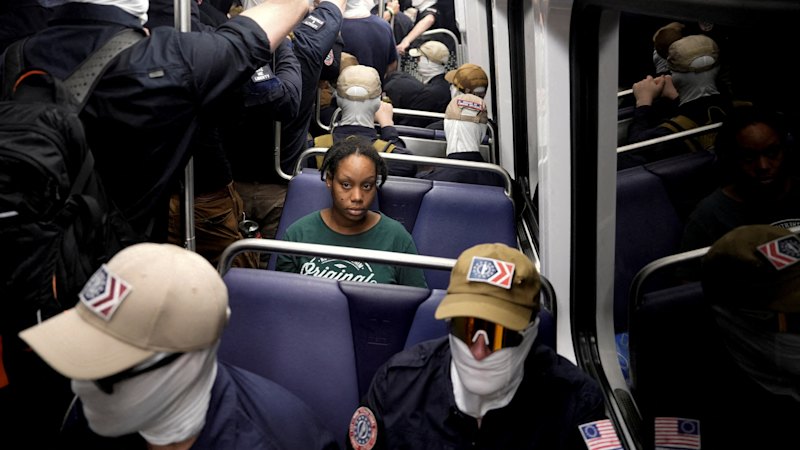
While families looked for air conditioning, the streets of the capital became a staging ground for ideological battles. Early in the morning, dozens of members of the white-supremacist group Patriot Front staged a march toward the U.S. Capitol. They wore matching uniforms, dark sunglasses, and white masks to hide their faces.
Carrying combat shields and inverted American flags alongside Confederate battle flags, they beat drums and chanted "Reclaim America!" through the sweltering streets. Experts from George Washington University note that the group openly pushes for a white ethnostate, rejecting multiculturalism entirely. The sight of masked men marching past the seat of American democracy on its 250th birthday provided a chilling visual.
Other protest groups made their presence felt throughout the afternoon. Activists from "Refuse Fascism" marched toward the White House demanding a total systemic overhaul, while another group dragged a massive 700-foot banner down Pennsylvania Avenue condemning the current administration.
The official speeches from leadership did little to bridge the gap. President Donald Trump delivered a dark, combative address on the National Mall. He mixed traditional patriotic nods to veterans with heavy political grievances. He used the platform to preview upcoming Republican midterm strategies, attacking the progressive wing of the Democratic Party by calling them a cancer and a communist threat. He also promised to pass the SAVE America Act to mandate strict citizenship proof for voting, and used his social media channels to bash European allies over immigration policies.
Meanwhile, in New York, Vice President JD Vance spoke from a U.S. Navy ship in the harbor, aggressively blasting critics who focus on the nation's historical flaws. He claimed that those highlighting national imperfections fundamentally misunderstand the true essence of America.
On the opposite side of the aisle, Democrats offered a vastly different perspective. Former President Barack Obama posted a message framing America as a constant work in progress, emphasizing that every generation must take up the unfinished work of fixing what is broken.
The Fractured Reality on the Ground
For everyday citizens who lived through the bicentennial in 1976, the contrast was heartbreaking. Many older attendees recalled a time when the 200th anniversary felt like a massive neighborhood block party filled with genuine, uncomplicated patriotism. In 2026, that feeling is gone. Gallup polling leading up to the holiday revealed that national pride has hit its lowest point since the organization started tracking the metric 25 years ago.
Even the celebrations that did happen were hyper-commercialized and physically restricted. Security fences, closed roads, and heavily armed National Guard checkpoints turned iconic Washington monuments into restricted zones. When severe thunderstorms rolled in during the evening, the Secret Service abruptly suspended security screening on the National Mall, forcing thousands of panicked attendees to scramble for shelter inside nearby museums.
Once the storms cleared, the administration moved forward with a massive fireworks display, launching 850,000 shells from ten different sites across the Potomac River and the Reflecting Pool. It was a visually stunning spectacle, but the tension remained. As law enforcement officers ordered the crowds to evacuate the Mall after the final explosion, groups of stranded attendees faced off with police, refusing to leave the risers while chanting political slogans into the humid night air.
Moving Past the Spectacle
If you want to understand where America actually stands at 250, ignore the fireworks and look at the logistics. The holiday showed that top-down attempts to force national unity through expensive festivals and military flyovers don't work anymore. The real work of maintaining a democracy doesn't happen during a synchronized light show.
If you want to participate in shaping the next chapter of this country, stop waiting for political rallies to give you a sense of purpose. Focus on actionable steps in your local community:
- Read the founding documents directly rather than accepting parsed soundbites from cable news commentators.
- Engage in local civic meetings where actual policy decisions regarding infrastructure, heat mitigation, and community safety are decided.
- Support local independent journalism that covers municipal realities rather than national culture wars.
The anniversary proved that America's story is far from finished, but the idealized version of a perfectly united nation is officially dead. It's time to deal with the reality of what exists.