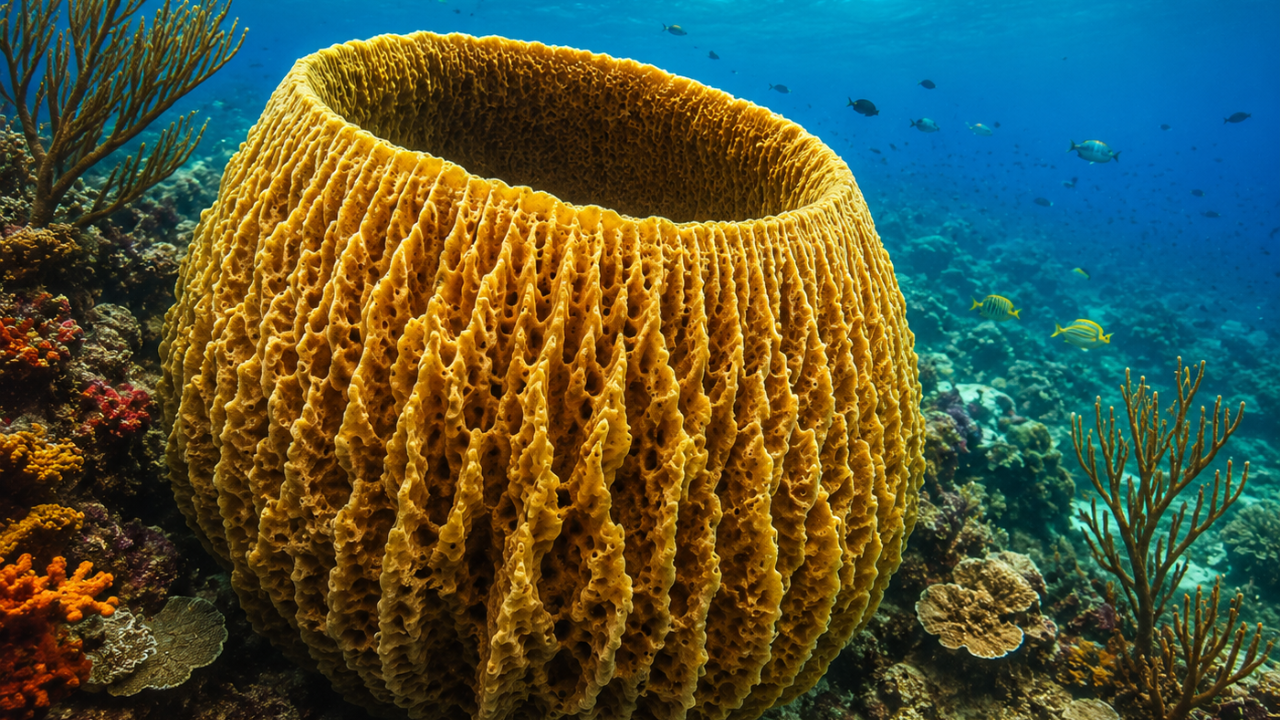
Imagine an animal that started its life centuries before the Roman Empire reached its peak. It sat on the dark seabed, completely still, while the Carthaginian general Hannibal crossed the Alps with war elephants. This isn't a mythical creature. It is a giant Caribbean sponge, Xestospongia muta, and it managed to live for an estimated 2,300 years by doing almost nothing at all.
When you think of ancient life, your mind probably goes to towering redwood trees or massive blue whales. You don't think of a giant tube-shaped blob sitting in the mud off the coast of Curaçao. But marine biologists have verified that these creatures, often called the "redwoods of the reef," are actually some of the longest-lived animals on our planet. They don't just sit there either. They act as massive, continuous water filtration systems that keep coral reefs alive.
The Math Behind a Two Millennia Lifespan
How do you figure out the age of something that doesn't have rings like a tree or bones like a mammal? Sponges are incredibly simple organisms. They don't have specialized, fixed organs or standard skeletal structures that record time. Instead, their bodies are an aggregation of cells built on a delicate silica scaffold.
Scientists had to get creative to figure this out. A research team led by Steven McMurray, James Blum, and Joseph Pawlik from the University of North Carolina-Wilmington spent over four years tracking these sponges in the Florida Keys. They used physical measuring tapes and stereo-digital photography to monitor exactly how fast these animals grow.
They discovered that the giant barrel sponge grows at an extraordinarily variable rate. A tiny juvenile might grow by 400% in a single year, while a massive adult barely expands by 2% annually. By feeding this long-term growth data into a complex mathematical formula known as the Tanaka indeterminate growth model, they established a reliable size-to-age ratio.
When they applied this exact growth equation to a colossal specimen found off the island of Curaçao, the results were mind-blowing. The sponge had a base diameter of 2.5 meters. According to the data, it would take between 2,000 and 2,500 years for an individual to reach those massive dimensions under normal conditions. The median estimate landed right at 2,300 years.
Surviving by Doing Absolutely Nothing
Living for 23 centuries requires an evolutionary strategy that is the exact opposite of how human bodies work. Our complicated organ systems are prone to wear and tear. Your heart pumps billions of times before it eventually gives out. Your brain cells deteriorate. Your immune system weakens.
The giant barrel sponge avoids all of these issues by being incredibly simple. It has no muscles to atrophy. It has no nervous system, no brain, and no heart. Its cells aren't locked into fixed roles either. If a section of the sponge gets damaged by a passing boat anchor or a storm, its cells can actually change their function to repair the gap. A cell that was once part of the outer skin can transform to help build the inner water canals.
Because it lacks complex biological machinery, it doesn't experience aging in the way we understand it. A 2,300-year-old sponge is biologically identical to a 20-year-old sponge. It just happens to be much bigger.
A Massive Water Pump Under the Sea
The sheer scale of what this single animal accomplished during its lifetime is staggering. Sponges are filter feeders. They use microscopic, whip-like tails called flagella inside their internal walls to pull water through tiny exterior pores. They extract plankton, organic matter, and dissolved nutrients before pumping the clean water out through the giant opening at the top, called the osculum.
A single adult giant barrel sponge can filter over a thousand gallons of seawater every single day. Over its 2,300-year lifespan, the massive Curaçao specimen pumped roughly 850 million gallons of water through its body. That is enough water to fill more than 1,200 Olympic-sized swimming pools.
This non-stop pumping does a few critical things for the ocean:
- It maintains extreme water clarity, allowing sunlight to reach the photosynthetic algae living inside nearby corals.
- It recycles massive amounts of organic carbon and nitrogen, releasing nutrients that sustain the rest of the reef community.
- It acts as a physical anchor, providing shelter for hundreds of species of small fish, crabs, and worms inside its deep central cavity.
The Tragic End of an Ancient Giant
You would think an animal that survived multiple ice ages, shifting sea levels, and hundreds of major hurricanes would be practically indestructible. Sadly, that isn't the case. The legendary 2,300-year-old Curaçao sponge is no longer with us. It died around the year 2000.
The culprit wasn't old age. It was a mysterious condition known as Sponge Orange Band (SOB) disease. The disease manifests as a bright orange line that slowly creeps across the sponge's surface, causing the tissue to bleach, rot, and dissolve away. A massive creature that took more than two millennia to grow can be completely destroyed by SOB disease in a matter of weeks.
Marine pathologists still don't know the exact pathogen behind the disease. Most evidence points to environmental stress. As global ocean temperatures continue to climb, these ancient organisms get stressed. When water temperatures stay too high for too long, the symbiotic cyanobacteria that live inside the sponge's tissues leave. This causes cyclic bleaching, leaving the sponge incredibly vulnerable to deadly infections.
What This Means for Conservation
Losing a 2,300-year-old organism is an ecological tragedy, but it serves as a massive wake-up call. We used to view coral reefs as communities dominated entirely by corals and fish. Now we know that these ancient, giant sponges are the silent infrastructure holding the entire ecosystem together. If the redwoods of the reef collapse, the rest of the system will quickly follow.
Protecting these ancient giants requires direct action. If you want to help preserve the remaining ancient sponges in the Caribbean, start by implementing these practical steps:
- Switch to reef-safe sunscreen: Standard sunscreens contain oxybenzone and octinoxate, which wash off your skin and trigger bleaching events in both corals and sponges. Look for mineral-based sunscreens that use non-nano zinc oxide.
- Practice perfect buoyancy control: If you are a scuba diver, secure your gauges and never touch or hold onto a barrel sponge. Their glass-like silica skeletons are incredibly brittle and break under human weight.
- Support marine protected areas: Champion local and international organizations that establish no-anchor zones and marine sanctuaries in the Caribbean to protect benthic organisms from physical destruction.