The Cosmic Explosion That Never Stopped
In July 1054, court astronomers in Song Dynasty China looked up and noticed a sudden, blinding "guest star" blazing near the constellation we now call Taurus. It wasn't just a faint twinkle. The explosion was so violently bright that people could see it clearly during the day for over three weeks, and it lingered in the night sky for nearly two years before fading from human sight.
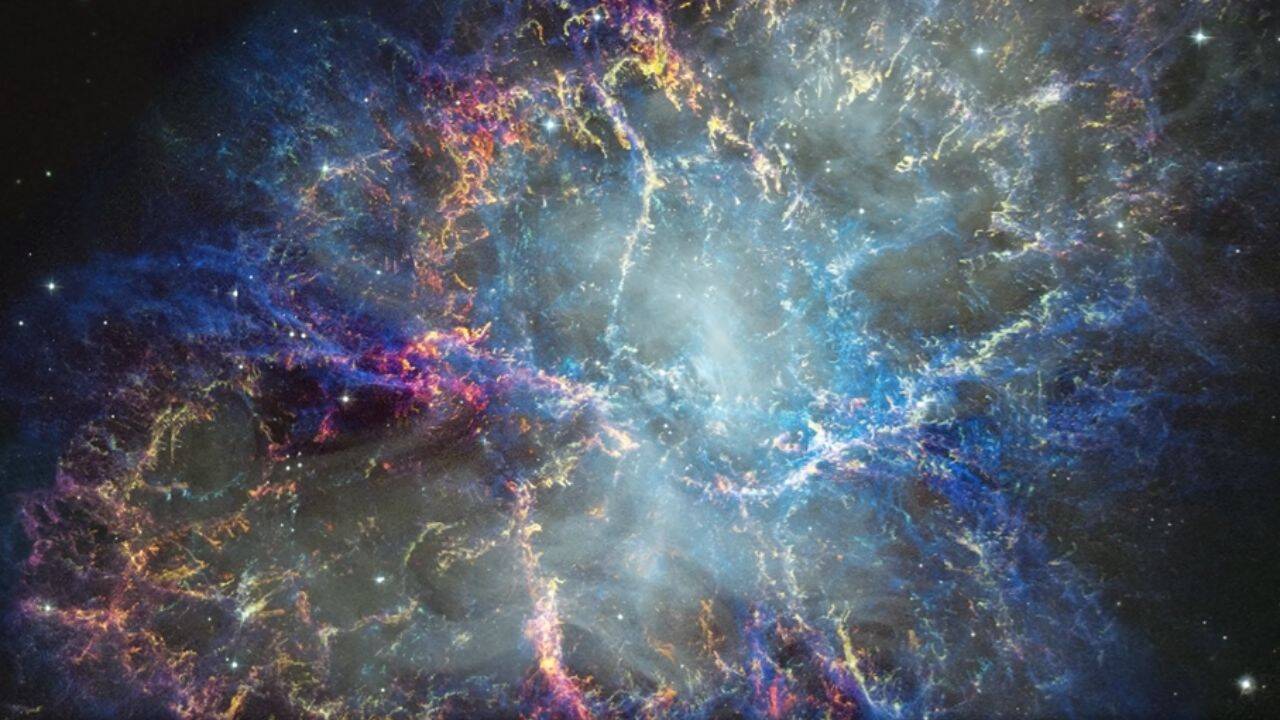
What they witnessed was the catastrophic death of a massive star 6,500 light-years away. Today, we know its screaming remains as the Crab Nebula.
If you think a thousand-year-old explosion is ancient, dead history, you're dead wrong. Fresh data released from the Hubble Space Telescope shows that this cosmic corpse isn't just sitting there. It's still actively expanding, changing, and violently blasting material outward into the void at an astonishing 3.4 million miles per hour (around 5.5 million kilometers per hour).
Space usually changes too slowly for a single human lifetime to notice. The Crab Nebula breaks all the rules. Thanks to Hubble's decades in orbit, we can literally watch the universe move in real-time.
How Hubble Caught the Universe in Motion
Astronomers don't just guess that the nebula is moving; they have the receipts. A research team led by William Blair of Johns Hopkins University used Hubble’s Wide Field Camera 3 to snap highly detailed new images of the Crab Nebula. They then compared these new shots with iconic data captured by Hubble back in 1999 and 2000.
A 25-year gap might be a blink of an eye to the universe, but for Hubble, it’s the perfect time-lapse window.
By overlaying the two images and tracking individual gas filaments against the static background stars, the team revealed that the outer edges of the nebula are pushing outward by about 0.3 arcseconds per year. It looks tiny from 6,500 light-years away, but the physics behind it are terrifying. That's gas and shredded stellar guts moving fast enough to circle the Earth in less than thirty seconds.
What makes these findings wild is how it's moving. Blair’s team noted that the filaments on the outer edges are moving significantly faster than the material near the center. It isn't just stretching like a rubber band; the entire structure is being forcefully driven out into deep space.
The Ghostly Engine in the Fog
Most supernova remnants expand because of the initial shockwave—like an explosion pushing a wall of smoke outward until it runs out of steam. The Crab Nebula doesn't play by those rules. It has a hidden engine keeping the fire alive.
Deep inside the glowing ghost of the star lies the Crab Pulsar. This is the crushed, ultra-dense neutron star left behind when the original star collapsed. It packs the mass of our entire Sun into a sphere roughly the size of a small city, and it spins at a dizzying pace of 30 times every single second.
[Crab Pulsar Core]
   │
   ├── Spins 30x per second ──> Generates intense magnetic fields
   │
   └── Accelerates electrons ──> Creates blue synchrotron radiation glow
                                       │
                                       └── Continually drives filaments OUTWARD
This rapid spin generates a monstrous magnetic field that flings out high-energy particles. When those particles collide with the surrounding gas, they create a ghostly blue haze known as synchrotron radiation. This constant injection of energy acts like a cosmic accelerator pedal, continuously pushing the colorful filaments of sulfur and oxygen outward. It's what astronomers call a pulsar wind nebula, and it's why the Crab remains one of the most dynamic laboratories in the night sky.
Breaking the Second Dimension
Looking at a flat picture of space gives us a distorted view of reality. The latest Hubble data is helping scientists shatter that flat perspective to map the Crab Nebula in 3D.
By analyzing the way the internal synchrotron radiation interacts with the surrounding matter, astronomers noticed something strange: some filaments cast sharp shadows onto the glowing interior gas, while other incredibly bright filaments cast no shadows at all.
This isn't an optical illusion. It means the shadow-less filaments are actually located on the far side of the nebula, buried deep behind the central radiation zone from our viewpoint on Earth. These subtle clues allow researchers to map the structural depth of the debris cloud, revealing a highly irregular, bubbly shape rather than a smooth, uniform bubble.
Furthermore, the team spotted two brand-new, previously unrecognized structures of filaments sitting directly opposite each other near the pulsar. Scientists still don't completely understand what caused these twin formations, proving that even after a millennium of observation, the Crab still hides secrets.
What to Do Next
The real value of this latest milestone isn't just looking at pretty pictures; it's about combining forces.
If you want to appreciate the full scale of what astronomers are uncovering, check out the public data archives. You can directly compare the optical structures captured by Hubble with the piercing infrared details released by the James Webb Space Telescope. While Hubble shows us the fast-moving gas filaments, Webb reveals the dense webs of cosmic dust tucked inside them. Tracking how these different layers interact over the coming years will finally give us a complete blueprint of how stars die—and how their remains seed the universe with the raw chemical elements needed to form future worlds.